Showing posts with label John Hunt Morgan. Show all posts

Sunday, February 4, 2018

Dave Mowery on Morgan’s Great Raid

Yesterday, I heard David Mowery talk at an event for the Cynthiana Battlefields Foundation about John Hunt Morgan and his Great Raid  of 1863. It was an enjoyable and informative talk and it made me wonder if I had reviewed his book. I remembered reading it, but not reviewing it.

I searched here and found this blurb in a post that included several such brief reviews of  books I read in 2014. I wish I had done a more thorough review of it, but I do remember it as a good book. It is not terribly long, but I definitely recommend it, especially to people interested in Morgan and his career. 

Copyright 2013, The History Press
This is not a long look at the details of every confrontation during this 1863 raid, but is a good overview of the entire raid and provides a nice look at how much ground Morgan, his men and his pursuers covered during these weeks. Mowery's writing is easy to follow and I enjoyed how he described the challenges that those in and against the raid faced. 

Dave is also a fine speaker. He is obviously comfortable giving talks and extremely knowledgeable about Morgan and his career. His presentation moves at a good pace and he does a terrific job of answering questions. (Of course, it helps when the crowd is attentive and asks good questions, like at yesterday’s event.) He is friendly and easy to approach, and his obvious enthusiasm for the subject only makes his presentation even better. 

Dave is a member of the Cincinnati Civil War Round Table as well as the Buffington Island Battlefield Preservation Association, and probably other groups as well. He says he has been to over 600 Civil War battle sites, many not on maps.  If you have the chance to see him speak, take advantage of it. 

Monday, November 13, 2017

Book Review: Kentucky Rebel Town by William Penn


By William Penn
Copyright 2016
The University Press of Kentucky

As I review another book, I also review another study of Kentucky in the Civil War. That is certainly a topic that has dominated much of my recent Civil War reading. It has been an enjoyable and informative process - I look forward to finding more on this subject to explore.

Kentucky Rebel Town is a deeply-researched work concentrating on the north-central Kentucky town of  Cynthiana and its home of Harrison County. Using information found in many sources such as newspaper accounts, letters, diaries, census records and more, author Bill Penn demonstrates that this county and town offered more moral and military support for the Confederacy than did most of Kentucky, and though support for the Union cause also existed locally, Confederate sympathy was more prevalent, especially before Union troops occupied camps in the area. He makes a persuasive case that Cynthiana truly was a “Rebel Town,” using a wide variety of historical records to support his argument.

This book is well-written, without the distraction of proofreading or editing errors. It compares the Confederate support in Cynthiana to the rest of the state, using information like public events and voting records, as well as biographical information of important local citizens and leaders and the political positions they held. Many different local people and families are mentioned throughout the text, making this a good possible source of information for some genealogists. It also includes an impressive selection of photographs of key people and places discussed throughout the text. Such photographs are always good additions to books like this, and that is the case here.

Among the challenges the author faced when researching and writing this book was a lack of period maps of the area. He did, however, manage to create and include several helpful ones based on his understanding and interpretation of existing evidence and modern development in the area. He also frequently mentions names of modern roads among discussions of old roads where something occurred. This is a helpful part of his writing.

In addition to his interpretation for the maps, the author offers frequent analysis of evidence he found, such as determining the probable location of events, or identities of people when period records were not specific. Such explanations and interpretations of unclear evidence occur often in the book. This goes beyond the mere repeating of established facts and details and adds to the understanding of the events being discussed. This is a strong part of this book and the author’s writing.

This book is a valuable work on many fronts, but especially to people who are interested in Kentucky’s role in the Civil War, its reputation as a Confederate state, and even in-state politics during the war years, especially regarding reaction to Federal policies and occupation. It also provides a detailed look at both the 1862 and 1864 battles of Cynthiana and the fighting done by Confederate General John Hunt Morgan, a key part of this work. Students of Morgan’s career or of Civil War cavalry raids will also find this book to be well worth the time.

The book’s organization is a very good and logical one. It includes end-notes and an informative section showing Union and Confederate Orders of Battle for both battles. Each chapter covers multiple related topics, but each also contains different specific sections for these topics. That helps the book flow more smoothly than books which do not break up chapters thusly, and makes it easier to read and understand. The order of the topics is also sensible, starting with the early war years, then the war and ending with a discussion of how local support of the Confederate cause did not end with the war. The author shows that some people regretted the war’s outcome. This organization makes the book even better. 

Overall, Bill Penn’s Kentucky Rebel Town is a fine book, a well-investigated and detailed discussion of how one Kentucky town and county offered more sympathy for the Confederate cause than did most of the state, especially early in the war, It also provides a good overview of the battles of Cynthiana and John Hunt Morgan’s performance in those contests. I find this book to be a terrific addition to the existing studies of Kentucky in the Civil War era and gladly recommend it to fellow Civil War enthusiasts and others interested in Kentucky history.

Location of Cynthiana, courtesy Americancivilwar.com 

Note: The author is a member of the Cynthiana Battlefields Foundation group. I am a member of the same group and have met him multiple times. I have tried not to allow this to influence my review, but I thought I should share this information with readers. 

Monday, September 18, 2017

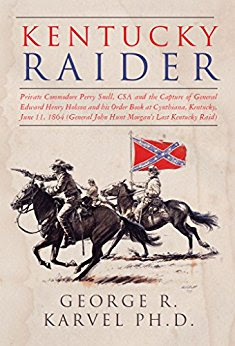
Book Review: Kentucky Raider by George Karvel, Ph.D


Author: George R. Karvel, PH.D.
copyright 2016
CreateSpace Independent Publishing Platform


The subject of my next book review is another book that discusses Kentucky in the Civil War. Even though this volume is not specifically about Kentucky, the story it tells is of a Kentuckian and of raids and battles throughout the Commonwealth, focusing on the raids of famous Confederate General, and Kentuckian, John Hunt Morgan.

Commodore Perry (C.P.) Snell, the great-great grandfather of the author joined the 2nd Kentucky Cavalry, under Morgan's command, in mid-1862. He served for the next three years, surviving Morgan's Christmas Raid, Great Raid and Last Kentucky Raid, as well as two instances of being captured. He was able to escape his captors and return to his unit both times, though his name confused Federal soldiers who thought "Commodore" was a title not a name. Snell apparently provided a false name as "Charles P.” more than once, perhaps to avoid this confusion. His name shows up as this "nom de guerre" in more than one official U.S. form. (The author does a good job of explaining the background of Snell's name and how the original Commodore Oliver Hazard Perry had inspired people to name children, including C.P. Snell, in his honor, early in the book.)

This book briefly describes each of the raids in which Snell took part. It is not an in-depth look at the details of these invasions, but that is not its goal. The synopses the author provides of these raids do give good  background information about Snell's experiences and make this book better.

The book is well-written and organized. I did not notice any proofreading errors and the writing style was very readable. It is a quick, informative work.

After discussing Morgan's capture in 1864, the book reaches the heart of this story, the order book that Morgan had captured from Union General Edward Hobson the day before his (Morgan's) capture. It then publishes each entry from this book. Most are short, usually a sentence or two, which makes for rather choppy reading, but this provides real examples of how such officers wrote their
orders. Additionally, the author adds good descriptions for these orders. These clarifications explain the orders and the military situations. This was a very helpful and valuable part of the book, adding an understanding of what the officers were doing and why.

Karvel addresses Snell's military career and his parole at the end of the war,  and then describes  Snell's post war life as much as surviving evidence allows. He tells that Snell found a new love interest during the war, despite already being married, and how he soon divorced his wife when he returned home. He notes that 1870 census records and Snell's will show that Snell had enjoyed good financial success and discusses how this may have happened. He mentions some rumors and family stories that may explain Snell's prosperity, as no official record seems to provide answers. This was an unexpected and fascinating section of this book.

The book includes footnotes listing sources and six appendices of background information on Snell's family history and family military background, a glossary of terms and other information. It also features several helpful maps at appropriate places in the text.

This book is a good, quick read and recounts an interesting story about the captured order book, what information it contained and how it came to the author's family. Morgan and his raids are popular topics for books and discussion, but George Karvel has found a new story to tell about this part of Kentucky's Civil War history. I gladly recommend this book.

Thursday, September 7, 2017

Book Review: Wild Wolf: The Great Civil War Rivalry


Author: Ronald Wolford Blair
Copyright 2015
Acclaim Press
Kentucky in and after the Civil War is a topic that has really caught my attention in recent years, and several books I have read and reviewed have added to my understanding of that era in my home state.

That is true of my latest finished book, Ronald Wolford Blair's Wild Wolf: The Great Civil War Rivalry,  about the author's great-great uncle, Union Colonel Frank Wolford of the 1st Kentucky Cavalry, a.k.a. The "Wild Riders."

Serving as a biography of the author's ancestor, the book starts by featuring the story of Wolford's military career, especially his many dealings with famous Confederate General John Hunt Morgan, before moving onto discussions of Wolford's polical and social beliefs and how he clashed with the goals and actions of President Abraham Lincoln.

The detailed overview of Wolford's military career iincludes his accomplishments as a leader and discusses how his folksy leadership style and manner of giving orders helped him earn his men's admiration. He was certainly no martinet, but earned his men's respect with his manners and fair discipline. His troops fought throughout eastern and central Kentucky and northern Tennessee, including clashes against Morgan's men, before embarking on a long chase of the famed Confederate during his "Great Raid" of 1863. After helping capture Morgan and many of his men, Wolford's troopers fought in the East Tennessee campaign, including the Siege of Knoxville, where they dealt with the usual trials of combat as well as the rugged terrain and bitterly cold weather.

As the war moved into the middle of 1864, the story transitions to one of Wolford's political battles and arrests, as the author describes in great detail Wolford's disputes with the Lincoln administration especially his opposition to emancipation and the use of African-American soldiers. Blair also shows how Wolford fought for civil liberties (particularly his own) such as free speech and speedy trials. Wolford was blunt, forthright and honest in his speeches and letters, not caring to whom his remarks were made or know they might be interpreted as aiding the enemy or hurting the Union cause. These political battles started late in the war and continued in the post-war years as he tried to help return life to how it was in ante-bellum days, particularly in the racial hierarchy in Kentucky society. The book frequently notes that Wolford's attitudes and opposition represented those of a majority of Kentuckians at the time.

Wolford was an intense and determined soldier and showed the same traits in his non-military fights as well, though he kept his focus solely on events in Kentucky. He may not have appreciated the progress the Union war effort had made nation-wide in 1864 and felt that a re-election of Lincoln would lead to more years of bloodshed. Wolford was, understandably, primarily concerned with the situation in his home state and area ("all politics is local" so goes the cliche) and strongly supported George McClellan in the 1864 election because of the way Steven Burbridge and the Lincoln administration were treating Wolford and his fellow Kentuckians.

This work is another valuable look at the complicated, twisted history of Kentucky in and immediately after the Civil War, showing that even a man who made personal and physical sacrifices to help preserve the Union also expressed many sentiments that clashed with his own government in terms of the treatment of slavery and African-Americans as well as interpretation of Constitutional rights and responsibilities. He focused on the civil rights of white Kentuckians, men and women.

The story in Wild Wolf is  similar to the one told in For Slavery and Union, describing how an individual soldier could fight for the Union but end up opposing some of the Union's political goals. It explores Wolford's political career after the war, as he served as a lawyer, state representative, Congressman and held other official positions as he tried to restore the pre-war social order. He also helped veterans and their families receive government pensions decades after the war.

This is a fine book. It does include endnotes and has two large sections of appropriate photographs and maps, which add much to the work. The research that went into this volume is impressive and the amount of material it covers is equally so.The book also includes three appendices publishing Wolford's most controversial speeches and his letter to Lincoln. These were smart additions to this volume.

I am pleased to have read this book and do recommend it to Civil War students, especially those interested in Kentucky, cavalry, John Hunt Morgan and/or political dissent on the Union side of the war. It is a good study of a mostly unheralded and unknown cavalry officer and influential political figure in the native state of both Civil War Presidents, showing another example of the complex and confusing nature of war and politics in Civil War-era Kentucky.

Monday, October 13, 2014

A Few Book Summaries

Here are a few other books I read in spring and summer. I enjoyed them all, but didn't take notes to do full reviews, but will add a few thoughts on each.


Co. Aytch by Sam Watkins
This book, made famous by Ken Burns' PBS series on the Civil War, was recommended to me when I was on a public hike at Perryville and imam glad I finally read it. It is a fun read, with good descriptions of what Watkins saw at many battles, including Perryville, where some of his lines are on museum displays and are commonly repeated in other books about that battle. It is Watkins' story, written tests after the war, so keep in mind how human memory works when writing so long after an event, but it is still an enjoyable read and a good look at what private soldiers in that wsr witnessed.

The Battle of Mill Springs Kentucky by Stuart Sanders
I still have not visited this battlefield, and am almost ashamed by that. This is a good book from the History Press and gave me a lot of good information on this early Union victory. I like how the author writes, as I also enjoyed his works on Perryville as well as this one. It is a good read

Lincoln's Melancholy:  How Depression Challenged a President and Fueled His Greatness
By Joshua Wolf Schenk
I had heard about this work years who, but never got around to reading it. I am glad I finally did. I found it to be a fascinating look at another side of  Lincoln's life and personality. His moodiness was not a new revelation to me, but it's depth and how often Lincoln struggled with it did add to my knowledge and perspective of this man. The Sutton seemed to have a good grade of psychological concepts and explained them in easy to understand ways.


Morgan's Great Raid: the Remarkable Expedition from Kentucky to Ohio by David Mowery
This is not a long look at the details of every confrontation during this 1863 raid, but is a good overview of the emtire raid and provides a nice look at how much ground Morgan, his men and his pursuers covered during these weeks. Mowery's writing is easy yo follow and I enjoyed how he described the challenges that those in and against the raid faced. 

Liddell's  Record by St. John Richardson Liddell, edited by Nathaniel Cheairs Hughes Jr.
If you like honest and blunt assessments from soldiers, this is a book you should read. Hughes Jr. cobbled together Liddell's records and molded them into a fine story in Liddell's own words. Like the Watkins book, this was written after the war, but is still a valuable read due to Liddell's honest accounts of battles and Confederate leaders he experienced or encountered during the war? He was not afraid to offer criticism of his superiors. He was another fascinating character I am glad I discovered. He may not be in the same class as Daniel Sickles in terms of being a "different" personality,, but is still another interesting individual, though not very well-known.

1864: Lincoln at the Gates of History by Charles Bracelen Flood
I found this book when looking for additional sources for my upcoming(January 8, 2015) talk on Abraham Lincoln, and I am fortunate to have found it. It offers a terrific account of what proved to be perhaps the most important year of the Civil War, and how Lincoln dealt with the many issues, including his re-election, that popped up throughout these 12 months. I found several new ideas and thoughts to incorporate into my talk, and a few details as well. It is a well-written, easy-to-read book about a crucial year.

Decided  on the Battlefield: Grant, Sherman, Lincoln and the Election of 1864 by David Alan Johnson
This is another book I found to help me understand the happenings of 1864 and it was another valuable reference. It focuses on the presidential election of 1864 and how battlefield events influenced the results of that voting. It is another well-written narrative and look at the last full calendar year of the war. This is another fine book.


Sunday, July 15, 2012

Book Review: One of Morgan's Men


Editor: Kent Masterson Brown
copyright 2011
University Press of Kentucky 

For students of John Hunt Morgan, Civil War cavalry and/or the western theater, this book, though only 204 pages of text (not including notes) is a very good resource that gives many details of what happened during various cavalry raids and scouting expeditions and how the men handled their jobs.

Written in the early 1870s, it of course raises questions about how the author remembered as many details as he did, even a few years after the war, and that question should remain in the reader's mind, but Brown did a masterful job of editing it. He even used many different sources such as census records to confirm the names Porter mentioned. Brown added additional information about these people and families in the very in-depth notes section - readers should be sure not to skip over this part of the book, which also includes modern references to the areas Porter traveled, including current road and town names. His research certainly adds to the credibility of the text.

This is an enjoyable, informative and well-written, well-edited book. Porter was a lieutenant, but this is not a memoir of an officer, but, rather, of a soldier following orders and doing his duty. Little is mentioned of grand strategies or even tactics - Porter sticks to telling what he and his comrades did, how they obeyed orders, the actions they undertook, and how they accomplished all they did, sometimes in challenging conditions or areas.

This is the story of night scouting expeditions, of travel through dark and rainy conditions, often in territory with Yankees around, of trying to find food and shelter for man and horse and of a man who clearly believed in his cause. Several times throughout the book, he emphasizes what he perceives as the correctness of the Confederate cause. He tries to avoid bragging about his own accomplishments, but is not afraid to describe the bravery and courage of his comrades and the units under Morgan's lead. He clearly believed that he and his fellow Confederates were fighting for the side of the right and that they were determined to give their all to achieve victory.

One of Morgan's Men also serves as a small sample of the story of Kentucky itself during the war. One fascinating aspect of the narrative is Porter's descriptions of how the scouts found so many friendly citizens to help, house and/or feed them throughout the Commonwealth, but especially the central and west-central parts of it. Though they had to be careful not to catch the attention of Union supporters or soldiers who were frequently in the same areas, they still found help when they needed it. This is another example of the split loyalties of what was still technically a Union state, even though that was not the intent of the writer or his book.

This work does include a nice selection of photographs and a few maps/drawings, which do add to to the quality of the work. The editing, with the information in the notes, and selection of the illustrations, deserves much praise for making this a better work, not just a word-for-word retype of Porter's manuscript.

Porter's writing (with some assistance from the editor) is easy to read, with a nice flow, and provides a fascinating perspective on the operations of Confederate cavalry, especially under Morgan's command. Most of the story takes place in southern Kentucky and Tennessee, but they did make their way to eastern and Central Kentucky too. Porter was captured prior to the Indiana and Ohio portions of Morgan's last great raid, but he provides many anecdotes and details of the raids and expeditions in which he took part.

This is a very good, interesting and valuable book. It gives gives a good look at the small, often forgotten or unrecorded aspects of war incidents that do not always make it to newspapers and major studies about the war. Those interested in the Civil War generally know of the reputation of Morgan and his men, but the details of their riding during the night and resting during the day, or of locating friendly civilians for rest or shelter are often missing from the official reports of such activity. This book provides some of those details.

John Hunt Morgan and his men caused a lot of chaos for Union soldiers, supporters and supply lines in the region during his reign, and John M. Porter's memoirs provide a very fascinating insight into the whats, wheres and hows of these various actions. This is a high-quality book that I highly recommend.

"Thunderbolt" by John Paul Strain

Sunday, January 10, 2010

2009: Year in Books, Part 2

Continuing my look at some of the books I read in 2009, I'll start now with Why the Civil War Came, edited by Gabor Boritt, which is a very nice collection of essays about the coming of the war, including his own thoughts on how Lincoln refused to see the war coming in time to try to prevent it, some interesting discussion of the failure of the U.S. political system, and other thought-provoking essays on topics like the Northern reaction to the war, as well as the pre-war actions of women and of African-Americans. It is a bit difficult to read at times, but is well worth the effort.

All That Makes a Man: Love and Ambition in the Civil War South by Stephen W. Berry is a book that I found difficult to read at times, trying to understand the language and themes he used, especially when he discussed psychological and philosophical themes . For some reason, it did not fit my personal style of what I like to read, or maybe I just did not fit it. This book discusses the role of love and ambition in Southern men, discussing gender roles and how that influenced the way men handled the controversies leading to the war. I liked how he used pairs of men as examples in different sections, showing how the experiences and lives of each compared and contrasted. It is a really good subject, with a lot of potential, but I just did not find this book as readable or as easy-flowing as his next book House of Abraham: Lincoln and the Todds, a Family Divided by War, which I read a couple of years ago.

I believe the following books (or most of them) have already been the subjects of reviews on my blog, but I will give them brief mention again here.

James P. Duffy's Lincoln's Admiral: The Civil War Campaigns of David Farragut is a very enjoyable, informative and smoothly-flowing review of the career of David Farragut, concentrating on his Civil War experiences on the Mississippi River, at New Orleans, Mobile Bay and other locals. I do wish it had included endnotes or footnotes, however.

I claim no objectivity on this one, as I do know Dr. James A Ramage and am privileged to work at the museum named in his honor, but still found his Rebel Raider: The Life of General John Hunt Morgan to be a very informative look at the life of this famed Confederate, offering both praise and critical analysis of Morgan's actions and decisions.

Another book that I found to be absolutely outstanding, both in style of writing and, especially, for its subject and treatment thereof was Mr. Lincoln's T-Mails: How Abraham Lincoln Used the Telegraph to Win the Civil War by Tom Wheeler. It is a concise, but informative review of Lincoln's uses of this new technology, which had not been available to any war-time U.S. President previously. Wheeler shows how Lincoln had no precedent on how to use such a tool, but how he found an effective way to employ it to his advantage.

One book which was a bit confusing at times due to the many voices used, yet still provided many unique and interesting perspectives was The Slaves' War: The Civil War in the Words of Former Slaves  , edited by Andrew Ward. The confusion came from so many different sources used, yet that added to the variety and diversity of opinions and viewpoints. There were surprising views as well, such as slaves thinking of Yankees as monsters, or protecting their masters' valuables from invading Northern forces. It took me some time to get used to the format but once I did, I found this to be a very interesting look at life from the perspectives of these who had lived as slaves during the war.

1776 by David McCullough took me away from pure Civil War studies, but I actually found several themes throughout the book that reminded me of various discussions of the "2nd American Revolution," including the one large, powerful existing government versus the upstart Rebels and some mentions of sectional discord or distrust among the American leadership and troops. It is an outstanding book to read and gives a fascinating look at this pivotal year in American history.

A Yankee Goes to Gettysburg is a series of beautiful photographs from the Gettysburg battlefield followed by original poetry by Todd Patrick Coleman, a local author whom I have been fortunate enough to meet and befriend and whose book is available at the Ramage Museum. I enjoyed these short tributes to those who fought at that Pennsylvania town – they are not the typical poems with rhyming lines, but are of a more abstract style, while still adding meaning to the wonderful pictures. This is a book that can be read in one sitting, and is well worth it.

Daniel Mark Epstein wrote a fine book entitled Lincoln's Men: The President and his Private Secretaries that provides a nice perspective at some of the background work taking place in Lincoln's White House, and how Lincoln and these young men came to rely on each other for support and developed close relationships over the years. The amount of work these men (John Nicolay, John Hay & William Stoddard) did was amazing.

I did read one collection of diary and journal entries this year, and it was another fascinating book, concentrating on the last year and 4 months of the Confederacy. No Soap, No Pay, Diarrhea, Dysentary & Desertion: A Composite Diary of the Last 16 Months of the Confederacy compiled by Jeff Toalson, is exactly what its long title suggests. It takes excerpts from many people and locations to provide a diverse set of views of the end of the Civil War, including comments from soldiers, sailors and people at home, including women, some of whom had very strong opinions on Confederate leadership. This work is very enjoyable and informative.

William Lee Miller's President Lincoln: The Duty of a Statesman is a good solid look at Lincoln during his presidential years, focusing on his new-found role as not just a local lawyer and politician, but a statesman who now had worldwide correspondents and responsibilities. It focuses mostly, though, on h is role in America as a statesman and how his personal set of values and morals guided him through the tough job of war-time leader. I found it to be very enjoyable and informative, and a fairly easy read.

Lincoln at Peoria: The Turning Point by Lewis Lehrman was the final book I finished in 2009, and is one of my favorites, not just from that year. It is a very detailed, organized and fascinating look at the importance and impact of the speech Lincoln gave at Peoria, Illinois in October 1854. Lehrman argues, convincingly, I may add, that this speech marked a change in Lincoln's professional life, in terms of how he prepared and delivered his speeches, and about the topics he argued in those speeches. It simply is an outstanding book that I enjoyed about as much as any other I can recall reading. It, along with White's & McCullough's works, is one of the best I read in 2009, and perhaps in my life.