Showing posts with label Siege of Cincinnati. Show all posts

Thursday, June 10, 2021

Book Review: Cincinnati in the Civil War: The Union’s Queen City


Cincinnati in the Civil War: The Union’s Queen City

David L. Mowery
Copyright 2021
The History Press


I admit my reading of books has been too slow in the past year or two, but I did just finish an enjoyable and informative book, one about a local topic.

David Mowery’s most  recent book, Cincinnati in the Civil War,seems like a fairly short book, 279 slightly undersized pages before the end-notes and index in the hardback copy I have, but is full of information and details about Cincinnati and even the northern parts of Kenton and Campbell Counties in Northern Kentucky. (Campbell County is my lifelong home.)

As I first heard of and purchased this book, I thought I had a good grasp on the basics of this subject, and though perhaps there was some accuracy to that egotistic belief, this work showed me just how basic that understanding was no how much more there is to Cincinnati’s Civil War story, far beyond the “Siege of Cincinnati” which was the subject most familiar to me. 

This book is quite readable, with a nice flow to it, and the various photographs and illustrations add more perspective to how Civil War Cincinnati appeared. The pictures of buildings long gone are especially intriguing (though perhaps additional illustrations of the forts and batteries constructed for the late 1862 panic may have contributed more to this work.)
 
The seven main chapters of the narrative do a terrific job of covering just what the title says, starting with the coming of the war, to concerns about Cincinnati's location near slave-state Kentucky, the importance of defending the city, then an apt description of the "Siege," followed by discussions of other southern support or threats north of the Ohio River and finally the ending of the war. It is not a review of the entire Civil War - it is a detailed look at one area's experiences in the war, the war's effects on that area, and, most of all, Cincinnati's impact upon the war. This book is exactly what its title says it is.

The seven chapters of the main text are followed by five separate appendices, touching on topics such as ship-building in Cincinnati, regional war-time fortifications, a very educational (at least to  me) look at the locations of Civil War sites in the area (even noting the locations of buildings, camps, etc. that no longer exist), a history of Spring Grove Cemetery and listing of notable period figures interred therein, and a table listing Civil War units in which men from Cincinnati (and its home of Hamilton County) served, noting which companies, regiments or other units were composed mostly of these men. The inclusion of so many people snd -laces in this section really adds a lot of value to the entire book. 
 
The book’s organization - the narrative description of the subject as included in the book's title, followed by the appendices, more focused on specific subjects that had contributed to the bigger story of the city's part in the war - works wonderfully.

Overall, I enjoyed this book because of the information it provides (and, perhaps selfishly, because of ideas it gives me for my project that I have discussed here.) It is, practically, a must read for those interested specifically in Cincinnati Civil War history, but is also a valuable work for other Civil War and local history enthusiasts. I certainly recommend this book.

Wednesday, June 10, 2020

“I am Fighting to Put Down Rebellion”

I found these stories in the Cincinnati Enquirer of January 26, 1862 and felt this perspective was worth sharing. 

It is not unusual to read of a Union soldier or group of soldiers opposed to the abolition of slavery as a war aim, so seeing anti-abolition sentiments in this letter from a soldier in the first few months of the war is not a shock. I do find myself wondering what this private felt about the Emancipation Proclamation, preliminarily issued about 8 months later, if he survived that long. 

This story further interests me because the 44th Ohio was one of the units in the northern Kentucky area around or just after the Siege of Cincinnati, a topic this blog has mentioned several times. It is kind of a local angle to this story. 

Also note that both this newspaper and the individual who wrote the letter were from Ohio, a “free state” in the North, yet both still expressed anti-abolitionist attitudes. That is not surprising from Cincinnati, which had many ties to the South, and is pretty typical of the Enquirer’s attitudes.

Abolition Tracts Among the Volunteers
Camp Piatt, January 12, 1862

To the Editors of the Enquirer:

SIR: Inclosed you will find a cursed Abolition document - it will speak for itself - which the negro worshippers are distributing among the soldiers in large quantities. Comment, if it is worth comment - and of course it is - I leave you to make. If I had time, I would write a long article on the subject, but I have not, as I’m but a private - and that is the reason I got the document. Privates are supposed to have no sense, or just sense enough to be made to believe and do anything; but the paper got into the wrong hands this time. And, further, I will say, or ask, if such papers are allowed to be distributed among the soldiers so profusely, when will this war end? This much I would like to say to them: I am not fighting to free negroes; and if they want them freed, let them do the fighting themselves. I will not. I would as soon shoot a real Abolitionist as a Secesh. I consider that they are as much the instigators of this war as any man in the South, and even more so; yet they claim to be Union men. Such Union men ought to be in purgatory. They now boldly declare their purpose, and are distributing their infernal trash among the ignorant soldiers, as they suppose; But there are some of them sharp enough to see what they are driving at. 

I am a native of Ohio, but not an Abolitionist, by any means; and I am fighting to put down rebellion, not to free negroes.

A Soldier,
Forty-fourth Ohio Regiment

———————

Here is how the editor reacted to this letter. In the first paragraph, I added the emphasis in bold because that is a line I’ve often seen or heard in discussions of slavery, but it is the first time I remember seeing it so explicitly stated in a period newspaper.

Cincinnati Enquirer January 26, 1862   

VOICE OF A SOLDIER 

We publish elsewhere a letter from a volunteer in the Forty-fourth Ohio Regiment  in relation to the distribution among the troops of Abolition documents. Accompanying the letter was a tract Entitled “CATECHISM FOR WORKINGMEN.”  It purports you have been  published by the “American Reform and Tract and Book Society of Cincinnati, Ohio.”  We have before noticed Abolition tracts issued from this manufactory, and designed for circulation among the troops. The one before us is filled with the usual Abolition sophistries, that slavery produced the war and ought to be destroyed. Purporting to be written “by the son of a blacksmith,” it makes an appeal to workingmen to aid in wiping slavery from off the face of the land. Every intelligent workingman knows that liberating four million slaves, to be the competitors in the field of voluntary labor with laboring whites, is not going to elevate but rather degrade the whites. The laboring whites at the South, though poor, know that they are not on a level with the blacks, as this tract asserts they are, but are a superior race. It is that knowledge that makes them take the interest they do in thwarting the schemes of the Abolitionists. The tract before us aims to induce the white laboring man and woman to aid in putting themselves on a level with the blacks. 

“A SOLDIER” sees through the game, and tells the intermeddlers, who are the primary cause of the war, that he regards them in the same light he does the rebels, that he is fighting to put down the rebellion, not to free the slaves, and that he can not be made their tool. That is plain talk, and we rejoice to hear it from such a source. 

Saturday, October 26, 2019

Citizens Transformed to Soldiers

The following article comes from the Cincinnati Enquirer of September 12, 1862, near the end of the episode called the Siege of Cincinnati. I wonder if the talks that the author mentions were with any of the soldiers (of either side) in the area at the time, or if this was based on earlier discussions.

Several of my recent (and probably upcoming) posts have come from articles like this that I found in the Enquirer. Some have been on topics I specifically looked up, while others, such as this one, have been interesting tales I found by chance and decided to share. 

This one is no Earth-shattering revelation of any sort, but I found it be a pretty good attempt to describe citizen-soldiers and their mindset, or at least the author’s perception of their mentality. 

Citizens Transformed to Soldiers
It is a thing which men will look upon with uneasiness or otherwise, according to their several temperaments, that we are approaching a state of things in which war will be a chronic condition. The moral revolution which men are required to experience before this condition arrives is more perceptible, perhaps, in the Southern than the Northern armies. Men who have, either as prisoners or otherwise, been within the lines of the former, and have had opportunities to converse freely with the troops, remark the transformation that has taken place by the process of converting, for long periods, the citizen into the soldier. The military qualities and ambitions are developed at the expense of the civil. The soldiers think and talk little of their homes in Alabama, Arkansas, or Mississippi. The army is their home; war their profession; its honors and its plunder their reward. Whether they ever return to their families and former places of residence is a matter of which they speak with indifference. Doubtless, though in a less perceptible degree, through a difference in the circumstances, the same process is going on in the Northern armies. The soldier, after a time, becomes a soldier of fortune. In the army all his thoughts are centered, and in the pains and pleasures, the desperate adventures and unrestrained gratifications of a soldier’s life, his entire moral capital is invested.  

There is no doubt that in this is the perfection of discipline and efficiency. When the civil and the domestic are abandoned - when the soldier no longer looks back with tender regret to home and farm and fireside - when he has adopted the army as at once family and country, it is then that he becomes dangerous - dangerous to the enemy in war, to his country in peace. Once a soldier of fortune, he needs employment. War is his element, and the excitements of the battle abroad are the only guarantee against his becoming a source of danger at home.

Here is one of the sad paradoxes of war. It is the duty of the soldier to make himself the iron thing which the necessities of the military service requires; and yet, at how sad an expense it is done of the civil, social, and domestic virtues! We cry out for discipline; and well we may. Elaborate leaders are written to show how necessary it is, not to the usefulness of the army merely, but to its safety; but yet, how few there are who take time to reflect how many sorrowful, and in any other aspect, undesirable, ingredients enter in to make up that discipline which is so greatly in demand.

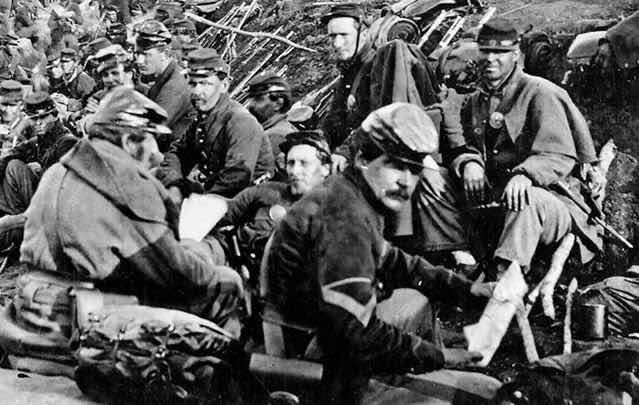
Soldiers, photo from irishcentral.com


Thursday, January 17, 2019

A Document from the Siege of Cincinnati

Here is some ephemera from late summer of 1862, when Confederates commanded by Henry Heth threatened the City of Cincinnati, then the 6th largest city in the United States, and an important Union supply area. These couple of weeks became known as the Siege of Cincinnati, which I have mentioned several times before, in whole or in part.

Dr. John (J.R.) Flowers was a private citizen at the time of this document, but officially enlisted into the Army as an Assistant Surgeon in the 52nd Pennsylvania Infantry on December 15, 1863. He was promoted to Surgeon on March 23, 1865 and mustered out with the unit on July 12, 1865 in Harrisburg, Pennsylvania. 

Not related to him, but an interesting note on Wikipedia (I know, I know, but it does cite sources. Still take this as seriously or not as you wish.)  about the unit he joined states that the regiment had been in South Carolina, where the 52nd Pennsylvanians were on hand to witness the ill-fated, but intensely courageous, July 16, 1863 assault by the 54th Massachusetts  on Fort Wagner, later recounted in the 1989 Academy Award-winning film, Glory. They then participated with other Union troops in the subsequent siege on the fort from mid-July through early September, at which point CSA troops abandoned the fort.


This pass allowed him to move through the defensive lines in northern Kentucky (behind Covington and Newport, the two largest cities in northern Kentucky) and across the Ohio River to Cincinnati and back.

This image from Pinterest shows the approximate locations of the defensive positions overlaid on a map of modern towns and roads. I just saw this map and it is a quite handy overview. It at least shows the relation of the defenses of Cincinnati to the city itself, giving an idea of where this pass allowed the doctor to go.


If this is the same man (this pass came with typed notes showing the same information as I found about Dr. Flowers)  questions about why he was in the Cincinnati area in 1862 are valid. Was he an aide-de-camp or other volunteer for one of the units there, or was he there as a civilian for some reason? Perhaps future research or someone who reads this will find these answers, but this document remains but a small reminder of the military presence in the region during that time. 

Saturday, January 5, 2019

Sidney Burbank, American Soldier


In a post I made early last year about the fascinating story of Lieutenant  Gilbert Ely, I briefly mentioned an officer named Sidney Burbank. This reference probably meant little to most readers, but I had previously started doing some research on General Burbank for another project and, after re-reading that entry, I decided to share Burbank’s story here. He held higher rank than Gilbert Ely, but, like the Lieutenant, was a largely unknown American soldier, and I think his story is one worth sharing as well.

Sidney Burbank was born in Lexington, Massachusetts on September 26, 1807, the newest member of a military family. He was the son of Lieutenant Colonel Sullivan Burbank, who had been wounded during the War of 1812. Sullivan’s father, Captain Samuel Burbank Jr., had served in the American Revolutionary War, apparently receiving a promotion after the Battle of Bunker Hill. 

Sidney attended West Point and graduated seventeenth out of forty-six in the class of 1829, which famously included future Confederate Generals Robert E. Lee and Joseph Johnston, as well as Ormsby Mitchel, who became a Union general and an astronomer who founded the Cincinnati observatory. Burbank ranked second on the class roll of conduct.

He served as a Second Lieutenant in the First Infantry in the 1830s, and returned to West Point as an assistant instructor of tactics. He then fought in the Indian Wars, including the Black Hawk War and the Seminole War. He was promoted to Captain and served in various outposts throughout the west, including Fort Crawford in Wisconsin and Fort Leavenworth in Kansas. In this role, he also helped establish Fort Inge and Fort Duncan, both in Texas. Burbank apparently had no involvement in the Mexican War.

In 1855, he received promotion to Major and in 1859 was appointed as Western Superintendent of Recruiting Services, headquartered at the Newport Barracks in Newport, Kentucky, across the Ohio River from Cincinnati. 

Newport Barracks

He remained there until 1861, when he was promoted to Lieutenant Colonel of the 13th Regiment of the U.S. Army on May 14. His new regiment received assignment as the guards at Alton Federal Military Prison in Illinois. This unit was there when it opened and received its first Confederate prisoners in February of 1862. 

One small example of his duties occurred on June 4, 1861, when he mustered the First Kentucky Infantry regiment into the U.S. Army at Camp Clay in Pendleton, Ohio, a small Cincinnati neighborhood. At this point, Kentucky was still trying to maintain neutrality in the war, so some Kentucky regiments, both Union and Confederate, organized in neighboring states and many non-Kentuckians joined these units, including the Lieutenant Ely mentioned previously.

Around this same time, some companies of the 13th Infantry were stationed at Beech Woods Battery (later renamed to Phil Kearney Battery) in Northern Kentucky, not far from the Newport Barracks. Burbank commanded these troops and served as commandant of Cincinnati in September, as the “Siege of Cincinnati” was taking place. One of the local defensive positions guarding against a threatened Confederate invasion, Burbank Battery, was named in his honor. (Ironically, most of the physical defenses of Cincinnati were not in the actual city, but, rather, among the hills of Northern Kentucky, as engineers took advantage of the terrain and the bend in the Ohio River.)
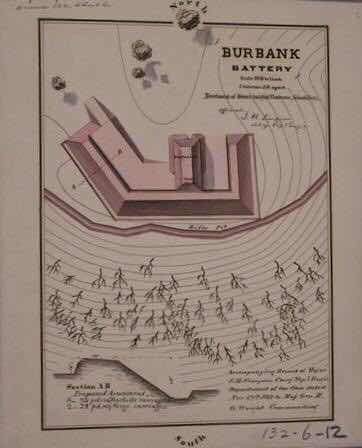


On September 16, he was promoted again, this time to Colonel of the Second Infantry Regiment. In 1863, he led this regiment and others as a brigade commander in the Army of the Potomac. He commanded these troops at the famous battles of Chancellorsville and Gettysburg. Here is his official report  from the battle in Pennsylvania, where his forces suffered heavy losses on July 2. 

He served in this role until early 1864, but, advancing in age as the war continued, he suffered issues with his health and eyesight. He received less stressful assignments, including responsibility for a draft rendezvous (where drafted soldiers were enrolled into the army) in Columbus, Ohio. He then rejoined the Second Infantry regiment in its headquarters at the Newport Barracks in June of 1864 and remained there until 1866, when the army transferred his command to Louisville.

Before this transfer, he had suffered a great personal loss when his son, Captain Sullivan W. Burbank, died in June of 1864 due to wounds received at the Battle of the Wilderness a few weeks previously. According to Ronald Coddington’s book Faces of the Civil War (2004, Johns Hopkins University Press), at the start of the war Sullivan had asked his father to find him a commission in the army. Sidney succeeded in doing so, but upon learning of his son’s death, felt tremendous guilt and sorrow over his son’s fate, as virtually any father would.

As the previously-mentioned transfer shows, he remained in the army after the war, as a military life was his destiny since birth. In 1866, he received a promotion to Brevet Brigadier General in the regular U.S. Army, effective March 13, 1865. He worked on rebuilding the Second Infantry and served on various boards and positions in these years. His work included recruiting duty and serving as President of the Army Examining Board for candidates to be appointed to the army, a title he received immediately after his transfer to Louisville. 

From 1867 to 1869, he was Assistant Commissioner of the Freedman’s Bureau in Kentucky. The Freedman’s Bureau existed to provide assistance to former slaves as they transitioned to freedom, but it faced many challenges in its brief existence, including financial troubles and racism. 

Burbank retired from the army in 1870 after forty years of service, and moved back to Newport, living not far from the barracks where he had served. He remained a resident of this city for over a decade, living on Front Street from 1870 until his death in 1882. 

In an example of the way the Civil War could affect American families, census records indicate that his wife Isabella (neé Slaughter) was a native of Virginia (as were her parents), though her loyalty surely remained with her husband’s side during the war. It is unknown how or if her family relations existed during and after the war. It is possible her family members were Southern Unionists who supported the Union cause, but perhaps they favored the Confederacy, yet still remained on good terms with the Burbanks. Another possibility is that the family ties broke apart during the war and then reconciled at a later point, but some families, like that of Union General George H. Thomas, another Virginian, saw their family bonds completely destroyed by the long, bitter war.

The Burbanks had three children, including two sons (Sullivan and Clayton) who served in the army, as well as daughter Frances, who married soldier William Maize, adding to the family’s military tradition. Clayton also was stationed in the Newport Barracks in the post-war years.

Sidney Burbank passed away on December 7, 1882 at the age of seventy-five, due to old age and inflammation of the bowels. He left behind an estate valued at just more than $10,800. According to his obituary in the Cincinnati Enquirer, his funeral was a private service at his home, with family and a few military colleagues present. He was laid to rest in a “beautiful casket, with massive silver ornaments.” The lid included a silver plaque with Burbank’s name and birth and death dates on it. His body wore a full Brigadier-General’s uniform, and flowers decorated the casket. He was laid to rest in an unmarked grave in section fourteen of Spring Grove Cemetery in Cincinnati. 

Sidney Burbank was a lifelong military man from a military family and led a long and honorable military life, in peacetime and in war. 

Rest In Peace, General Burbank. 

Wednesday, August 3, 2016

1862 Letter from the Siege of Cincinnati: Private William G.Johnson, 97th Ohio

Several months ago, I posted about an envelope I had acquired along with the letter inside. My intent was to follow that post up quickly with the transcription of the letter and some research on it. I clearly failed to follow up on that intention, for no one particular reason, but now I have fixed that and here is the text of the three-page letter as followed by my research and thoughts on it. (I have left the spelling and grammatical errors as they appear on the original, as they make it feel more genuine and do not hurt its readability. I did not add the distracting "sic" either, but did, however, break it up into paragraphs.)

Page 1 of letter

----
Covington, Kentucky
September 8, 1862

My dear wife. I sit down this after noon in the enemy country to write you a few lines to let you no how I am getting along. I am well and hope these few lines will find you injoing the same blessing.  

We left Zanesville yesterday morning and arrived here about three o’clock last night. Sabers were left in Zanesville and Walter Barnett allso Matt left camp with out leave and has not been heard of since. 

I do not no how long we will be here. We may leave in one hour’s time and we may not leave for one week. I heard that the 85th Ohio was here and I have been out looking for James and the rest of the (illegible - army?)  but I could not find any of them nor hear from them. 

Dear Mary. I suppose you have got my likeness. I sent it you you by CAS last  Saturday. Mary, I told CAS to tell you to give mother three dollars. Do so if you have not. 

Dear Mary I would love to have seen you once more before I left but I could not. Now Mary cheer up and keep in good spirits for I will take good care of my self and I do want you to do the same.

I must close for my time is limited. You need not write to me untill you here from me again. May God bless you Mary. 

Fare well, from your true and affectionate husband,

W.G. Johnson 
----

William Johnson had been born in Ohio in 1840, probably in Guernsey County. He enlisted as a private in Company B of the 97th Ohio Infantry regiment, on August 1, 1862, for a three-year term. (The company mustered in on September 1, 1862 at Camp Zanesville, Ohio.) He did not serve the entire term however as he was discharged on January 15, 1863 in Gallatin, Tennessee on a surgeon's certificate of disability, just a couple weeks after the Battle of Stone's River. Records do not indicate what caused the disability.

The Walter Barnett mentioned in the letter was a sergeant in the same company and a neighbor of the Johnson family. He was wounded at Kenesaw Mountain in 1864 and was promoted to 1st Lieutenant, so he obviously did not desert as the letter indicated he may have done. 

"James" was likely William’s younger brother. He was a private in company I of the 85th Ohio, a three-month regiment that was also involved in the defense of Cincinnati.  

The identities of "Matt" and "CAS" are unknown. A search of the 1860 census showed one "Mathew Lennon" as a neighbor of the Johnson household. The only military record for him, however, shows he joined the 122nd Ohio Infantry.  It was also organized in Zanesville, but not until September 30, after this letter was written. Might Mathew have joined a three-month regiment like the 85th Ohio and then changed to the 122nd somehow? Perhaps his paperwork was incomplete or lost? Or, probably, "Matt" was someone else. 

No candidate for "CAS" seems obvious. (I capitalized it in my transcription, but it was in small letters in the document. My assumption is they are a person's initials, based on the context.)

I also wonder about the "likeness" he sent home. Did it make it there? How long did it survive? Perhaps it is still in someone's collection, stuck in a pile of old photographs of unidentified men and women. Or maybe one of his descendants still has it.

Anyway, Ohio Civil War Central tells the story of how Johnson and his comrades in the 97th Ohio ended up in Covington and its actions following this scare to Cincinnati, then the country's sixth largest city.

"On September 7, 1862, officials dispatched the 97th via railroad to Covington, Kentucky, where, the following day, the regiment took up a position near Fort Mitchel. Confederate General Kirby Smith was currently leading a raid in northern Kentucky, and authorities believed his goal was to capture Cincinnati, Ohio, which was located just north of Covington and across the Ohio River. The attack never materialized, and on September 20, 1862, the 97th boarded the steamer Emma Duncan and sailed for Louisville, Kentucky, arriving two days later. The regiment immediately joined the Army of the Ohio, which was preparing to pursue Confederate General Braxton Bragg’s army.  The Army of the Ohio departed Louisville on October 2, 1862 and engaged a portion of Bragg’s command on October 4, 1862 in a small skirmish at Bardstown, Kentucky. On October 8, 1862, the Battle of Perryville, Kentucky occurred. The 97th fought well in this engagement."
Fort Mitchel, courtesy sonofthesouth.net
It is noteworthy that he referred to Covington as "enemy country." It is part of Kentucky, which was a slave state, but also remained in the United States. Covington lies along the northernmost border of Kentucky, on the south side of the Ohio River, the unofficial border between north and south at the time, at least west of the Mason-Dixon Line. Underground Railroad stations existed throughout the region, but, on the other hand, when John Hunt Morgan escaped from prison in Columbus, Ohio, he supposedly found a safe house one night in the Covington/Fort Mitchel area. Both sides of the war enjoyed support in the area, so it was not unreasonable for a northerner, even one from a state bordering Kentucky, to think of it as "enemy country," though it certainly caught my attention.

William married Mary Harper in 1865. They had eight or nine children, as records I found varied. He spent much of his life in Ohio, but by 1895 lived in St. Paul, Minnesota. He was in Minneapolis in 1905 and in the Minnesota Soldier's Home in the same city by 1910.

MN Soldier's Home, courtesy cityhistory.us


Mary passed away in 1916 and William lived until January 5, 1921 when he died at the soldier's home. He is buried in section C, lot 204 at Hillside Cemetery in Minneapolis.

Rest in peace, private William Johnson.

Courtesy findagrave.com

Tuesday, September 11, 2012

Squirrel Hunters in the Siege of Cincinnati

I've made several recent posts about the Black Brigade, a group of African-American men from Cincinnati. They helped create the defensive positions on the hills of Northern Kentucky, just south of Cincinnati and these positions helped defend the region from a potential Confederate attack in early September 1862.

Well, another group of men who were among those who joined in the area's defense during the Siege of Cincinnati became known as the the "Squirrel Hunters." One local legend states that their name came from their ability to shoot squirrels out of trees on the Kentucky banks of the Ohio River while they were still in Ohio. I tend to doubt this, because that area did not feature a lot of trees, even then, as both sides of the river were used for boat landings. Plus, any trees that may have been there likely would have been torn down just to give a better line of site. My guess is that the name came due to these men bringing their hunting rifles and wearing their hunting clothes. These were not professional soldiers, or even trained volunteer soldiers. They were, actually, much like the famed "Minutemen" of Revolutionary Times, though perhaps not even as experienced as them. They heard their country call for help (probably from proclamations issued by General Lew Wallace when he took command of forces in the area or from Governor David Tod), grabbed their gears and traveled to Cincinnati, by train, horse or foot.

Here is a very nice article by David E. Roth on the Cincinnati Civil War Roundtable's website that provides more details on these men and their unique nom-de-guerre. 

Once in the area, they crossed into Kentucky, where they assisted in building and manning many of the fortifications in the local hills. Approximately 22,000 actual army troops, under command of General Gordon Granger had rushed from Mississippi, but a large group of volunteers, perhaps 40-50,000, from Ohio and Indiana joined them. Thousands of these volunteers were the "Squirrel Hunters." 

After a couple of weeks, the siege let up and the Confederates headed back south. There was no further need for the Squirrel Hunters and they even may have become a bit of a nuisance, at least to a regular Army man like General A.J. Smith who wrote "Cannot I get rid of the Squirrel Hunters? They are under no control" in a letter to Lew Wallace on September 17, 1862.  (The War of the Rebellion: A Compilation of the Official Records of the Union and Confederate Armies Series 1, Volume 16, Part 2, page 524)

The Federal government did not recognize these men as a separate unit, or even as enrolled volunteers as their service ended, much like the Black Brigade. Ohio Governor David Tod did appreciate their efforts, however, helping to find money to pay for their train rides home and even had discharge certificates printed up for these men.


The state of Ohio eventually did offer pensions for some of these men, as Jim Schmidt explains in this blog entry

The legacy of these men is one that probably deserves some more study and research. When I mention them in a museum tour or when discussing the Civil War in the area, their nickname often brings about a smile on people's faces, almost like it's a cute story of some sort. The legend of their shooting ability does the same. People seem to appreciate their patriotism but as something less than true soldiers. Perhaps, however, that is a correct impression.

In the end, however, these were men trying to partake in serious business, defending their homes and families (that was not just a Southern desire.) Certainly they did not provide the usual military discipline of Army soldiers or even of many volunteers, but their state and region were in jeopardy of invasion and they turned out in large numbers to help as they could, though the first article linked above shows they mainly wanted to fight and not do as much of the dirty work. The threat ended up being much less than expected - some early reports claimed tens of thousands of Confederates were invading (see an example here), but Henry Heth's men only numbered 8,000 or less - but it was a threat and they responded to it quickly and bravely and earned pride in their name and, eventually, even a pension from their state.
 

Monday, September 10, 2012

Black Brigade Ceremony

The good news is that I did get to represent the Ramage Museum at last night's ceremony to dedicate a new monument to the Black Brigade of Cincinnati.

The bad news is that since I had to man the museum's table, and since the historical groups were not very close to the monument or ceremony, I did not actually get to hear the speakers or even see the monument. I did hear some positive remarks from others who attended and did get to see a group of men doing a presentation of some members of the unit, marching around with shovels, picks, etc. and chanting some tune I did not recognize. I wish I had been able to get a picture of them as they were impressive.

I was able to see the seating area and it appeared to be standing room only. They had said they were expecting a crowd of 250 or so and I think they got that, and perhaps a bit more. There were also quite a few African-Americans present; that makes sense with this type of monument, but I have seen stories and other blogs wondering about the lack of interest in the Civil War by African-Americans. I talked with a few dozen people at my table, including some African-Americans, and was pleased with the level of interest in local history and the Civil War. I had several good conversations and met quite a few knowledgeable people. That was a  pleasant part of the evening and hopefully at least a few of them will take time to visit the Ramage Museum or find other ways to study the war, locally or in general.

One cool thing was a local group of re-enactors who fired their cannon to start and end the event. The echo from the buildings in Covington, across the Ohio River, was impressive, and after the first shot, a local water patrol drove up to the Ohio shore to see what was going on. I don't think anything came of that, since the group did fire the ending shot about an hour later.

I also learned of some upcoming Civil War events at other local institutions and will post an entry or two about them in the next few days. It sounds like there will be some very good presentations and talks in the area in the next few weeks, many of them about events in the Cincinnati area. Some may not realize it, but Antietam and the Maryland campaign were not the only events taking place in September 1862. Hopefully at least some of the citizens of this area will understand that the war extended even into Northern Kentucky and Cincinnati, even if no major battle occurred.

I do wish I had been able to see the monument (but will find time to go visit and photograph it soon enough) and witness the actual ceremony, but I still had a good evening, being happy with the crowed that turned out for the event and the folks who stopped to visit my table. From what I saw, it was a successful event and a positive step for the study of local history.

Saturday, September 8, 2012

Pontoon Bridge Across the Ohio River, revised

Well, as I hope that my home internet connection problems are now resolved, I am republishing this entry, with small revisions. I originally posted in September 15, 2010, but the whole pontoon bridge to get men across the Ohio River has been one of the aspects of the Siege of Cincinnati that has fascinated me the most.


Soldiers crossing from Cincinnati to Covington KY, Harper's Weekly 9-27-1862
In Civil War discussions and blogs, there are many topics that generate excitement and discussion, from causes of the war, to who was right, to why one side won or lost. 

One thing that may not, however, seem so interesting, and may, in fact, appear rather mundane, is the role of everyday objects such as bridges. In Cincinnati in late summer 1862, such a topic was anything but mundane and, almost 150 years later, I still find the construction and role of a pontoon bridge to be one of the more fascinating aspects of the "Siege of Cincinnati."

When the Confederate approached the region after the Battle of Richmond (KY) of August 29 and 30,  General Lew Wallace took charge of local defense and declared martial law as he attempted to fortify the existing defenses in the hills of Northern Kentucky. One problem he quickly discovered was in trying to get soldiers from Ohio across the Ohio River into those fortifications. Boats were available to serve as ferries, but this was a slow process, even with the river being rather shallow at the time, due to the drought that hot summer had brought. 

In  Our Moment of Glory in the Civil War: When Cincinnati was Defended From the Hills of Northern Kentucky, (reprinted 2007 by the James A Ramage Civil War Museum and the City of Fort Wright) , Chester Geaslen described how General Wallace found a solution to this problem. Wallace

"consulted Cincinnati architect Wesley Cameron on the feasibility of constructing a pontoon bridge across the broad Ohio, by using empty coal barges lashed side by side, and anchored securely onto both shores. Cameron's reply was...'You get me the material and manpower, and I'll get the job done.' He was a man of his word because between the rising of the sun of one day, and its setting the next, Cameron had performed a miracle."

This improvised bridge proved invaluable in the crossing of so many volunteers and so much equipment in so short a time. 

Among the units that served in the Cincinnati area, shortly after the panic had subsided, was the 77th Illinois Volunteer Infantry. A couple of years ago, I read an enjoyable book that surprisingly gave me more details on this bridge. 

The Civil War Diary of a Common Soldier: William Wiley of the 77th Illinois Infantry, (editor Terrence J Winschel, copyright 2001, Louisiana State University Press) describes that unit's camp in and around Cincinnati, and mentions this bridge on pages 13 through 15. I've left in a couple of sentences before and after the description of the bridge to serve as background information and used bold font for the  mention of the bridge. Crossing that span, especially while trying to convince mules to do the same, must have been an interesting experience.  (The transcription in the book included spelling and grammatical errors as in Mr. Wiley's diary, but I have tried to clean them to make this easier to read.)


Oct 7th (1862)
...We had one team and wagon assigned to each company. Three for the Regt. headquarters and one for the hospital. And our teamsters had a serious time getting their teams broke in as they consisted of wild and vicious mules bought up all over the country and every one that had a mean vicious mule or horse sold them to the government. These mules were corralled on the Ohio side of the river and our teamsters in the first place had to go over to the coral, catch their mules, harness and hitch them to the army wagons [to] get them down through the city and across the Ohio River on the pontoon bridge and out to camp the best way they could. The greater part of the mules were young and had never been handled. A detail of soldiers would be sent over with the teamsters to help them. They would try to get one mule that had been broke for each team for a saddle mule and the balance they would just take whatever they could get a hold of. The greater part of them would just have to be lassoed and choked down until they would get the harness on them. Then they would let them up and get them hitched to the wagons the best way they could. The teams consisted of from four to six mules. When they would get them hitched to the wagons the teamsters would mount his saddle mule and get two or three soldiers on each side to scare them along thus they would go down through Cincinnati to the pontoon bridge which consisted of boats made like very large skiffs anchored in the river about twelve feet apart with timbers laid from one boat to the other and two inch plank spiked onto the timbers. The bridge was twelve or fourteen feet wide with no side railing whatever. The bridge would sway up and down and sideways when the weight would come on it and was not the best kind to drive a big team of wild mules over. But by prodding, whipping, and scaring they would get them forced  onto the bridge and the noise and swaying of the bridge each mule a pushing with all his might for fear of being pushed off the bridge which was at least 80 rods long and then by the same scaring process they would force them out through the town of Covington to camp. They would continue to drive them around until they were tired out before they would unhitch them but the harness was never taken off until they were thoroughly broke. Then they would have to be shod so they could stand the racket over the racks and pikes of Kentucky. This was accomplished by getting them in the stocks and strapping them down so they could do nothing but bray and then the shoes would be fitted and drove."

The Cincinnati Enquirer mentioned this bridge in a couple of its editions.

On September 10, 1862, it informed readers: "It should be understood that the pontoon bridge across the river is only eligible to the military. The guards are continually annoyed by the application of civilians and ladies who are anxious to cross merely, we should imagine, for the novelty of the thing."   It's easy to imagine army officers easily losing their cool as person after person approaches them asking for a special "one-time" favor or an exception to the rules, but it's just as easy to understand the fascination citizens had with it and the curiosity they must have felt about such a strange sight. 

On November 7, the paper reported: "The pontoon bridge across the Ohio River to Covington from this city is being removed."  It followed up this report 8 days later, stating that "Mr. Montgomery will sell, this afternoon, all the lumber used in the construction of the pontoon bridge, lately crossing the Ohio River, per order of Colonel Swords."  Unfortunately, the next day's paper was missing from the microfilm roll, so I could not find any details about the sale of this wood.


During this time, a second pontoon bridge was also constructed, on the Licking River, connecting Campbell and Kenton Counties in northern Kentucky.

Soon after the war ended, construction on the John Roebling's Suspension Bridge was completed, at the same spot where the pontoon bridge crossed the Ohio. This new bridge would serve as a model for the much more famous Brooklyn Bridge of later years.  In the illustration at the top of this post, a piling is visible on the far shore. This was from where construction of this permanent bridge had begun before the war. Note that it is on land, but in modern times is now firmly within the bounds of the mighty Ohio.

In 1866, the Roebling Suspension Bridge finally opened after years of political and financial controversy and trouble. Those issues still face the region today as politicians try to find a solution to replacing the aging and over-used Brent Spence Bridge, just west of where the pontoon bridge once stood. No such temporary measure will suffice today.


Wednesday, September 5, 2012

Another Black Brigade Article

Here is another article that I had not seen before publishing yesterday's entry. It is good to see this story starting to get more attention, as well as the Brigade itself. I am anxious to see the monument.

Thanks to my friend Tom for forwarding me the link

Tuesday, September 4, 2012

Some Recognition for the Black Brigade of Cincinnati

One of the more fascinating aspects of the Siege of Cincinnati was the involvement of the group that became known as the "Black Brigade of Cincinnati."  (Please take time to read that last link - it is an online version of an 1864 book about this unit, thanks to the Public Library of Cincinnati and Hamilton County. It gives more details than I do here. Click on the "PDF" link on the page to which this link goes.)

As Confederate troops approached the city and panic began to ensue, many of these men, in a city technically in the north, but with many ties and sympathies lying with the south, tried to join in the action, only to be told words to the effect that it was a "white man's war."

As possible invasion came closer to reality, however, some of the cops in Cincinnati took a different tone and actually rounded up many African American men, and took them to a pen on Race Street (a sadly ironic name), treating them almost like slaves.

Fortune smiled on these men however, when General Lew Wallace, in charge of the Cincinnati and Northern Kentucky defenses per the orders of General Horatio Wright, found out about this treatment and disapproved of it. He ordered Judge William Martin Dickson to take charge of the African Americans and the Judge did so. He met these men where they had been gathered and told them they could go home to see their loved ones and then report back in the morning. Local lore states that about 400-500 men were there that evening but that over 700 showed up the next morning.

Over the next couple of weeks, these men helped build local defensive positions in Northern Kentucky, mostly in Campbell County. They were kept segregated from the tens of thousands of other troops working in the region and they were not allowed to carry weapons, but they actually did reportedly receive the same pay as the white volunteers, which slowly climbed from nothing to $1.00 per day and finally to $1.50 per day.

(The above image shows the Ohio River dividing Cincinnati on the north from the northern part of Kentucky to the south, with the Licking River separating Kenton (west) and Campbell (east) Counties in Kentucky. The defensive positions rested on hills and ridges which took advantage of the bend in the Ohio River to form a ring-shaped system of defenses. )

When the panic had ended and the Confederates under General Henry Heth had headed back towards central Kentucky, these African Americans found that their work did not go unappreciated. Judge Dickson, pictured below, even presented them with their own flag, also pictured below, which now resides in the Ohio Historical Society.


The Black Brigade was not a permanent unit, and it did break up once the panic and expected siege had ended, but several members of this group eventually joined other African American Units, including Powhatan Beaty, who won a Medal of Honor at the Battle of Chaffin's Farm in 1864.

I also find it remarkable that this happened before the Emancipation Proclamation, when the use of African-American troops had not become customary and was still a very controversial topic. Perhaps this was a symbol of how fear can change people's viewpoints, as locals allowed these African Americans to help defend them, when they heard (often exaggerated) reports of how many Confederates were coming and what their plans for the city might be.

Recently, I have seen a couple of articles and announcements about this unit and am glad to see more attention given to this group of brave men. Here is an  announcement about an upcoming dedication of a Black Brigage monument next Sunday. I encourage people to attend this and will try to be there myself as a representative of the Ramage museum. I am anxious to see the new monument and to try to interpret it through not only my initial reactions, but from a "memory" perspective too, to try to see what it says about how this unit is regarded and what the monument designers want people to see and perhaps feel.

The Cincinnati Herald also has a nice article about the recent Battery Hooper Days event and the Black Brigade.

Kevin Levin also had a post about a video about the creation of the monument. I think the video is about a year old, but it still is a nice summation of the project.

Powhatan Beaty
Flag Given to the Black Brigade

Tuesday, August 28, 2012

Cincinnati Museum Exhibit: Cincinnati and the Civil War

Image from Cincymuseum.org
Well, I publish  infrequently in recent weeks, then post two entries tonight. The previous one was the one I focused on, but I thought this upcoming exhibit at the Cincinnati Museum Center deserved some attention as well and wanted to post this while I had the time. I'll certainly visit this exhibit as soon as I can, though I'm not sure if it will be this weekend. The following week may be better for me.

Cincinnati and the Civil War: The Queen City Responds 1861-1862

Here's a brief description from their site, but if you go to the link, you'll see more, including photos of some of the items on display. It looks promising. You can search my blog for articles on the Siege of Cincinnati, though I'll try to be republishing some of those stories or hopefully creating new ones in the next three weeks. The Siege of Cincinnati took place in the weeks following the Confederate route of Union forces at Richmond, Kentucky, at the end of August 1862.

September 2012 marks the 150th anniversary of the Confederate Siege of Cincinnati, which compelled soldiers and citizens to organize defenses around our Queen City. Learn about the defense of Cincinnati, the Battle of Perryville and other events from the first two years of the Civil War explored through actual uniforms, weapons and equipment of the common soldier as well as photographs, letters, broadsides and paintings of the period from our collections.

Tuesday, August 7, 2012

It was MY error, not theirs

Wow! Almost 2 weeks since my last post. I'm sorry for the lack of posts as I have not had much time to do a lot of research or looking for topics. I will have some information on Battery Hooper Days at the James A Ramage Civil War museum posted soon, since it is coming up on the 18th and 19th of this month. (End shameless plug now.)

I was actually really looking forward to writing a long, perhaps even smug, post this weekend. I thought I something good and that I had found an error on the National Park Service's wonderful Soldiers and Sailors System. Sometime Saturday I began looking for links and other sources (such as local newspaper articles I had previously seen) to support my understanding and claim. I was starting to copy and paste text, and highlight the errors when a final reading of their text revealed that they had the right information after all, just much lower in the text than I had looked closely before. Talk about a let-down!

I thought they had been mistaken in the description of the 13th Infantry Regiment of the United States Regular Army. They had it located at Newport News, Virginia while Confederates threatened Cincinnati. I was going to jump over that and claim the regiment was actually at Newport, Kentucky, a city across the river from Cincinnati. Geographically, that made much more sense (why be in Virginia and mention the threat against a city hundreds of miles away?) and it seemed logical that someone could have mistaken "Newport" for "Newport News." I was even ready to propose this as a sign that of the bias towards the "eastern theater" and Virginia as opposed to the the west. Ah-ha! I thought - here's evidence of that bias, and I found it. I guess pride does cometh before the fall, however, as later down the report of this unit, this site did list that one unit of this regiment had been at Newport Barracks starting in September 1862 when the Confederates threatened Cincinnati during the "Siege of Cincinnati" I have often mentioned.

Here is a link to that unit's page, and below is the text it will take you to, with emphasis added on the text that originally caught my attention and the line I had overlooked at first.

So much for my "discovery" huh? C'est la vie, I suppose. At least I figured it out before posting it and really making a fool of myself.

(It's also  interesting to me that this unit was at Young's Point, Louisiana in early 1863 as my g-g-g-grandfather was a member of the 7th Kentucky Infantry in the same area about that time. He became ill and ended up in the Veteran's Reserve Corps for the rest of the war.)


13th Regiment, US Infantry (Regular Army)


Overview:
Created by direction of the President May 4, 1861,  and confirmed by Act of Congress July 29, 1861. Organized at Jefferson Barracks, Mo. Company "A" organized October 8, 1861, "B," "C" and "G" November 13, 1861. "D," "E" and "F" April 1, 1862. Battalion ordered to Alton, Ill., February 12, 1862, and duty there till September 4, 1862. Moved to Newport News, Va., September 4, and duty there during Kirby Smith's threatened attack on Cincinnati, Ohio. Moved to Memphis, Tenn., October 14-22. Attached to District of Memphis, Tenn., Right Wing 13th Army Corps, Dept. Tennessee, to December, 1862. 1st Brigade, 2nd Division, Sherman's Yazoo Expedition to January, 1863. 1st Brigade, 2nd Division, 15th Army Corps, Army Tennessee, January, 1863. Headquarters, 15th Army Corps, to September, 1863. 1st Brigade, 2nd Division, 15th Army Corps, to December, 1863. District of Nashville, Tenn., Dept. Cumberland, to July, 1865.


Service:
-Duty at Memphis till November, 1862. Grant's Central Mississippi Campaign, "Tallahatchie March," November 26-December 12. Sherman's Yazoo Expedition December 20, 1862-January 3, 1863. Chickasaw Bayou December 26-28. Chickasaw Bluff December 29. Expedition to Arkansas Post, Ark., January 3-10, 1863. Assault and capture of Fort Hindman, Arkansas Post, January 10-11. Moved to Young's Point, La, January 17-22, and duty there till March. Expedition to Rolling Fork via Muddy, Steele's and Black Bayous March 14-27. Black Bayou March 21. Deer Creek, near Rolling Fork, March 22. At Young's Point till April 29. Demonstration on Haines and Drumgould's Bluffs April 29-May 2. Moved to join army in rear of Vicksburg via Richmond and Grand Gulf May 2-14. Jackson May 14. Battle of Champion's Hill May 16. Big Black May 17. Siege of Vicksburg, Miss., May 18-July 4. (1st at Vicksburg.) Assaults on Vicksburg May 19 and 22. Advance on Jackson, Miss., July 4-10. Siege of Jackson July 10-17. At Big Black till September, 1863. Moved to Memphis, Tenn., thence to Chattanooga, Tenn., September 27-November 21. Action at Colliersville October 11. Operations on the Memphis & Charleston Railroad in Alabama October 20-29. Bear Creek, Tuscumbia, October 27. Chattanooga-Ringgold Campaign November 23-27. Battles of Chattanooga November 23-25. Foot of Missionary Ridge November 24. March to relief of Knoxville, Tenn., November 28-December 17. At Bellefonte, Ala., till January 1, 1864, and at Huntsville, Ala., till April 4. Duty at Nashville, Tenn. Guard at Headquarters of General Sherman till July, 1865. Battle of Nashville December 15-16, 1864. Moved to St. Louis, Mo., July 13-20, 1865. To Jefferson Barracks August 8. To Fort Leavenworth, Kansas, August 24, thence moved to Fort Riley, Kansas. Company "E" at Newport Barracks, Ky., September 4, 1862, to May 4, 1863. At Dayton, Ohio, till June 6. Moved to Vicksburg, Miss., June 6-16.

Regiment lost during service 3 Officers and 55 Enlisted men killed and mortally wounded and 7 Officers and 121 Enlisted men by disease. Total 186.

Wednesday, February 8, 2012

A Local Civil War Fact mentioned on TV

So I was watching "Only in America" with Larry the Cable Guy (I don't know why either, so don't ask) and they had a segment on squirrel hunting and said (I'm paraphrasing): "During the Civil War, the Confederates did not invade Ohio because they enlisted 15,000 squirrel hunters" before making some joke about the squirrels being happy about that.

I found it interesting that such a fairly obscure Civil War fact was mentioned in a show like that. I guess his writers may be Civil War buffs or maybe there just are not many interesting facts about squirrels and squirrel hunters out there.

Also, that is an actual bit of history mentioned on the History Channel (or "History" as it is now known.) That seems unusual too (Perhaps there were no "ancient alien squirrel hunters" they could discuss.)


Friday, September 30, 2011

September 1861: Important Action

Major General Ormsby M Mitchel
From the Covington Journal of September 28, 1861 comes this brief article about a meeting that would have some long-term effects in Northern Kentucky and the defense of the Cincinnati region.

The Mayors of the cities of Cincinnati, Covington and Newport, and committees of Councils, met General Mitchel last evening, and an important conference was held as to the defense of the city. It was decided, among other matters, to employ a large force of laborers to dig intrenchments or redoubts on the hills back of Covington and Newport, four in number, and two flanking redoubts on the hills back of this city.  

The force of laborers to be employed will be large, and the wages per day have been fixed at seventy-five cents. 

[Cin Enquirer, 27th]

--
The results of this meeting were the beginnings of the construction of what would be 28 defensive positions in the area, 2 in Cincinnati and 26 south of the Ohio river, forming a shape like a ring with one side not quite rounded, each end attached to the river, taking advantage of the waterway's curve that forms Kentucky's northern border.

These defensive positions would fortify the area when Confederates under General Henry Heth threatened the region in September 1862, in what became known as the Siege of Cincinnati

The below illustration is a drawing of "Hooper Battery" (or "Battery Hooper") which was one of the first six positions fortified in the fall of 1861. (The others were built more hastily as the Confederates approached a year later.)  This is also the land where the James A. Ramage Civil War Museum is now located, on a hill in what is now known as the town of Fort Wright, named for General Horatio G. Wright.


Wednesday, December 22, 2010

Tuesday, December 14, 2010

Black Brigade of Cincinnati, 1864 book

This link should take you straight to the beginning of a 34 page book about the Black Brigade of Cincinnati, published in 1864.  If not, try the 2nd link and click on the book to open and read it  This is from the "virtual library" of the Public Library of Cincinnati and Hamilton County

Downloadable version

 Main page

Monday, November 1, 2010

Siege of Cincinnati / Battery Hooper article in Cincy Enquirer

I had not planned to make this entry, but the Cincinnati Enquirer today published a good description of the "Siege of Cincinnati" that I mention frequently and I found it to be worth sharing.

It is somewhat surprising that the Confederates did not make a more serious attempt to attack Cincinnati during the war, as it  was quite an important city at the time, and the Ohio River was a major transportation route. It was, however, far enough north to be a difficult challenge for the southerners to undertake, and after Heth and his men saw the fortifications that had been built by the time of their approach in September of 1862, they knew a successful attack would not be easy. The bend in the Ohio River, the hills of Northern Kentucky and the skills of U.S. Engineers like Charles Whittlesey and James Simpson combined to create a strong line of defenses.

Within a few weeks of this threat, a major battle took place a few hours south of Cincinnati,  at Perryville and soon after that fight the Confederates would leave the Bluegrass State, virtually for good. Despite later raids by men such as John Hunt Morgan and the grandiose late 1864 dreams of John Bell Hood,  no major Confederate force ever remotely approached Cincinnati again.

 _____


The above image from Google Earth displays my attempt to show the general outline of where the defenses of Cincinnati were. This, of course, is a modern image, but the path of the Ohio River is fairly obvious as it winds its way towards a meeting with the "father of all waters." The yellow pins represent my understanding of where, amongst the modern sprawl, the fortifications were located. I know they are not exact and there were more than I have pinned so far (plus 2 north of the river) but I think this image provides at least a basic bird's-eye view of the how the shape of the river, the topography of Northern Kentucky and the man-made defensive positions worked together to make this a formidable position, almost a "ring," especially for a force as small as Henry Heth's (estimated from 6,000 to 8,000 men.)

The small, dark north/south line almost exactly in the middle of the page is the Licking River, which runs from southeastern Kentucky and empties into the Ohio River across from Cincinnati. (One of Cincinnati's early names was Losantiville, meaning "across from the Licking.") It divides Campbell County (on the right) and Kenton County (the left) in this image, and for an aggressive attacker, this small river could have served almost as a driveway straight into the heart of the defensive lines, but the engineers knew that and designed some of the positions, including Battery Hooper, to overlook this river and the valley it carved out along its route. If anybody gets the opportunity to visit the Ramage Museum, the view from the front yard, where Battery Hooper once stood, is of this valley and is quite spectacular at times. That type of view makes it seem obvious why the engineers put the batteries where they did. The below image shows a slightly zoomed-in view during the middle of summer.