A while ago, I began working on a story about a Civil War soldier named Michael Gabbard, who supposedly was on the honor guard transporting Abraham Lincoln’s body from Chicago to Springfield. I planned to do a post exploring that story, but part of the information a cousin gave me about this was a typed autobiographical sketch of this man’s wife, Mary Ann Mangan. I started to use excerpts from it in my post, but the sections related to him and/or the Civil War were much longer and more interesting than I expected, so I realized that her story would make a worthwhile post itself. It provides unique perspectives of life in that era, including how a relationship developed into the life of an immigrant, marriage, family loyalty, even an example of teenage rebellion (not a new concept), and, overall, a life story of one young woman in mid-nineteenth century America. Those interested in studying gender roles or race relations in Kentucky might find parts of this story valuable. (For anyone curious about her entire story, a copy of the full document is here.)
In my transcription of the pieces of the document relevant to this post, I attempted to correct most spelling/grammar errors, but intentionally left a couple grammar mistakes which I thought added authenticity or a “down-home” feel to this tale, making it read how I imagined she spoke. I have italicized her words below, but added a few links and other details.
Mary Ann Mangan was born March 25, 1848 in Ireland. In her youth, she lived in both Ireland and England, before sailing to the United States in 1858, landing in New York Bay. In New York, “we exchanged our British money for U.S. money. I saw the first Negro I ever saw in New York.” Her family travelled west to Milwaukee. “There I saw my first watermelons, cucumbers and squashes. There I saw the first ear of corn. I didn’t know whether it was hand made or natural.” They eventually moved to Illinois.
While living in Peru (Illinois,) I attended church and Sunday school regularly. While attending school, I became acquainted with a number of nice young men and girls who were my classmates. In the spring of sixty-one, while on my way to school, I was told the South had seceded and war was inevitable. War was the topic of the day. The war cloud was darkening the northern horizon and the valiant sons of the North were preparing to rush to the awful encounter.
I quit school, went home, and went to clerk in a store in my home town. The proprietor of the store was a Southern lady and she it was who persuaded me to marry your father, my husband. I stayed with this Southern storekeeper in the summer. When school opened, I would quit the store and go to school. I left the Southern lady and went to work for an old gentleman and his wife. The lady was an invalid. She was very kind to me and I liked to live with her very much.
I was living in Chicago and, with a friend, went to visit the great Senator Douglas’ grave on the bank of Lake Michigan. There was a picnic on the grounds. There were swings. I got into one and my friend was going to swing me when a young man stepped up and said: I’ll swing you if you wish me to. I let him move the swing a short time. Then I said Please stop the swing. He done as I requested. I thanked him and went walking off. It was time to go home. When I was getting to the street car, my acquaintance of the swing was at the car door and asked me if I enjoyed myself. Yes, I answered in a happy, joyous way. My friend who was with me was an old lady and she requested the name of the young man who swang me and had been so nice to her. He gave her his name and address. He promised to get a pass for the lady to go inside of Camp Douglas. The law of the camp was ‘No citizen allowed inside,’ unless some friend was a soldier and on duty there. The young man’s name was Michael Gabbard, Co. G 7th Regt., V.R.C. Camp Douglas, Chicago, Ill. He got my address and I hadn’t been at home but two days when I got a letter from said Michael.
And what began in an indifferent acquaintance ended in marriage. I had not been long acquainted with Mike Gabbard when he asked me to marry him. I was not thinking of such a thing. I was young and told him I didn’t want to marry. He was persistent. I went home. Mike wrote to Mother while I was at home, asking her consent. She was furious. She made life so hard for me. I went to my southern friend with my trouble and of course she was for her Southern friend. She persuaded me to leave home and marry him, which I did. If Mother hadn’t been so harsh to me, I wouldn’t have left home and married a strange man. Mother never forgave my Southern friend for what she done in the matter. After I was married and with Mike in Chicago, mother wrote to me to come home and stay with her until Mike got his discharge as Mike could not get a house to move into as the houses in camp were all occupied. Mike consented for me to go. I was but a short time at home when he got a pass for twelve hours, which he lengthened to eight days. When he went back to camp, he was put in the guardhouse four days. It was Christmas time and he had lots of company in the guardhouse. Mother and my good stepfather treated him royally. Aunt Sally and Aunt Kate gave us a dinner as also did Mike’s Southern friend. Mike went back to duty at Chicago. I stayed with Mother.....Mike was at this time waiting for a house to become vacant. At last, the happy time arrived. He notified me to come. He had a house. Well, we got to housekeeping.
Mother hated to see me go very much and I hated to leave her and my good old stepfather. He and mother came to the train to see me off and bid me goodbye. That was the last time I ever saw my stepfather. I parted with him forever; he was a good man. Mike liked him. I went to housekeeping in Camp Douglas, Chicago. I liked to keep house very much. There was three young men, soldiers, of Mike’s company, (who) boarded with us. We enjoyed their company very much. One was a New Yorker, one was an Indianan, and one was a Canadian. They were cultured gentlemen, and we enjoyed their company very much. (Let me say here, your Father was well liked by all his comrades.) In the latter part of sixty-five, the war was over. The prisoners were all discharged, and gone home. And the soldiers wanted to be discharged also. They had enough of war, such a cruel war. They wanted to follow their peaceful avocations of life.
Mike got his discharge from service at Chicago, Ill. Your Father received two honorable discharges. We left Chicago in the latter part of Nov, 1865, arrived on Lexington, Ky., and stopped at the Broadway Hotel. Took the stage next day for Richmond, Ky., stayed over night at the Webster Hotel. Next day took the stage to Irvine, Ky. We arrived in Irvine on Sunday evening, the landlady was not at home when we arrived at the Iiamson House, our hostess being a colored lady. She took charge of my things, waiting on me very politely. In the mean time, plying me with questions. She asked me where I was from, and when I told her I was from the North, she asked me if she was free. I told her “yes! You’re as free as I am.” She gave me an earnest look, threw her arms up over her head and shouted “Thank you Lord. I’ll just stay with them through Christmas.” Her mistress had told her she was not free in order to get her work. She was a good cook and her place couldn’t easily be filled. The landlady got very angry at me for telling her black woman she was free. I had no apology to make to the landlady.
Mike and I walked to Proctor, stayed all night at an old acquaintance of Mike’s, Frank Daugherty. Next day we started to walk to Booneville Ky.
She then writes more about her life before concluding with the following revealing, especially sad lines:
Married at Chicago in September 15th - 1864
Michael Gabbard of Booneville Ky to Mary A Mangan of Henry, Illinois.
The marriage was performed by a Justice of the Peace. His name was Charles Chilson. I kept his business card a long time after I came to Ky. It was not a happy marriage with me but I remained true to my obligations as a wife and as a mother. I done the best I could for my children, whom I dearly loved. They are all married and in homes of their own and I am in the evening of life. I wish to live in quiet until I reach the Home not made with hands, eternal in the heavens.
A family history site claims Michael may have been known as “Drunk Mike,” perhaps the cause of the unhappiness, and my cousin wondered if he may have been shell-shocked or had what we now call post-tramautic stress disorder, especially since he had been serioysly injured in the war (thus his presence in the Veterans Reserve Corps.) Could such a condition have led him to the bottle?
I find it extremely interesting - perhaps even suspicious - that this account makes no mention of her husband as part of Lincoln’s honor guard. Could she have forgotten this information from about 50 years earlier? Any memoirs or reports written so long after an event or time may include faulty memories. (For instance, she noted Michael I. The 7th regiment, VRC, but re olds show he was in the 8th. That was likely a slip of the memory on her part.) Another possibility is that the nature of the marriage may have discouraged her from praising him, but she did make other positive comments about him, so her intentionally omitting the honor guard situation seems improbable. The document does not read as though she was bitter, nor that she intended to discredit him. It makes no mention of his supposed fondness for the bottle and only includes that one line about unhappiness.
I do wonder about this omission because if her husband was on that honor guard, that would have seemed like an important piece of his life, but maybe it was not important to her. Otherwise, did she not believe he was on the honor guard? Was he truly part of that unit? If not, where did the story come from? In the next post, I will explore this part of their story more.
The lack of a name for her “Southern friend” also puzzles me, but 50 years is a long time so her memory may have failed or she felt it too insignificant to include.
Mary Ann (Mangan) Gabbard passed away on November 14, 1923 and was buried in the Elihu Reynolds Cemetery in Cow Creek, Owsley County, Kentucky. Her husband had died in 1902 and was buried in the Esau-Gabbard Cemetery in Ricetown, Owsley County. Was her burial in a different cemetery due to her unhappiness with the marriage? Or was her spouse buried in a family cemetery which ran out of room before she died?
One of their granddaughters, Edna Gabbard, married Charlie McIntosh. My family tree includes a McIntosh line (including a direct ancestor in the war) though any relation to this particular family is likely quite distant. That might be a genealogy project for the future.
I will continue to work on the story about her husband Michael Gabbard and will post it when it is ready.
These undated photos are from findagrave.com.
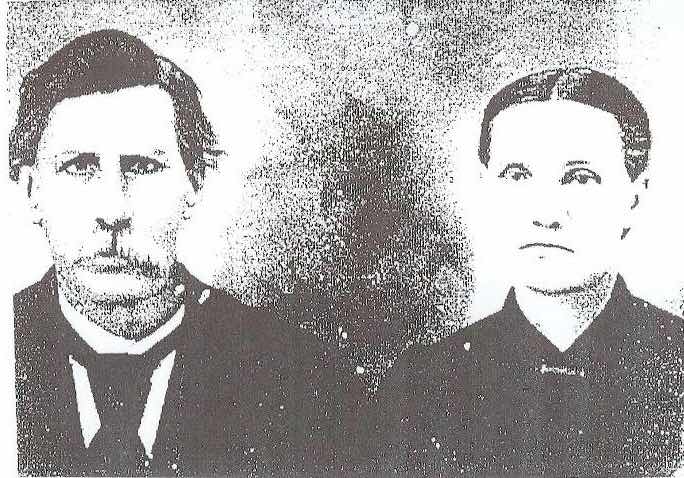
Michael and Mary Ann Gabbard

Mary Ann Gabbard
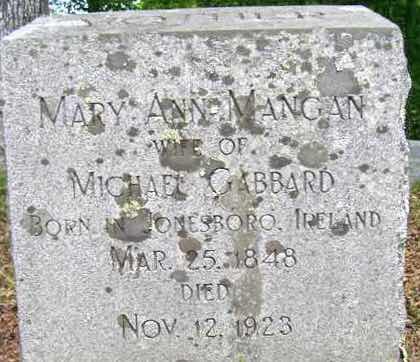
Headstone of Mary Ann (Mangan) Gabbard.

