Showing posts with label violence. Show all posts

Tuesday, May 7, 2024

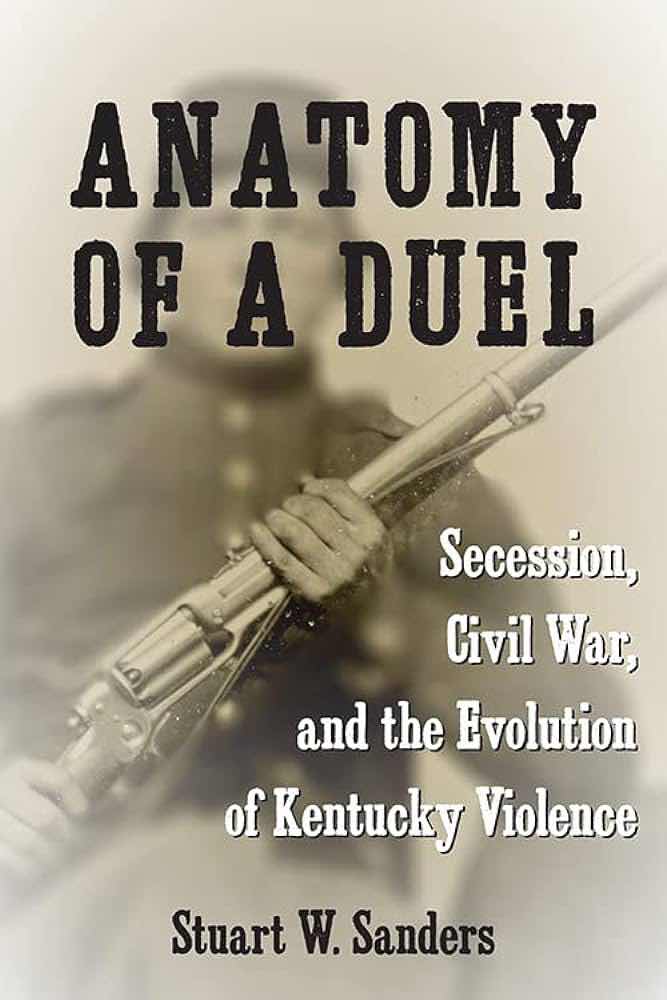
Book Review: Anatomy of a Duel: Secession, Civil War, and the Evolution of Kentucky Violence


By Stuart W. Sanders 
2023
University Press of Kentucky 

At first glance, using one duel taking place on one afternoon in an obscure Kentucky community to explore a state’s culture may sound like a challenging proposition, but Stuart Sanders tackled that idea and turned it into a fine book describing a key piece of nineteenth-century life in Kentucky. 

In this deeply researched book, involving many sources, Sanders, author of multiple books about Civil War Kentucky, as well as one about violence on a period steamboat, uses his experience and writing ability to craft a fascinating story about how the confrontation between William Casto and Union Colonel Leonidas Metcalf illustrates the importance of the code duello in Kentucky life. He, however, goes beyond just that confrontation to show why it happened and why it was a bit unusual for its time as change was slowly happening in the Bluegrass State as civil war approached.

As the book’s title so aptly says, this work is truly an anatomy (or dissection) of this one fight, showing how state (and southern) culture, combined with the Civil War (and the tensions that led to war), the background of the individuals involved, and the actions of Union leaders who were trying to keep Kentucky (and Kentuckians) out of the Confederacy, all somehow worked together over time to lead to this contest. It was not simply a case of two men suddenly becoming angry and immediately dueling. It was a process based on those factors that Sanders explores and describes in a very readable and enjoyable book.

This book is more than a story about the duel, even as that word in the title is the attention-grabber. The author discusses violence in Kentucky, particularly the art of dueling, and how the state's citizens and government accepted it as part of life, but also shows how that form of manhood and honor had started changing in the Civil War era, especially during and after the war. Violence and fighting remained an unfortunately large part of life in the Commonwealth, but the formality of duels, with strict rules, regulations, and traditions, gradually changed into more improvisational street fighting, including the use of concealed weapons. The book’s title refers to this as “evolution,” but a reasonable argument could contend that “de-evolution” would be just as or perhaps more appropriate.

This work also discussed how the culture of violence, including both dueling and the newer style of fighting, injured, or even changed, Kentucky’s reputation nationwide. The frequent violence, fighting, and murdering came to define the state in many eyes, transforming the state’s reputation from the land of Henry Clay, compromise, and a forward thinking educated people to an image of a backward and poor population that constantly resorted to physically harming or killing fellow citizens. 

This truly is a good perspective not only on dueling or violence, but on the state of Kentucky in the mid-nineteenth century, including how the population was split in supporting the Union or Confederate side (even in the same towns and counties) and how that division sometimes led to violence like in the Casto-Metcalfe duel.  It is a much bigger story than just that of one of one fight or of that style of combat.

For those who seek satisfaction from books they read, I believe this one will accept and meet your challenge. I enjoyed this read and certainly recommend it.


Monday, April 25, 2011

Free Speech in Cincinnati

Related to my recent post  about "ruffianism" in Cincinnati, here is  yet another article from the Covington Journal of April 20, 1861. I guess I should  just link to that page and let everyone read the whole issue, since I'm posting so many entries from it, but I'll go ahead and post this one too. I'm keeping it separate from the "ruffianism" article to keep these posts at a more reasonable length.

Free Speech in Cincinnati
A few nights since the proprietors of the Cincinnati Enquirer had to call in the aid of two hundred armed friends to protect their office from the threatened assault of a Black Republican mob.


Such paragraphs as the following are exultingly paraded in the coercion papers of Cincinnati as an evidence of the healthy public sentiment over there:


"A fellow on Fourth street Saturday night, expressed the opinion that Sumter ought to have been taken. The next moment he was sprawling on the bowdlers, most lustily crying murder. A 'peaceable citizen' knocked him over." 


"A horse-dealer, who made a similar expression in a stable in the western part of the city this morning, had a cane broken over his head, but was permitted to hurry off to a surgeon's."


Out in Brighton, a couple of fellows, jokingly offered to raise a Secession flag. The idea created such an excitement, that the jokers had to make themselves scarce."

Saturday, April 23, 2011

Ruffianism in Cincinnati

The Covington Journal of April 20, 1861 is full of interesting articles in the aftermath of the firing on Fort Sumter, including a few about reactions and incidents in Cincinnati. (This was a weekly newspaper, and the April 12th bombardment happened too close to this papers deadline to be covered until the following week.) Here is one more of these articles.

Ruffianism
Affairs have come to a deplorable pass when acts of ruffianism are exultingly paraded in the columns of a newspaper as evidences of loyalty to the North.

This has been done by newspapers published in Cincinnati. We believe, however, that only the least offensive cases have been published. 


We are strictly within the bounds of truth in saying that it is at some risk of personal safety that a citizen of Kentucky now goes to Cincinnati for the purpose of transacting ordinary business. He may go there with a determination to express no opinion as to the cause of our national troubles; but if he happens to get into a crowd of anti-slavery fanatics his opinions are demanded in such a way that he cannot remain silent without debasing his manhood. No matter what his views, if they do not accord with the prevailing sentiment he is liable to be called a "d____d liar" or a "d____d traitor."


We have heard of several instances this week, in which Kentuckians, giving their views (moderate and conservative) in compliance with requests which could not be evaded, have been grossly insulted. 


It is well understood that the Cincinnati Enquirer, which was a true Union paper, has been compelled by threats of mob violence to take another chute.


On Tuesday last, ex-Senator Bright of Indiana stopped at the Spencer House. He was suspected of entertaining anti-Lincoln sentiments. A mob committee was appointed to conduct him out of Cincinnati. The committee went to the hotel for the purpose of executing the order, but Mr. Bright had left for the East, and thus avoided their tender of Black Republican hospitality.

---
It's interesting that they claim there were situations where a Kentucky man would lose his "manhood" if he elected to keep his opinions to himself; that's a good example of how "honor" was so important to many Southerners, or at least the image of being honorable. (Ironically, this same newspaper had an add that began: "Manhood, How Lost, How Restored." See my previous post about this ad in an earlier edition of this newspaper.)

It also is perhaps a bit ironic that Cincinnati eventually developed a reputation for having much support for the South, and the Enquirer did too, but I guess in the days when feelings on both sides were at their highest pitch, those pro-Southern leanings had not yet become evident.

Tuesday, October 20, 2009

Legacy of John Brown

The anniversary of John Brown's ill-fated raid on Harper's Ferry has just passed, one of the more violent and incredible acts that took place in the antebellum years, leading up to the Civil War.

First of all, the House Divided Blog has posted a couple of very interesting posts about this subject, including a link to the online exhibit at the Gilder Lehrman Institute. Both of these sites are very interesting and much more in-depth than anything I plan to post, but I thought I would post a few of my comments about this subject anyway.

A few  weeks ago, I made a post claiming 1850s was a volcano, with many mini-eruptions spewing out controversies throughout the land. If this is true, the Harper's Ferry raid may have been the nearest thing to the Mount St. Helens type explosion, at least during this decade (though the firing at Fort Sumter was the ultimate eruption.)

I guess my interest in the matter is regarding the legacy Brown left. Was he a hero, dying for his cause? Or was he a 19th-century terrorist, using violent crime to make his point? A martyr or a threat to civilization?

My opinion, I suppose will be nothing new. I can understand the concept of "dying for what you believe in" and appreciate that his opposition to slavery was admirable, especially in that time, but to resort to such violence, even after what he had witnessed in Bloody Kansas, was not justified.

Perhaps a reasonable argument is that time proved Brown right - that the coming of the Civil War meant his prediction that bloodshed would be required in order to end slavery turned him into a sort of Nostradamus of his time. Maybe he had more foresight than most of  his peers.

As much as I do, however, not like the actions he took, the decisions he made, the killing, the bloodshed and the violence he produced, there is a small nagging feeling that perhaps something so radical was necessary to help lead towards the end of an institution that had been so violent and evil towards not dozens, but millions of people over 250 years. I cannot get rid of the feeling that maybe Brown was heroic, at least in some sense of the word.  I do not mean to defend the killing he and his minions did, but simply wish to point out what a complicated, confusing issue this can be.