Monday, September 18, 2017

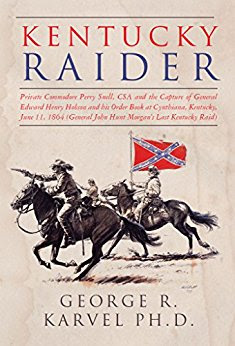
Book Review: Kentucky Raider by George Karvel, Ph.D


Author: George R. Karvel, PH.D.
copyright 2016
CreateSpace Independent Publishing Platform


The subject of my next book review is another book that discusses Kentucky in the Civil War. Even though this volume is not specifically about Kentucky, the story it tells is of a Kentuckian and of raids and battles throughout the Commonwealth, focusing on the raids of famous Confederate General, and Kentuckian, John Hunt Morgan.

Commodore Perry (C.P.) Snell, the great-great grandfather of the author joined the 2nd Kentucky Cavalry, under Morgan's command, in mid-1862. He served for the next three years, surviving Morgan's Christmas Raid, Great Raid and Last Kentucky Raid, as well as two instances of being captured. He was able to escape his captors and return to his unit both times, though his name confused Federal soldiers who thought "Commodore" was a title not a name. Snell apparently provided a false name as "Charles P.” more than once, perhaps to avoid this confusion. His name shows up as this "nom de guerre" in more than one official U.S. form. (The author does a good job of explaining the background of Snell's name and how the original Commodore Oliver Hazard Perry had inspired people to name children, including C.P. Snell, in his honor, early in the book.)

This book briefly describes each of the raids in which Snell took part. It is not an in-depth look at the details of these invasions, but that is not its goal. The synopses the author provides of these raids do give good  background information about Snell's experiences and make this book better.

The book is well-written and organized. I did not notice any proofreading errors and the writing style was very readable. It is a quick, informative work.

After discussing Morgan's capture in 1864, the book reaches the heart of this story, the order book that Morgan had captured from Union General Edward Hobson the day before his (Morgan's) capture. It then publishes each entry from this book. Most are short, usually a sentence or two, which makes for rather choppy reading, but this provides real examples of how such officers wrote their
orders. Additionally, the author adds good descriptions for these orders. These clarifications explain the orders and the military situations. This was a very helpful and valuable part of the book, adding an understanding of what the officers were doing and why.

Karvel addresses Snell's military career and his parole at the end of the war,  and then describes  Snell's post war life as much as surviving evidence allows. He tells that Snell found a new love interest during the war, despite already being married, and how he soon divorced his wife when he returned home. He notes that 1870 census records and Snell's will show that Snell had enjoyed good financial success and discusses how this may have happened. He mentions some rumors and family stories that may explain Snell's prosperity, as no official record seems to provide answers. This was an unexpected and fascinating section of this book.

The book includes footnotes listing sources and six appendices of background information on Snell's family history and family military background, a glossary of terms and other information. It also features several helpful maps at appropriate places in the text.

This book is a good, quick read and recounts an interesting story about the captured order book, what information it contained and how it came to the author's family. Morgan and his raids are popular topics for books and discussion, but George Karvel has found a new story to tell about this part of Kentucky's Civil War history. I gladly recommend this book.

Thursday, September 7, 2017

Book Review: Wild Wolf: The Great Civil War Rivalry


Author: Ronald Wolford Blair
Copyright 2015
Acclaim Press
Kentucky in and after the Civil War is a topic that has really caught my attention in recent years, and several books I have read and reviewed have added to my understanding of that era in my home state.

That is true of my latest finished book, Ronald Wolford Blair's Wild Wolf: The Great Civil War Rivalry,  about the author's great-great uncle, Union Colonel Frank Wolford of the 1st Kentucky Cavalry, a.k.a. The "Wild Riders."

Serving as a biography of the author's ancestor, the book starts by featuring the story of Wolford's military career, especially his many dealings with famous Confederate General John Hunt Morgan, before moving onto discussions of Wolford's polical and social beliefs and how he clashed with the goals and actions of President Abraham Lincoln.

The detailed overview of Wolford's military career iincludes his accomplishments as a leader and discusses how his folksy leadership style and manner of giving orders helped him earn his men's admiration. He was certainly no martinet, but earned his men's respect with his manners and fair discipline. His troops fought throughout eastern and central Kentucky and northern Tennessee, including clashes against Morgan's men, before embarking on a long chase of the famed Confederate during his "Great Raid" of 1863. After helping capture Morgan and many of his men, Wolford's troopers fought in the East Tennessee campaign, including the Siege of Knoxville, where they dealt with the usual trials of combat as well as the rugged terrain and bitterly cold weather.

As the war moved into the middle of 1864, the story transitions to one of Wolford's political battles and arrests, as the author describes in great detail Wolford's disputes with the Lincoln administration especially his opposition to emancipation and the use of African-American soldiers. Blair also shows how Wolford fought for civil liberties (particularly his own) such as free speech and speedy trials. Wolford was blunt, forthright and honest in his speeches and letters, not caring to whom his remarks were made or know they might be interpreted as aiding the enemy or hurting the Union cause. These political battles started late in the war and continued in the post-war years as he tried to help return life to how it was in ante-bellum days, particularly in the racial hierarchy in Kentucky society. The book frequently notes that Wolford's attitudes and opposition represented those of a majority of Kentuckians at the time.

Wolford was an intense and determined soldier and showed the same traits in his non-military fights as well, though he kept his focus solely on events in Kentucky. He may not have appreciated the progress the Union war effort had made nation-wide in 1864 and felt that a re-election of Lincoln would lead to more years of bloodshed. Wolford was, understandably, primarily concerned with the situation in his home state and area ("all politics is local" so goes the cliche) and strongly supported George McClellan in the 1864 election because of the way Steven Burbridge and the Lincoln administration were treating Wolford and his fellow Kentuckians.

This work is another valuable look at the complicated, twisted history of Kentucky in and immediately after the Civil War, showing that even a man who made personal and physical sacrifices to help preserve the Union also expressed many sentiments that clashed with his own government in terms of the treatment of slavery and African-Americans as well as interpretation of Constitutional rights and responsibilities. He focused on the civil rights of white Kentuckians, men and women.

The story in Wild Wolf is  similar to the one told in For Slavery and Union, describing how an individual soldier could fight for the Union but end up opposing some of the Union's political goals. It explores Wolford's political career after the war, as he served as a lawyer, state representative, Congressman and held other official positions as he tried to restore the pre-war social order. He also helped veterans and their families receive government pensions decades after the war.

This is a fine book. It does include endnotes and has two large sections of appropriate photographs and maps, which add much to the work. The research that went into this volume is impressive and the amount of material it covers is equally so.The book also includes three appendices publishing Wolford's most controversial speeches and his letter to Lincoln. These were smart additions to this volume.

I am pleased to have read this book and do recommend it to Civil War students, especially those interested in Kentucky, cavalry, John Hunt Morgan and/or political dissent on the Union side of the war. It is a good study of a mostly unheralded and unknown cavalry officer and influential political figure in the native state of both Civil War Presidents, showing another example of the complex and confusing nature of war and politics in Civil War-era Kentucky.