Showing posts with label Campbell County. Show all posts

Tuesday, November 17, 2026

Robert Maddox: His Troubles Continue

In previous posts, I discussed arrests of suspected Confederate sympathizers in Campbell County, Ky., in late 1861.

I followed that up with a deeper look into the case of one suspected southern supporter who was arrested again in 1862, Hubbard Helm.

This post does the same for Robert Maddox.

On July 1, 1862, the military once again arrested him on suspicion of aiding the rebellion and confined him the Newport Barracks for a day before transferring him to Louisville.

New Provost Marshal Henry C. Gassaway spent much of his term searching for and arresting suspected Confederate supporters, including Maddox, but what led to such suspicions?

 On July 3, Gassaway wrote to Brigadier General Jeremiah T. Boyle in Louisville, the recently appointed Military Governor of Kentucky. He reported that he was going to pick up four affidavits concerning Maddox (Unfortunately, none of them remain in either Gassaway or Maddox' file on fold3.com). 

These testimonies showed him that Maddox was “a man of means" who "has great influence with his money particularly in his neighborhood and uses it freely to effect (sic) his ends. He is a dangerous man to our Government and if he and Yelton are held for some time it will do much good in quelling outburst among the Rebels in this county.” (Jesse Yelton was another accused southern supporter under arrest.)

Maddox again remained imprisoned for months. On the 4th of August, 93 Kentucky political prisoners at Camp Chase, 27 (29% of the total) from Campbell County alone, signed a letter to Kentucky Governor Beriah Magoffin asking him to have the state legislature help them. They had been “brought here by the force of arms, against our will and consent, in violation of the laws of Kentucky and the laws of the United States.” Robert Maddox was one of the signatories. 

Furthermore, these men complained that they were “confined and restrained of our rights and liberty that we are justly entitled to,” and again vowed that they were “law-abiding citizens” and “had not violated laws” of either Kentucky or “our common country.”

Their government proved unwilling or unable to help, and nothing happened.

On October 23, Ohio governor David Tod wrote to commanders at Camp Chase, requesting Maddox’ parole so that he could seek medical treatment in Columbus. 

Maddox signed a Parole of Honor, on October 15, 1862. He pledged his honor to report to Columbus, Ohio for medical treatment and not to leave there without permission from either Governor Tod or the commander at Camp Chase. He promised to report to the governor at 10:00 every morning and neither commit hostile acts against the U.S. Government nor aid the Confederacy.

In ten days from October 15th, he would report in person to the commander of Camp Chase. 


He complied with these orders and on November 8 signed a Release form that listed him as 44 years old, standing 5 feet 11 inches tall, and featuring a light complexion, light hair, and blue eyes. His facial hair was also of light hue. 

He then returned to daily life. In February of 1863, he was chosen to be a delegate at a Democratic conference in Frankfort.

——

This was not the end of his trouble with Union military leaders. 

On August 7, 1865, statewide elections took place, but in Campbell County military interference in the voting was the dominant topic, eventually leading to the voting being voided and then redone in the following February.

On this election day, Maddox was traveling to Cincinnati with a wagon full of pears to sell. He stopped at the Cold Spring blacksmith shop, which happened to be close to the polling place, to have his horse shod. He may have attempted to vote at the same time, but even if not, Captain J.W. Read of the 53rd Ky. Infantry arrested him. 

A story described Maddox as a native Kentucky who had never cast a vote outside of his home state. He was a legally qualified voter at the Cold Spring precinct, at least per the law at the time. Even General Palmer's order (issued on July 26, 1865, it was the edict that began the controversy around the 1865 election) should have protected Maddox, per the author, but Read "abused him most famously" simply because Maddox had been a Democrat. [Cincinnati Enquirer March 15, 1866]

Read also sent troops to arrest John McHatton, who was a tenant of Maddox. The captain was serious about limiting who voted. 

Fortunately for Maddox and his tenant, one of Read's superior officers released them the same day, but trouble still followed Maddox. 

On Saturday August 12, Read, perhaps miffed at being overruled, traveled to Maddox' home, removed him his bed, where he was lying sick. He took him to a local church where Read apprehended another man (Charles Murnan, an old resident whose story seems to be quite fascinating. Perhaps its worth another research project, but his obituary claims he had shook Lafayette's hand back in 1824 and had helped set up the state's old Constitution. It also states he had voted Democratic in every election, certainly the information Read had gathered). Read had the two men transported to Covington, in neighboring Kenton County, ordering them not to leave Campbell County soon. 

At some point not recorded, the men were set free and returned home.

Maddox' initial release had come via an order General John M. Palmer, who announced: "in substance as follows: 'That abundant evidence having been produced that said Maddox used his influence in getting men to join the Federal army is hereby released and his bond annulled."

This seems unusual for a supporter of the Confederate case, and a local newspaper noted the same, reporting "A great many Union men hereabout are anxious to know who testified before General Palmer that Mr. Maddox ever induced anyone to the Federal army.” They asked the newspaper to pose that question, obviously in disbelief of the story. [Cincinnati Daily Commercial, 8-26-65]

More than two dozen Campbell County men had been indicted for their actions during the 1865 election, but Governor Thomas Bramlette had pardoned them before they even faced trial. Local politician R. Tarvin Baker, who had also benefitted from military assistance in the polling, had encouraged Branlette to take this action, but had forgotten about Read's actions toward Maddox and Murnan, so Read was put on trial for those incidents. Read was convicted and fined $2,000.

After all this trouble, Maddox' name appeared on a list of 19 Campbell County men who sued Gassaway and other officials, all seeking $50,000 for false imprisonment. The lawsuits, called the "Camp Chase cases" in one account, bounced around in the court system for years. The last known mention of the suits was in the Cincinnati Daily Enquirer of December 11, 1867, which noted that the case was continued again, in the United States District Court in Covington.

Maddox continued participating in local Democratic politics. In the summer of 1866, he attended a meeting to select the party's Congressional candidate in the summer of 1866. [Cincinnati Daily Enquirer, August 22, 1866]

In February 1866 he went to another political meeting, this one in his hometown of Cold Spring, where he had faced the election day troubles a few months previously.

Adversity continued to find him. In February 1866, he went to another political meeting, this one in his hometown of Cold Spring, where he had faced the election day issues just a few months previously.
The meeting must have been a contentious one. Maddox “received two severe blows over the head from a cane in the hands of TJ Shafer,” who was convicted in court and given a fine as his punishment. 

Maddox then sued his attacker and won a verdict for $1,000. [Cincinnati Daily Enquirer, November 4, 1867]

After all these issues during and right after the war, Robert Maddox disappears from the spotlight, his life no longer documented as much as in the years 1861 -1865. This obscurity likely made him more than a little bit happy and perhaps brought him some peace and quiet.

Sunday, November 8, 2026

Hubbard Helm's Troubles Continue in 1862

Former Campbell County, Ky., sheriff Hubbard Helm was no stranger to being arrested, as a previous post, about late 1861 Campbell County discussed.

1862 only added to this familiarity.

On July 19 of the new year, Union authorities, led by Provosty Marshal Henry C. Gassaway, arrested Helm, the third time this had happened.  They initially placed him in the Newport Barracks for more than a week, then transferred him to Camp Chase, near Columbus, Ohio. He was but one of numerous Campbell Countians arrested during this summer. 

These political arrests sometimes seemed arbitrary, but Gassaway did not act without reason, at least in his mind. Two local men gave him sworn statements about Helm on July 29, both putting the suspect's loyalty in questionable light.

Joseph Mariana acknowledged that he knew Helm. He stated the time the news arrived here of our forces having taken Fort Donaldson. He was talking with some union men at Barlow's Corner. He appeared to be excited. He stated that the news about Fort Donaldson being taken was a damned lie and any man that took that up was a liar and a Son of a Bitch. When news came of the defeat of the Federal Troops, he seemed to be elated and gratified. His manner and conduct as I have frequently witnessed it showed that he was the enemy of the Government and that he desired the success of the Southern Confederacy.

The comment about the "defeat of the Federal Troops" may have referred to a false report about the battle that Helm and/or others had heard. For instance, the Cincinnati Enquirer of February 14, 1862, reported that some local men claimed that US Grant was surrounded and "in imminent danger of being captured, together with all his army." Helm, Mariana, and others may have heard this or similar rumors, not unheard of when people (like even still today) were so anxious for news that they were liable to believe anything they heard. Reports of Confederate success would not have been unusual at this stage of the war.

Another man, James Perry, was acquainted with Helm and gave similar testimony as Mariana. Perry asserted that he had heard H. Helm swear that he was a Rebel and that we had no government. He said the Constitution was gone and we have no Constitution. At the time of the news of Fort Donalson arrived he was quite excited and said any man that said Fort Donaldson was taken was a damned lying Son of a Bitch. He expressions were all against our government.

These accusations, and perhaps others, provided Gassaway reason enough to act.

At Camp Chase, Helm was among 93 Kentucky prisoners there - a startling 27 just from Campbell County - who signed an August 4 letter to Kentucky Governor Beriah Magoffin asking him to have the state legislature help them. They insisted: “We were brought here by the force of arms, against our will and consent, in violation of the laws of Kentucky and the laws of the United States.”

They had been “confined and restrained of our rights and liberty that we are justly entitled to,” and repeated that they were “law-abiding citizens” and “had not violated laws” of either Kentucky or “our common country.”

Magoffin proved unable to provide the assistance they needed. 

--

On October 8, Ohio Governor Tod sent a note to a Major (name illegible) at the camp:

"Sir You will parole H.D. Helm a prisoner at Camp Chase to this city for 40 days upon the usual terms and conditions on account of his health."

On that same day, Helm signed a "Parole of Honor” form as a political prisoner of war. He promised that he would immediately go to Columbus for medical care, "and will not leave there without special permit" from Tod or the commanding officer at the camp. He agreed to report to Governor Tod at 10:00 every morning until told otherwise.

Helm further swore that he would do no "act of hostility" and would not "furnish any aid nor information" to the Confederacy. He agreed to return to Camp Chase after ten days and acknowledged that this parole was "granted on account of ill health."

On October 25, still in 1862, the Cincinnati Daily Enquirer reported that a group of unnamed "active Union men" of Newport were working on a petition to have Helm released. At this point, "The paper has received many signatures."

Those efforts may have helped. On that same date, the state's Judge Advocate sent a telegram to the commandant of Camp Chase: "You will parole HD Helm to go to Campbell Co Ky and return to your custody again within forty days by order of Secy. of War"

Helm signed another parole document on the 26th, this one stating that he would, without delay, return to Campbell County and not leave there without special permission from Governor Tod or Camp Chase's commanding officer.

He again agreed not to do anything to hurt the Union cause or aid the Confederacy "and in Forty days from this date" would report in person to the commander of Camp Chase.

This parole was per an order from Secretary of War Edwin Stanton.

—

On April 10, 1863, Helm received his complete freedom. He vowed that, after his release from the prison camp, I will immediately report in person to the Federal Military Commandant at Newport, Ky., and will thereafter, during the present rebellion, do no act of hostility against the Government of the United States, nor furnish any aid or comfort to the Enemies thereof.

This allowed him the freedom to leave Newport without special permission. He also no longer needed to report to anyone once he had visited the military leader in Newport.

This release was following a War Department order. This form announced: "H.D. Helm of Newport, Campbell Co. Ky., a political prisoner, is hereby released from custody on his parole of honor as above."


Eighteen days after signing his parole, he sent a letter asking for an official copy of his parole form for his records. 

He made it through the rest of the war unscathed, but in 1864 his name appeared on a list of Campbell County men drafted into the Union military. Whether the irony of his name on that list generated any conversation is unknown, but, perhaps needless to say, he did not serve in the Union army. 

He had not forgotten the treatment he had received. He was one of 19 Campbell County men who sued Gassaway and other officials, all seeking $50,000 in damages for their false arrests.  These lawsuits, called the "Camp Chase cases" in one account, bounced around in the courts for years, with the last mention I've found so far in the December 11, 1867, Cincinnati Enquirer, which state the cases were continued again in the U.S. Circuit Court in Covington, Ky. 

Hubbard Helm passed away September 15, 1885, when he fell from a wagon in Cincinnati. He was buried in Evergreen Cemetery in the same county where he had experienced so much in his 63 years.

I'll soon discuss Robert Maddox, the man arrested alongside Hubbard in late 1861, in an upcoming post, but I just found some new information about him that I need to review and perhaps add.

Friday, September 25, 2026

An Evolution on Abolition: The Growth of George P. Webster

Some people continue to grow throughout their lives, even in adulthood, including in attitudes and perspectives. Such change is often so subtle that it goes unnoticed, but for some public figures, it is very visible.

One such example in the Civil War era is that of George Parmelee Webster. (Not the Colonel George P. Webster who died at Perryville.)

Webster, a Connecticut native, was a 49er, a lawyer, and, as secession arrived, a prominent Union supporter in Campbell County, Kentucky, making speeches and attending Union meetings throughout the area. He soon won a spot in the Kentucky legislature but resigned it to accept a position as an assistant quartermaster of U.S. Volunteers, for which he was stationed in nearby Covington, giving him opportunity to deliver other local addresses on occasion. This variety of experiences took part in the first half of his life, establishing his pattern of movement and a willingness to try something new that he kept for the rest of his years. His whole story is one of my favorites but is much too long to share here. One piece of his story, however, intrigues me - how his views of a controversial issue of the time changed during the war.

Newspaper stories describe a scuffle involving him in Newport on November 9, 1856, which, not coincidentally, was Election Day.

Webster had previously been a member of the Know-Nothing Party, but by the time of this election had become a Democrat, a change that did not sit well with his former colleagues.

As he went to vote, some nearby Know-Nothings yelled slurs at him, calling him various names. He feared for his safety and tried to back away, but someone struck him from behind while another rioter fired gunshots, though missing everyone. More insults and threats then came his way. Tension was high.

At one point, one of his antagonists loudly cheered for Republican Presidential candidate John C. Fremont in Webster’s direction. He intended it as a joke, but Webster (a supporter of Stephen A. Douglas) was in no laughing mood, responding: “That’s right. G_d D__n you; hallo for the man you like best. You are all d____d Abolitionists, and if you were in Ohio you would vote for Fremont!”

This mess eventually calmed down with no injuries (or even arrests) occurring other than perhaps some hurt feelings. Webster’s role in this fracas showed his opinion of abolitionists at that time.

After the Civil War had raged for half a year, Webster, a fervent pro-Union man and a frequent speaker at public meetings since the dawn of the secession crisis, spoke again at a gathering in Newport on October 6, 1861.

Abolition was a part of this discussion, but this time, instead of using that word as a slur against its supporters, he simply, “denied that the present war is waged for the extermination of slavery, but for the maintenance of the Union and the Constitution.”

This was not a radical change but actually showed that Webster now held a view similar to President Abraham Lincoln’s administration. That he spoke civilly on this subject on this occasion demonstrates a change in his approach since 1856. Had he used this opportunity to condemn abolitionists, as in 1856, the newspaper would have noted that, but it made no such critique.

In the next two-and-a-half years, he made his larger shift on this topic. On February 8, 1864, he appeared at an abolition meeting in Newport, at which he and another speaker, local abolitionist and lawyer Ira Root, “made strong anti-slavery speeches.” Both men were “in favor of the enlistment of negro soldiers in Kentucky.” 

Abolition was still not a popular idea in the slave state of Kentucky, but the use of African American troops was at least equally as controversial if not more so. Making such remarks in a public setting showed moral courage on Webster’s part and signaled how his attitude toward abolition had evolved drastically in the past eight years.

Following the war, he moved to St. Louis briefly, then headed to New York, where he later won a spot in that state’s legislature. At some time, maybe even before the war ended, he officially became a Republican, but just before 1890, he reverted back to being a Democrat and joined the infamous Tammany Hall organization.

He never achieved fame nor glory during his busy life, but he never stopped looking for new ventures to attempt and vocations to pursue. His life was among the most interesting stories of Campbell County in the Civil War that I've uncovered, but the growth he showed in regard to his perspective on abolition stands out as a noteworthy nugget from his life.

Thursday, July 9, 2026

The Arrest of James Digby Part 1: Setting the Scene

This was supposed to be a short, quick story about Union authorities arresting a southern sympathizer in Campbell County, not an unusual tale in the Commonwealth, but a topic I have not  yet explored much during my research or on this site. 

I started this story and it was going well, but I decided to add context about the local situation as the war arrived. I found an approach I liked but then kept going down rabbit holes of ideas and topics relevant to the subject, finding perspectives I had not considered and information I did not know, and suddenly this grew into a much longer project, leading me to split it into two parts. I think this is the best way to tell this story. 

One other decision I made was to omit citation numbers and endnotes as I feared they would be distracting and only make this post longer. Most sources are the various Cincinnati newspapers. I have included a few links and one mention of a book that provided valuable context. I hope this arrangement works out well.

This first part will focus on Campbell County and its relationship with slavery and abolition as the war approached while part two will discuss the arrest that initiated this project.

—

Kentucky, of course, was a border state in the Civil War, a slave state next to sister slave states like Virginia, Tennessee, and Missouri, while also alongside free states Ohio, Indiana, and Illinois, with West Virginia soon joining that latter group. The Bluegrass State was snuggly in the middle of the separate sections, caught between two differing worlds.

Campbell County sits at the top of the state, its eastern and northern borders along the Ohio River, just a few hundred yards from Ohio. It was truly a "border county in a border state.”

From 
https://en.wikipedia.org/wiki/Campbell_County%2C_Kentucky#/media/File%3AMap_of_Kentucky_highlighting_Campbell_County.svg

Like its home state, which famously attempted to remain neutral, Campbell County found itself in a conundrum when the Civil War came. Families of both northern and southern backgrounds had settled here, as had immigrants from Europe, especially Germany, mirroring the state’s awkward position. Its access to the Ohio River connected it to distant parts of the state - where different cultures, topography, and economies, including the reliance on slavery, existed - as well as to other states both free and slave. The Licking River on the county’s western border served as a route from further south and east all the way to the Ohio River. (I jokingly call it the Campbell County Peninsula.)

Economically, its position along the Ohio River was vital to the state, which “depended heavily on northern trade.” For instance, “ferries from Cincinnati made over 1,000 weekly crossings.” Campbell County was a natural destination for such deliveries.

On the other hand, as that link shows, Kentuckians in general “disagreed with the South’s anti-tariff policy, valuing manufacturing more than most southern states.” Despite this difference, the state did share one important trait with the Deep South - “slavery was vital” to its economy. Kentucky was like the rope in a game of tug-of-war, pulled in opposing directions by northern and southern economies and laws. That role would continue into 1861 and 1862.

The future of that peculiar economic, political, and social institution was a frequent matter of national debate over much of the nineteenth century - would it be maintained only where already allowed, banned from new lands, completely abolished everywhere, or expanded and legalized everywhere? Entire political parties formed and/or dissolved over the decades due to their stances on such contentious issues.

Slavery was, of course, legal in Campbell County, yet was far from a dominating presence. In 1860, the 115 slaves in the county were 62 fewer than at the previous census, and the 0.55 percent of the county's population of 20,909 that slaves represented was the third lowest rate of the state’s 109 counties.

By contrast, Kentucky in that same year held a population of 225,843 slaves, who made up 19.5% of the state’s total population, 35.5 times more ubiquitous than in Campbell County, a significant difference.

As those numbers show, slavery was alive but not thriving in Campbell County as the 1860s began, but the low number of slaves was not because residents disapproved of human bondage. As one local historian puts it, this county was in no way “a bastion of abolitionist sentiment.”

A series of incidents in 1859 - mostly local, but one of significant national concern - revealed the distrust and dislike many locals held towards abolition. Additional happenings in 1860 and early 1861, however, may have had led to some questions or re-thinking over slavery’s effects even on free people in free states.

This was an eventful era in Campbell County.

—

William Shreve Bailey was a native Ohioan who in 1839 had moved to Newport, where he purchased a newspaper in 1850. 

He first grabbed the attention of slavery’s supporters the following year when he added an “abolitionist tone” to his writings, escalating his rhetoric, not a popular tactic in a slave state.

By October of that year, he had agitated enough locals that a group soon "burned the store and residence where Bailey was publishing.”

Bailey and his family survived this attack, then local friends and citizens raised money to enable him to resume his publication. He pressed forward with life, even as he faced other challenges in the remainder of the decade. Of course, nationwide debates about slavery also continued.

As the 1850s marched forward, and the nation’s slavery dispute unknowingly approached a cataclysmic end, Bailey named his newspaper The Free South, setting the stage for an experience reminiscent of the 1851 affair, bookending his decade with turmoil.

His journal, “the only Republican newspaper in the state at the time,” maintained its anti-slavery theme, but a violent event in Virginia shocked the nation, frightened slaveholders, and refocused local attention on Bailey and his writings.

In the middle of October 1859, radical abolitionist John Brown led a raid on Harper's Ferry, an attempt to arm slaves to fight for their freedom, resulting in the deaths of several  of Brown’s followers and his eventual execution. This failed uprising alarmed slavery’s supporters, including those in Campbell County. Bailey was an obvious target of the strong emotions Brown had stirred.  

John Brown

The Cincinnati Enquirer of October 29, 1859, described local reaction to Brown’s raid.

It can not be denied that the Captain Brown insurrection case, now being tried at Charleston, has had its affect upon the people every-where in the South. The statement made in the examination of Brown and his confederates, that an outbreak of the same kind that occurred at Harper’s Ferry would be commenced at the same time some-where in Kentucky, led some of our citizens to believe that it might occur at Newport Barracks, and they have been on the qui vive for such an outbreak ever since. 


Newport Barracks, behind the Ohio River

In connection with this matter we will state that there has been published in Newport for the past several months a paper entitled the Free South, the proclivities of which have been decidedly Black-Republican, and since the late outbreak of Harper’s Ferry, a portion of our citizens have been of the opinion that Mr. Bailey, who is publishing said paper, was in some way connected with the movement, and they have felt that some approval or disapproval should be manifested on the occasion.

Last night the fire-bell rang, and in a few minutes after a large number of our citizens assembled at County-house Square, to see what it meant. Some one suggested that they should go down to Taylor-street and “move” the press of the Free South and following that suggestion a party started down to the office. 

Arriving there, some fifteen in number, they went up into the office, took the forms on the press for the printing of to-day’s paper, and moved them into the street, all of which was done very quietly, and then made an attempt to move the press, which proved too heavy for them. Finding they could not move the press, and after distributing the “forms” of the paper, the crowd advised Mr. Bailey that he had better move his office to the opposite side of the river, and if it was not done within the course of fifteen days, they would do it for him. 

Over two days and nights, the mob eventually succeeded in destroying Bailey's press, then demanded he leave town, but he refused to do so as he gathered weapons to defend his office. He continued to print his views until authorities arrested him under the charge of publishing “incendiary” articles.

Local supporters again came to his rescue, bailing him out of jail as he awaited trial. They sent him on a tour of Europe, where he continued speaking on slavery. He was gone so long that his criminal trial was postponed until his return, but the arrival of war led to its outright cancellation, giving the anti-slavery faction a small victory in a much larger fight.

Bailey then moved his operations to Cincinnati.

—

Three weeks after the attack on Bailey’s newspaper, anti-abolition agitation was again in the news. 

In mid-November, Dr. J.R. Whittemore, a Newport Republican and candidate for Congress, received a letter in the mail and had it published in the newspapers.

Sir, the citizens of Newport have decided that they will no longer permit any person to promulgate such “principles” as you and your brethren in the cause of Abolitionism have been promulgating for the last four years in their city. Therefore, you are hereby notified to leave the city of Newport on or before the first day of December, 1859. Otherwise, you must abide the consequences of your own folly and obstinacy, which, we assure you, will be serious. DETERMINED CITIZENS  

In contrast to that letter’s insinuation, other sources described Whittemore’s reputation as that of “a good citizen” and a “quiet gentleman” who was not “one of the Abolition stripe of politicians” and had “never waged war” against slavery other than wanting to stop its expansion into new territory. Despite that gentle touch in his social and political lives, at least this one anonymous writer was convinced that he was among the group of anti-slavery zealots.

Two other dramas played out in public, bringing slavery and its potentially far-reaching effects to the forefront. 

In August of 1859, shortly before those public controversies, a young and free man named James Waggoner was kidnapped in Cincinnati (in an ostensibly free state) and brought against his will to Campbell County (in an unquestioned slave state.)

Newport officials discovered his presence, and quickly placed him in jail to investigate his status, initiating a fatiguing year-long saga.

The case dragged on, with Waggoner trying to escape his cell at least twice, and in mid-1860, Newport Mayor Edmund Hawkins, in charge of the trial, (and himself the largest slaveowner in the county, with ten pieces of  human property), ruled him a slave. The city then sold him at auction in Alexandria to Dr. John Q. A. Foster, Newport’s postmaster. The court had issued an injunction to stop the sale, but Foster had made his purchase before that ruling reached him, though what he knew and when he knew it became a point of contention. Foster hid Waggoner from pursuers trying to stop the sale, and soon thereafter tried to resell his property for a profit in Lexington, but no acceptable offer was forthcoming. 

As this was going on, newspapers claimed that "public sentiment" in favor of Waggoner was growing, and that it "demanded fair play." Once Foster learned of skepticism over the handling of the Waggoner affair, he agreed to return the man to Newport for a more thorough investigation, restarting the legal process. At least one paper speculated that the public's interest in Waggoner's welfare and treatment had influenced Foster's decision.

Brown's raid was months in the past by this time, but it remained influential. It had “made some excitement” before the arrest of the kidnappers, but after the attack on The Free South, the “slavery feeling became so excited that the Newport witnesses would not attend” the trial for the kidnappers in Ohio. Even residents not directly involved in slavery and/or abolition, were influenced by these issues that clouded the nation's future.

After more legal back-and-forth, with continuing detailed newspaper attention and commentary, another trial took place, and a second verdict arrived. On August 17, a year after the kidnapping, Judge Samuel Moore announced:

“From the proof in the case there can be no doubt, but that plaintiff is a free man, wherefore it is adjudged that the injunction be perpetuated, and that any sale of plaintiff be taken for naught; that he may be released from custody and enjoy his freedom in some other country than this Commonwealth” (emphasis added). 

Even a court ruling in favor of liberty left Waggoner unwelcome in Campbell County, or Kentucky itself. Waggoner returned to Ohio, probably happy to do so, closing this difficult chapter of his life.

This is a basic summary of the main aspects of the Waggoner case. For a more detailed account, see the book I am a Free Man by Shirlene Jensen, available at that link or at the Campbell County Historical & Genealogical Society office.) 

On January 15, 1861, an incident unrelated to slavery, but that was a result  of the political atmosphere in the county caused a local stir.

On that day, the “Union-loving portion" of Newport residents planned a ceremony to fire 100 shots in honor of Major Robert Anderson and the Union. 

A local artillery unit, using two guns Kentucky Governor Beriah Magoffin had sent, was about to begin the firing when Dr. John Foster, who had purchased Waggoner the previous summer, waited until the last second before running to the flagpole and cutting the lanyard, stopping the raising of the U.S. flag. Foster declared that this was a “Bell and Everett” pole, and that he, a proponent of those candidates in the recent Presidential election, would allow “no stars and stripes” to hang from it in his presence.

Foster moved quickly, catching onlookers by surprise, and almost immediately after he cut the cord, the cannonade started. Because of the timing and noise of it all, “no one resisted the act,” as it happened, though a few moments later, attendees realized what they had seen and “were loud in their denunciations” of the doctor, with some attendees even demanding Foster be lynched. 

News of this event quickly spread. “There is no mistake but the affair has created a great sensation in the quiet city of Newport.” Days later, a jury convicted Foster of breach of the peace an On January 15, 1861, an incident unrelated to slavery, but that was a result  of the political atmosphere in the county caused a local stir. 

On that day, the “Union-loving portion" of Newport residents planned a ceremony to fire 100 shots in honor of Major Robert Anderson and the Union. 

A local artillery unit, using two guns Kentucky Governor Beriah Magoffin had sent, was about to begin the firing when Dr. John Foster, who had purchased Waggoner the previous summer, waited until the last second before running to the flagpole and cutting the lanyard, stopping the raising of the U.S. flag. Foster declared that this was a “Bell and Everett” pole, and that he, a proponent of those candidates in the recent Presidential election, would allow “no stars and stripes” to hang from it in his presence. 

Foster moved quickly, catching onlookers by surprise, and almost immediately after he cut the cord, the cannonade started. Because of the timing and noise of it all, “no one resisted the act,” as it happened, though a few moments later, attendees realized what they had seen and “were loud in their denunciations” of the doctor, with some attendees even demanding Foster be lynched. d fined him $20.

Compared to the violence of Brown's raid and the attack on Bailey, this was a minor incident, but it showed the potential for trouble as tension among opposing loyalties grew.
—
Three months after the disrupted ceremony and just eight months after the Waggoner drama had concluded, another episode of “Slave or Freeman?” found its way to Newport, ending just two days before the firing on Fort Sumter.
A

Eve
(

On April 4, 1861, a white man arrived in Newport, accompanied by a young African American named Chancellor Livingston.

Curious bystanders noticed the unknown duo and approached them, soon finding a chance to speak to Livingston, who insisted that he was not a slave, and that he could provide evidence of his freedom. The bystanders, perhaps recalling the Waggoner story, suspected this was a kidnapping and sent for police.


City Marshall William Bennett arrived shortly and spoke to Livingtson, leaving his companion with a deputy as he attempted to learn what the two men were doing in Newport.

Livingston, about 20 years old, again swore he was not a slave. He stated that the other man, whom he called Jones, had tricked him into leaving New York by promising him work. One account said the job was supposed to be in Ohio, a free state, but another stated the duo was going to Kentucky, which Jones had convinced his victim was also a free state.

The marshal then turned his attention to the alleged kidnapper, but he had escaped the deputy's careless watch. Local attorney Albert S. Berry (a future Confederate soldier) was nearby and said that the man was supposedly in his office. When this group arrived there, the stranger had vanished again. 

While the search for Jones proceeded, the not-so-hospitable authorities “lodged” Livingston in the Newport jail, where he awaited a court hearing.

This situation with Livingston was obviously not Newport’s first experience in the contest between servitude and liberty, and because of the previous case of “tampering with the rights of free negros,” the city found itself rather “desirous” to bring this new case to a quick end. Even a city where slavery existed was tired of such moral and legal dilemmas.

George Webster, who had worked on Waggoner’s behalf, now represented Livingston before Mayor Hawkins. He presented the key evidence, an affidavit from a Lockport, New York resident whose testimony provided a “description of a negro named Chancellor Livingston, who had recently vanished from that place, and as the description corresponded with the defendant in Court.”  

Hawkins weighed this information and on April 10, pronounced Chancellor free. He also ordered Marshall Bennett “to give him a safe transit to the opposite side of the river,” (emphasis again added) to Ohio, as, like with James Waggoner, this free African American was not welcome in Newport.

Livingston, now officially free, went “on his way rejoicing,” preferring not to stay in the slave state of Kentucky, even had the choice been his. 

As a postscript to this case, a local man had raised money “sufficient to pay his [Livingston’s] expenses home.” That some white Campbell County men were even willing to pay to remove an African American from their presence speaks loudly. Despite the sympathy felt for Waggoner and the assistance given to Livingston, the results of these cases confirm that local attitudes on race had not evolved much. Even indisputably free men were escorted out of the state.

—

Thus stood the Campbell County scene as the Civil War arrived - a cocktail of slavery’s supporters, combined with few actual slaves, blended with even fewer vocal abolitionists, all assembled among a silent majority who took no public stance, forming a fitting mixture of perspectives in this land on the border of freedom and slavery.

How would such a mash-up handle civil war, and how would civil war handle it? The story of James Digby is a fair representation of Campbell County during the early war years. 

Part two, He Could Whip any Linconite, will follow shortly.

Friday, April 4, 2025

"Due to Despondency:" The Life and Death of Edward Riley, 8th Kentucky Cavalry

Immigrant Civil War soldiers in Campbell County has become one of the unexpected stories that my research has uncovered. I readily admit that surprise may be my own fault, and my original expectations should have been more accurate. Immigration to the U.S. was a common occurrence in the nineteenth century and my previous Civil War reading has often discussed immigrant soldiers, frequently of German heritage, but it took my digging into this project for me to connect that national trend with the local situation. In hindsight, I should have known that soldiers born outside of the United States would constitute a significant part of my research. Oh well. Live and learn.

I mention the idea of immigration because this story is about another local soldier with an European past. Edward Riley was born in Ireland about 1830 or 1831.

After arriving in the United States, Edward had found a home in Newport, Kentucky by 1860, when he worked as a pattern maker. He lived with his wife Mary and their pair of offspring as of that year’s census, and was listed as 29 years old.

The Civil War broke out in April of 1861, but Edward waited some time before joining. Perhaps he thought the war would not last long, or his family did not want him to enlist, but he eventually overcame any hesitation and decided to join in the fight.

He enlisted in John Arthur’s cavalry company on August 14, 1862, in Newport. Arthur had been part of a three-month Ohio regiment, then had led a local home guard unit, before finally recruiting his own company. Edward joined this new company for a term of one year and paperwork showed him as 30 years old. He mustered in on September 13 in Henderson, Kentucky. He signed up as a private and served as the company’s farrier, ensuring that the unit’s horses had hooves and shoes that were in good enough shape to perform their duty.

The company Edward joined consisted of 103 men, who had the pleasure to enjoy a “fine dinner” that local women prepared for them in the engine house on York Street1 before their departure for war. (Additionally, Captain Arthur had found it necessary to reject twelve other men who attempted to join the regiment after it had reached its quota and filled.)2 The men soon departed on the steamship Florence traveling first to Louisville, from where they were to move to Eminence, Kentucky, “where they will go into camp for a short time.”       

The men arrived safely at Louisville and settled into camp near there but soon learned they would now be joining the 1st Battalion of Colonel James Shackelford’s 8th Kentucky Cavalry.3

This regiment, officially organized at Russellville, Kentucky, mustered in on an August 13, a few weeks before Edward was officially added to the roster.

In mid-September, a Cincinnati newspaper reported that one man, whom it described as a soldier in the company, though his names does not appear on the roster, had returned to Newport and reported that these men were in “excellent health and spirits” in Henderson and that they had received their bounty money after mustering in, certainly good news for them. The boys were now “eager for the fray” like new and innocent soldiers often were.4,5

The 8th Kentucky spent most of its year in the service throughout western Kentucky, helping to chase irregular Confederate soldiers, often labeled “guerrillas” by Union leaders, then in July of 1863 joined in the chase for General John H. Morgan’s Confederate troops as they raided Kentucky, Indiana, and Ohio on what became known as that general’s “Great Raid,” which resulted in many of the southerners being captured at the Battle of Buffington Island, Ohio.6    

Shackelford, a “prominent” guerrilla hunter in the Western Kentucky region, had been promoted to Brigadier General of U.S. Volunteers and to end this raid commanded a group of men who captured Morgan at the Battle of Salineville, Ohio near the end of July.

Edward mustered out of the service on September 23, 1863, in Russellville, and resumed daily life back in Campbell County, where, in 1880 he lived in Newport with Mary and seven children. He was 49 years old and made a living as a stove finisher.

Sadly, life did not always go as he wished and in mid-1888, the former foreman at the Favorite Stove Works company in Newport had “been out of work at his trade, which was that of a machinist, and has been compelled to work on the streets of Newport.” This must have been a tough situation for a proud man to accept. 

About 11:00 on the night of June 8 of that year, Edward’s son Jim walked into the dining room of the family home on Jefferson Street (now called Sixth Street) and “discovered his father hanging by the neck from the wall.” He immediately “raised the alarm,” and his mother and siblings helped cut down the body, which a doctor soon confirmed was lifeless.

His trouble finding regular work had “greatly discouraged him, and his rash act is due to despondency.”7

Edward’s funeral took place on June 10, and “was quite largely attended.” He was buried in St. Stephen Cemetery in Fort Thomas.8

The newspaper reported him being fifty years old, which differs by a few years from other records. His wife and seven children survived him and somehow pressed on with their lives despite such a terrible shock Edward’s death, especially the way it happened, gave them.9

1Cincinnati Daily Enquirer, August 19, 1862
2Cincinnati Daily Commercial, August 19, 1862 
3Cincinnati Daily Enquirer, August 22, 1862 
4Cincinnati Daily Enquirer, September 20, 1862 
5Cincinnati Daily Commercial, September 20, 1862 
6https://www.nps.gov/civilwar/search-battle-units-detail.htm?battleUnitCode=UKY0008RC, Accessed April 10, 2023 
7Cincinnati Enquirer, June 9, 1888
8Cincinnati Enquirer, June 11, 1888
9Cincinnati Enquirer, June 9, 1888


Tuesday, November 19, 2024

Another Distant Campbell County Connection with Perryville

This should be my final post from the Symposium in the Field at Perryville and the wonderful time I had in those few days. This may be more of a personal interest, relating to my research on Campbell County, Kentucky in the Civil War, but I'll go ahead and post it.

While looking at a battlefield historical marker that I have seen so many times, I realized I could make another tiny connection between the battle and Campbell County. 

As the below advertisement from the September 20, 1861, Cincinnati Daily Commercial shows, an ambitious Campbell County man was recruiting volunteers for a company of Kentucky Cavalry. Despite the newspaper’s spelling, his name was Lewis Wolfley (pictured below in his uniform, the photo from findagrave memorial #9747.)  (Recruits should "loose" not time" - oops. :) )


He was looking for men to join Colonel James Streshly Jackson’s 1st Kentucky Cavalry regiment, but as happened so often early in the war, plans changed, though only slightly, and Jackson took command of the 3rd Kentucky Cavalry.

Jackson soon left that regiment, for good reason, as he was promoted to Brigadier General of U.S. Volunteers in July of 1862, and commanded the Union’s 10th Division as it met Braxton Bragg’s Confederates at Perryville, while Lewis served as a captain, then major, in the 3rd for the entire war until his discharge in August of 1865. He then lived a long and interesting life. I’m working on a story on him, but an basic internet searches will turn up numerous hits on his name for those interested.

Wolfley had been recruiting for Jackson’s unit in 1861, so it is possible, perhaps likely, that the two had communicated at least by writing, if not in person.

 James S. Jackson, photo from Wikipedia 

Jackson, unfortunately, did not survive the battle in the Chaplin Hills, as a well-aged historical marker on the Open Knob describes.

Author's photo

These two men, one living in Campbell County and the other from Fayette County, Kentucky had originally worked to find men for the same regiment. Both were politicians for brief periods, with Jackson serving in Congress before the war, and Wolfley serving as Arizona’s governor decades after the conflict. Aside from their political experiences and their work for what became the 3rd Kentucky Cavalry, however, the fates of war took their careers and lives in very different directions.

Saturday, April 6, 2024

Ely Ralls: Veteran of the Mexican-American and Civil Wars


A man of uncertain origins, Ely (or Eli) Ralls was born in March of 1829, but records differ on where he was born, with Virginia, Kentucky, Ohio, and Indiana all appearing as his birthplace on various census records.


Some parts of his life, though are more certain.


In the late 1840s, as the age of "Manifest Destiny" was in perhaps its prime years, he served as a private in company L of the 2nd Kentucky Infantry during the Mexican-American War. On February 22 and 23, 1847, this unit was involved in the Battle of Buena Vista, a victory for the United States that brought fame to General Zachary Taylor, perhaps contributing to his future election as United States President.1 (His decision to join that regiment might suggest he lived in central Kentucky at the time.)

At this battle, “Jefferson Davis’1st Mississippi Rifles, the 2d Kentucky Rifles, the 2d and 3d Indiana, and the 3d Ohio volunteer regiments united in a supreme force.” (Davis, of course, was the future Confederate President.) 

“Never had the salutary effects of combined discipline and leadership of American citizen-soldiers been more convincingly demonstrated than in that desperate two-day struggle.”2 That struggle was part of the American victory in that conflict, a victory that brought a significant amount of land into the United States, an acquisition that only added to the questions about how that land - and the territory already part of the nation, should be governed.

Ely survived the war with Mexico and married Hiley Ann(a) Keethler (possibly Kirchler) in 1849.


By the time of the 1860 census, he lived in Brown County, Ohio, in a full household including his wife and their six children. He worked as a blacksmith.


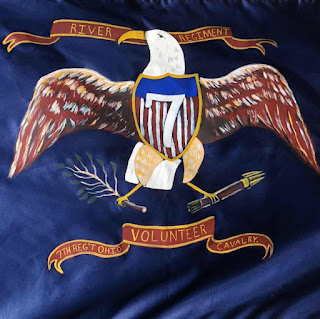
After the start of the Civil War, at least partially due to the unsettled questions that the acquisition of land from Mexico had stirred up into the public's attention, Ely remained at home for more than a year and then enlisted as a private in company E of the 7th Ohio Cavalry on September 2, 1862. On September 27, he was promoted to farrier (a person working with a horse’s hooves and shoes, obviously a vital position in a cavalry unit, and a good use of his blacksmithing experience) and officially mustered in on October 26. 


                                                                        photo from https://www.facebook.com/7thovc    


The 7th Ohio Cavalry had organized at Ripley, Ohio in October of 1862, but, “before the 7th's members were mustered into the service, a detachment of Confederate cavalrymen occupied Augusta, Kentucky, burning much of the town. Company E of the 7th crossed the Ohio River and traveled the few miles downstream to Augusta, driving the enemy from the community without suffering a single casualty.3”


 Ely was in company E and probably with the unit, ready to use his blacksmith and farrier skills if needed, but likely not in the actual combat.


View up the Ohio River along Augusta, author’s photo


In the following weeks, 25 men from that company joined a battalion from the regiment and scouted in the area, winding up in Falmouth, Kentucky, which other Union troops were already occupying.4 

In 1863, the regiment participated in the Union pursuit of Confederate General John H. Morgan and his forces in Morgan’s “Great Raid,” and was present at the Battle of Buffington Island, when many of those Rebels became Union prisoners on July 19.


The men of the 7th Ohio Cavalry moved south to the eastern half of Tennessee and joined in the Knoxville Campaign. On November 6, some of the men of the opposing armies met in a contest known as the Battle of Rogersville or the Battle of Big Creek.


During that fight, the Confederates captured several hundred Union soldiers, including Ely.5


The 1890 Veterans Schedule claims that he spent 18 months in Libby Prison, but that was probably a mistake, as no other reports mention that facility. Also, Libby Prison generally housed Union officers, and Ely was not an officer.


Other records do show that he was a “possible prisoner” at Andersonville.6 


If so, he was lucky to survive that dirty, crowded camp.


The first prisoners arrived at Camp Sumter in late February 1864. Over the course of the next few months approximately 400 prisoners arrived daily. By June 1864 over 26,000 prisoners were confined in a stockade designed to house 10,000. The largest number of prisoners held at one time was 33,000 in August 1864.

The Confederate government was unable to provide the prisoners with adequate housing, food, clothing, and medical care, Due to the terrible conditions, prisoners suffered greatly, and a high mortality rate ensued.

When the war ended, Captain Henry Wirz, the stockade commander, was arrested and charged with "murder, in violation of the laws of war." Tried and found guilty by a military tribunal, Wirz was hanged in Washington, D.C. on November 10, 1865.7

One military record on ancestry.com shows that Ely was paroled but provides no date or other details. If accurate, this could mean he did not spend any time at all in Andersonville (or any other prison) as being paroled meant the Confederates had physically released him on his world of honor not to fight again until he was officially exchanged for a Confederate soldier of similar rank.


Some soldiers did ignore their promises and immediately returned to their regiments, but the lack of details for Ely makes it impossible to know if or when he was exchanged and returned to the regiment.


After the action at Rogersville, the 7th Ohio Cavalry remained in the service and in 1864 saw action at contests like 2nd Cynthiana in Kentucky, various battles in the Atlanta Campaign, and both Franklin and Nashville in Tennessee. 


They also joined in General James H. Wilson’s Raid into Alabama and Georgia in early 1865, as the bloody war was finally nearing its end.


Whether Ely had been present for any or all of the unit’s 1864 battles is unclear, but he did muster out of the service with his company on June 30, 1865, per the regimental roster. 


 In 1870, Ely, Hiley, and their eight children resided in Brown County, Ohio, where he worked as a blacksmith. 


In 1880, he lived in Cincinnati with the family of his daughter and her husband, along with four more of his children and a woman named Ivlanan, which may have been a bungled recording of his wife’s name. He worked as a fisherman. 


He lived on the southern bank of the Ohio River in Dayton, Kentucky in 1890, and remained there in 1900 with his wife and grandson. He still listed blacksmith as his occupation but had been unemployed for all twelve months in the previous year. He was able to read and write.


Ely Ralls passed away at age 78 on November 15, 1907, in Bellevue, Kentucky and was buried in nearby Evergreen Cemetery, where hundreds of his fellow Union veterans also lie at rest.


1https://www.loc.gov/item/today-in-history/february-23/

2https://kynghistory.ky.gov/Our-History/History-of-the-Guard/Pages/The-Mexican-War.aspx

3 https://www.ohiocivilwarcentral.com/7th-regiment-ohio-volunteer-cavalry/

4 https://www.gutenberg.org/cache/epub/31584/pg31584-images.html

5 https://www.hmdb.org/m.asp?m=114918

6 https://www.nps.gov/civilwar/search-prisoners.htm#sort=score+desc&q=Ralls,+eli

7 https://www.nps.gov/ande/learn/historyculture/camp_sumter_history.htm