Showing posts with label Christmas. Show all posts

Thursday, December 24, 2020

Christmas With the Slaves

This is a revised version of a post I made in 2009 but thought was worth sharing again. 

This story appeared in the boom The Civil War in Song and Story 1860-1865 by Frank Moore.

CHRISTMAS WITH THE SLAVES

 A letter writer at Port Royal, South Carolina, gives the following account of the way in which the slaves kept the first Christmas after the Proclamation of Emancipation:


Christmas Eve was celebrated by the colored people at General Drayton's plantation. About half past eleven o'clock a bell was rung, and precisely at twelve a pine fire was kindled in front of the cabin where the meeting was to be held. They called the festival a serenade to Jesus. One of the leaders, of which there were three, was dressed in a red coat with brass buttons, wearing white gloves. The females wore turbans made of cotton handkerchiefs., All ages were represented, from the child of one year to the old man of ninety. 
 

The first exercise consisted in singing hymns and spiriual songs, among which were those beginning, "Salvation! O the joyful sound; ' 'The voice of free grace;' 'Come, humble sinner, in whose breast;' 'O, poor sinner, can't stand de fire, can't stand de fire in dat great day;' and a Christmas song containing a medley of everything the fruitful mind of the leader could suggest, with the refrain, 'We'll wait till Jesus comes.' One of the leaders lined the hymns, and though none of them could read, it was remarkable with what correctness they gave the words. Their Scripture quotations were also correct and appropriate, not only having the exact words, but naming the chapter and verse where they could be found. 
 

After singing for some time, a prayer-meeting was held. The prayers were fervent and powerful, and when an allusion would be made to the soldiers who had come from  their distant homes, in the North country, to 'help and save de poor slave, and, like Jesus, bring dem good tidings of great joy,' a shout went up that sent its notes on the still night air to the distant pickets in the surrounding pines. When asked, as they could not read, how they could quote the Scriptures, they replied: 'We have ears, massa, and when de preacher give out his texts, den we remembers and says dem over and over till we never forgets dem; dat's de way, massa, we poor people learns de Word of God.'
 

The next exercise consisted of speaking and signing, at intervals. While one was speaking, another would take a blazing pine torch from the fire, and hold it up, so that all might see the speaker. At two o'clock, a recess was had, and all were invited to partake of coffee, which luxury they can now purchase without any difficulty, as they have plenty of money, obtained of the soldiers for vegetables and poultry. 
 

After this came what they called the shouting exercise. It was introduced by the beating of time by three or four, with the feet. Soon the whole company formed into a circle, and commenced jumping and singing to the time and tune of

'Say, brothers, will you meet me, 
Say, brothers, will you meet me, 
On Canaan's happy shore?'

This was continued until the most fertile imagination was exhausted, embracing an invitation to sisters, soldiers, preachers, &c., to meet them on Canaan's happy shore. 

Never did these poor slaves celebrate a Christmas Eve under such circumstances before. Whatever may be their future, the are now, 'to all intents, purposes, and constructions whatever' free; that they may 'choose it rather' is beyond question more certain.

Here is a little bit of information about that verse.

What a wonderful Christmas!

Saturday, December 24, 2011

Merry Christmas

courtesy sonofthesouth.net

I know it's kind of a sad image, but this Thomas Nast print from Harper's Weekly of January 1863 is probably my favorite image of Christmas during the Civil War. It carries a very powerful message, and may be a great example of the "a picture is worth a thousand words" cliche. What words could convey this message so simply, yet powerfully?

I certainly hope my readers all have a Merry Christams, or a Happy Hanukkah if that fits your beliefs, and that all will be happier than the couple pictured here. I hope it will be more like the bottom picture, that I found at printsoldandrare.com


Monday, December 12, 2011

Good end to year at the Ramage Museum

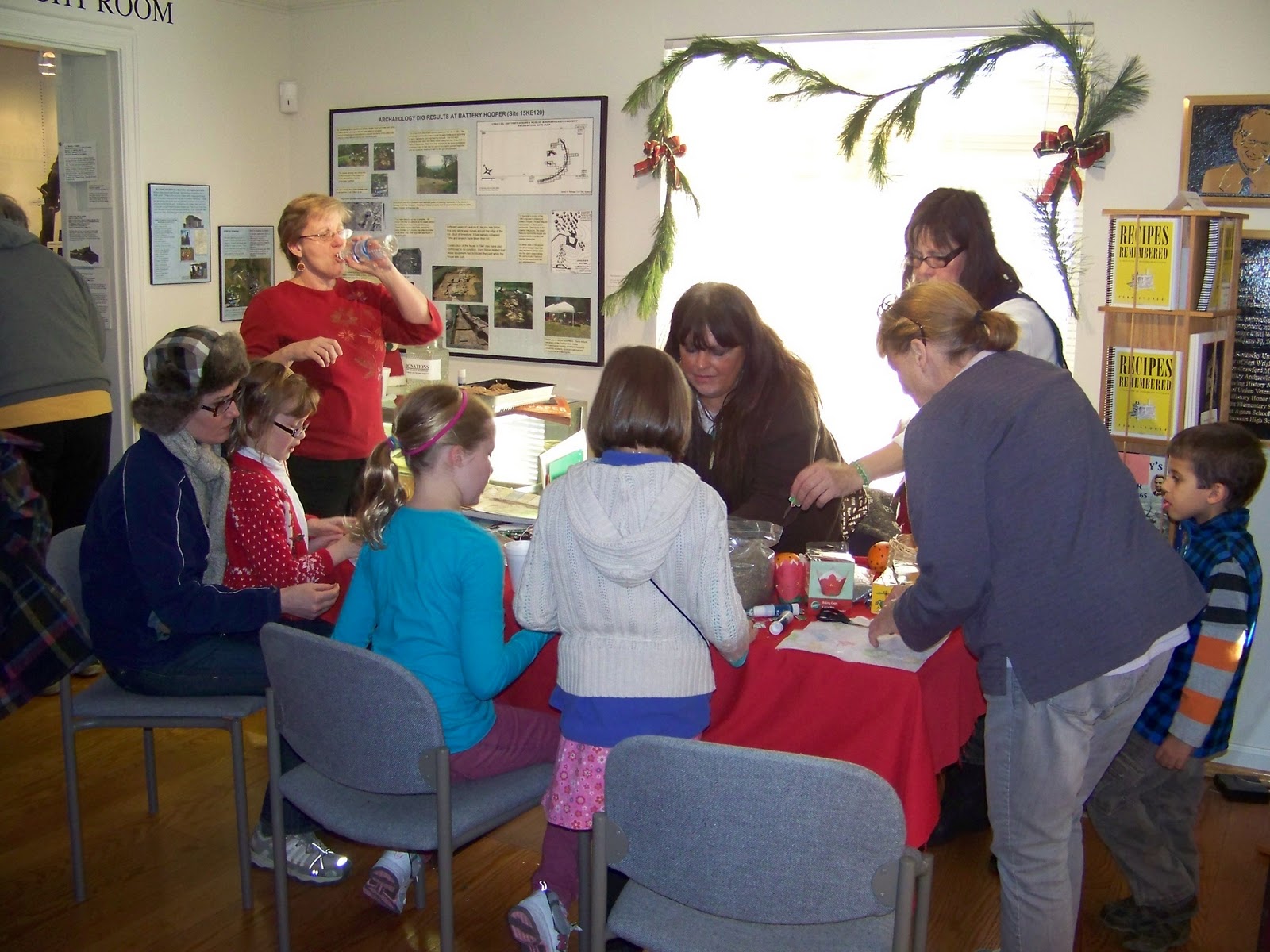
Yesterday we had our annual Civil War Christmas, the event which closes the museum for the year, and this year's exhibit was a terrific success. We had approximately 300 visitors and had a good day of sales through our gift shop and used book sale. Santa and Mrs. Clause were wonderful in entertaining the many kids who showed up, the ornament-making was popular and the dulcimer music, courtesy of Don,  added a great touch to the event. That style of music is perfect for this time of year.

Thanks also to Judy B. for stopping in and showing kids (and parents) how to use ribbon to make ornaments and decorations. Her table was crowded virtually the entire day.

The group of re-enactors who showed up were terrific too, talking to people and demonstrating how to fire their rifles. Guests always like to see these men in their uniforms and that proved true again today. Their presence was much appreciated.

We had a fine year in 2011 as we transitioned into a financially self-sufficient model and look forward to more success in 2012, with our annual planning and scheduling meeting coming soon.

Thank to everybody who visited or supported us in 2011. Please consider purchasing a museum membership for 2012 as well. We still need your support


Wednesday, December 23, 2009

Christmas among the Freedman

Here is the second and final Christmas story I will post from Frank Moore's The Civil War in Song and Story 1861-1865, found on page 22. It is not quite as detailed or expressive as the previous story, but still shows another perspective of what this holiday meant to some 146 years ago.(The story is told in dialect for the parts spoken by the African-Americans, so I have typed it just as it appears in the book.)

CHRISTMAS AMONG THE FREEDMEN - It is well understood that Christmas was the grand holiday of the slaves on the southern plantations. In some parts of the South, the colored people have this year, 1863, celebrated it with unusual zest. A correspondent writes home about one celebration by the soldiers of the Ninth Louisiana Regiment, corps D'Afrique, adn tells how they met and gave expression to their feelings, on Christmas day - their first free Christmas. After prayer, and speeches were in order, one man, says the correspondent, spoke about as follows:

"Fellow Soldiers of the Sebenth Regiment: I is mighty glad to enjoy dis portunity for enjoying dis first free Christmas in dis world what we live in. A year ago, where was we? We was down in de dark land of slavery. And now where are we? We are free men, and soldiers of the United States. And what have we to do? We have to fight de rebels so dat we never more be slaves. When de day of battle come what will we do? I speak for me, and I say for myself, I go and fight de rebels till de last man die. Yes, under de flags what was presented to us from New York, we fight till de last man die; and if I be de last man, what will I do? I hold up de flags, doing my duty. De President of de United States is one great man what has done more good dan any oder man what ever was borned. I bless de Lord we fight for  so good Commander. I have no more to say now and evermore - Amen."

Whether these troops were of the 9th or 7th regiment is unknown, and perhaps not important, but the "Corps d'Afrique" designation was unique to African American troops from Louisiana.

Here is an essay about the United States Colored Troops during the war.

Tuesday, December 22, 2009

Christmas with the Slaves

A few days ago, I mentioned the book The Civil War in Song and Story 1860-1865 by Frank Moore and posted that I would be adding a few more stories from it. Two of the stories I found involved African-Americans and the celebration of Christmas, which I thought would be appropriate during this yuletide season. Here is the first one, from pages 465 and 466 of this fascinating book.


CHRISTMAS WITH THE SLAVES  - A letter writer at Port Royal, South Carolina, gives the following account of the way in which the slaves kept the first Christmas after the Proclamation of Emancipation:

"Christmas Eve was celebrated by the colored people at General Drayton's plantation. About half past eleven o'clock a bell was rung, and precisely at twelve a pine fire was kindled in front of the cabin where the meeting was to be held. They called the festival a serenade to Jesus. One of the leaders, of which there were three, was dressed in a red coat with brass buttons, wearing white gloves. The females wore turbans made of cotton handkerchiefs., All ages were represented, from the child of one year to the old man of ninety.

"The first exercise consisted in singing hymns and spiriual songs, among which were those beginning, "Salvation! O the joyful sound; ' 'The voice of free grace;' 'Come, humble sinner, in whose breast;' 'O, poor sinner, can't stand de fire, can't stand de fire in dat great day;' and a Christmas song containing a medley of everything the fruitful mind of the leader could suggest, with the refrain, 'We'll wait till Jesus comes.' One of the leaders lined the hymns, and though none of them could read, it was remarkable with what correctness they gave the words. Their Scripture quotations were also correct and appropriate, not only having the exact words, but naming the chapter and verse where they could be found.

"After singing for some time, a prayer-meeting was held. The prayers were fervent and powerful, and when an allusion would be made to the soldiers who had come from  their distant homes, in the North country, to 'help and save de poor slave, and, like Jesus, bring dem good tidings of great joy,' a shout went up that sent its notes on the still night air to the distant pickets in the surrounding pines. When asked, as they could not read, how they could quote the Scriptures, they replied: 'We have ears, massa, and when de preacher give out his texts, den we remembers and says dem over and over till we never forgets dem; dat's de way, massa, we poor people learns de Word of God.'

"The next exercise consisted of speaking and signing, at intervals. While one was speaking, another would take a blazing pine torch from the fire, and hold it up, so that all might see the speaker. At two o'clock, a recess was had, and all were invited to partake of coffee, which luxury they can now purchase without any difficulty, as they have plenty of money, obtained of the soldiers for vegetables and poultry.

"After this came what they called the shouting exercise. It was introduced by the beating of time by three or four, with the feet. Soon the whole company formed into a circle, and commenced jumping and singing to the time and tune of

'Say, brothers, will you meet me,
Say, brothers, will you meet me,
On Canaan's happy shore?'

This was continued until the most fertile imagination was exhausted, embracing an invitation to sisters, soldiers, preachers, &c., to meet them on Canaan's happy shore.

"Never did these poor slaves celebrate a Christmas Eve under such circumstances before. Whatever may be their future, the are now, 'to all intents, purposes, and constructions whatever' free; that they may 'choose it rather' is beyond question more certain."


The General Drayton referred to is Confederate General Thomas Fenwick Drayton

Some background information on the verse they sung that night is at this link, as this hymn was one of many verses adapted to the tune we know now as "The Battle Hymn of the Republic."   Another source of  information about it, including words to other verses, is here.

I also included this timeline of events involving the Port Royal area during the Civil War including General David Hunter's May 1862 attempt to declare local slaves free, months before the Emancipation Proclamation (and the above story) and which President Lincoln revoked, believing such decisions belonged to the President and Congress, not generals in the field. (Lincoln had previously countermanded a similar order from General John C. Fremont in Missouri in September 1861).

I wonder how many people have felt a spirit of Christmas as intense as the feeling those newly freed people experienced on that glorious night and morning.

Glory, hallelujah, indeed!