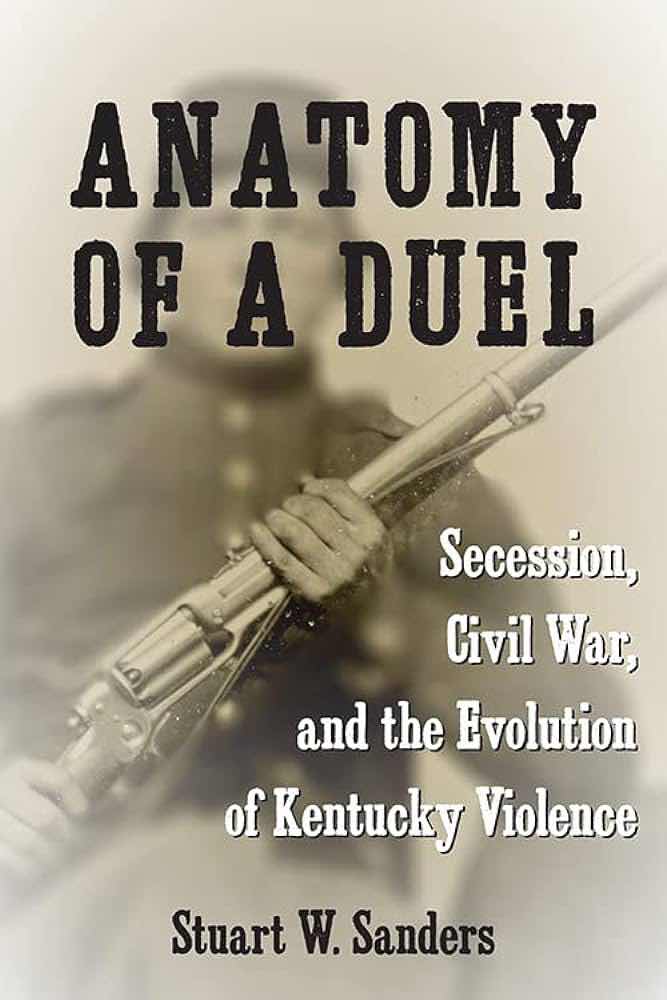
By Stuart W. Sanders
2023
University Press of Kentucky
At first glance, using one duel taking place on one afternoon in an obscure Kentucky community to explore a state’s culture may sound like a challenging proposition, but Stuart Sanders tackled that idea and turned it into a fine book describing a key piece of nineteenth-century life in Kentucky.
In this deeply researched book, involving many sources, Sanders, author of multiple books about Civil War Kentucky, as well as one about violence on a period steamboat, uses his experience and writing ability to craft a fascinating story about how the confrontation between William Casto and Union Colonel Leonidas Metcalf illustrates the importance of the code duello in Kentucky life. He, however, goes beyond just that confrontation to show why it happened and why it was a bit unusual for its time as change was slowly happening in the Bluegrass State as civil war approached.
As the book’s title so aptly says, this work is truly an anatomy (or dissection) of this one fight, showing how state (and southern) culture, combined with the Civil War (and the tensions that led to war), the background of the individuals involved, and the actions of Union leaders who were trying to keep Kentucky (and Kentuckians) out of the Confederacy, all somehow worked together over time to lead to this contest. It was not simply a case of two men suddenly becoming angry and immediately dueling. It was a process based on those factors that Sanders explores and describes in a very readable and enjoyable book.
This book is more than a story about the duel, even as that word in the title is the attention-grabber. The author discusses violence in Kentucky, particularly the art of dueling, and how the state's citizens and government accepted it as part of life, but also shows how that form of manhood and honor had started changing in the Civil War era, especially during and after the war. Violence and fighting remained an unfortunately large part of life in the Commonwealth, but the formality of duels, with strict rules, regulations, and traditions, gradually changed into more improvisational street fighting, including the use of concealed weapons. The book’s title refers to this as “evolution,” but a reasonable argument could contend that “de-evolution” would be just as or perhaps more appropriate.
This work also discussed how the culture of violence, including both dueling and the newer style of fighting, injured, or even changed, Kentucky’s reputation nationwide. The frequent violence, fighting, and murdering came to define the state in many eyes, transforming the state’s reputation from the land of Henry Clay, compromise, and a forward thinking educated people to an image of a backward and poor population that constantly resorted to physically harming or killing fellow citizens.
This truly is a good perspective not only on dueling or violence, but on the state of Kentucky in the mid-nineteenth century, including how the population was split in supporting the Union or Confederate side (even in the same towns and counties) and how that division sometimes led to violence like in the Casto-Metcalfe duel. It is a much bigger story than just that of one of one fight or of that style of combat.
For those who seek satisfaction from books they read, I believe this one will accept and meet your challenge. I enjoyed this read and certainly recommend it.

