Showing posts with label honor. Show all posts

Tuesday, May 7, 2024

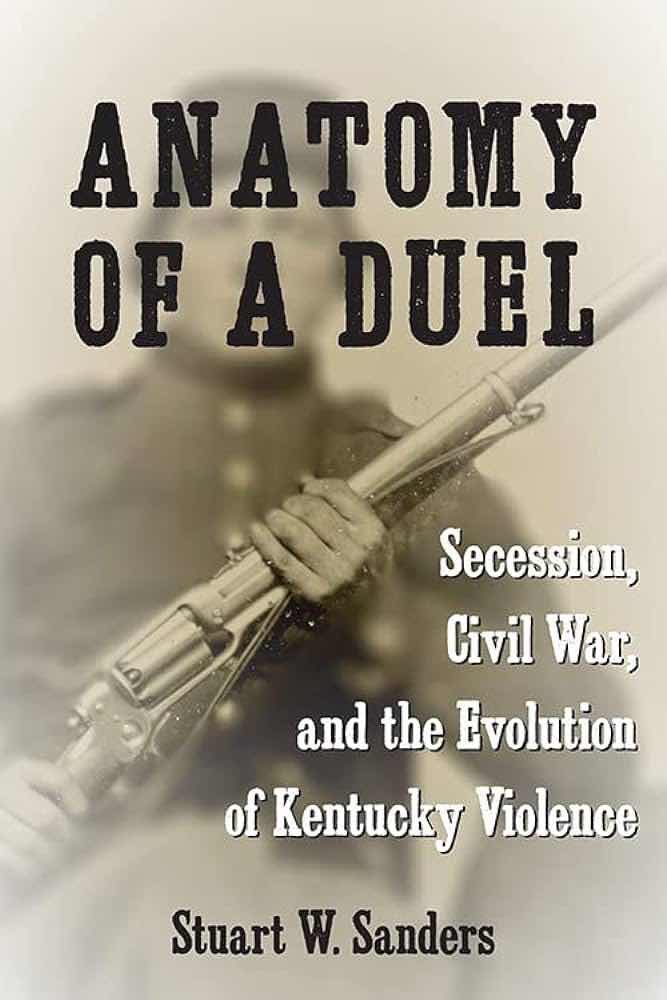
Book Review: Anatomy of a Duel: Secession, Civil War, and the Evolution of Kentucky Violence


By Stuart W. Sanders 
2023
University Press of Kentucky 

At first glance, using one duel taking place on one afternoon in an obscure Kentucky community to explore a state’s culture may sound like a challenging proposition, but Stuart Sanders tackled that idea and turned it into a fine book describing a key piece of nineteenth-century life in Kentucky. 

In this deeply researched book, involving many sources, Sanders, author of multiple books about Civil War Kentucky, as well as one about violence on a period steamboat, uses his experience and writing ability to craft a fascinating story about how the confrontation between William Casto and Union Colonel Leonidas Metcalf illustrates the importance of the code duello in Kentucky life. He, however, goes beyond just that confrontation to show why it happened and why it was a bit unusual for its time as change was slowly happening in the Bluegrass State as civil war approached.

As the book’s title so aptly says, this work is truly an anatomy (or dissection) of this one fight, showing how state (and southern) culture, combined with the Civil War (and the tensions that led to war), the background of the individuals involved, and the actions of Union leaders who were trying to keep Kentucky (and Kentuckians) out of the Confederacy, all somehow worked together over time to lead to this contest. It was not simply a case of two men suddenly becoming angry and immediately dueling. It was a process based on those factors that Sanders explores and describes in a very readable and enjoyable book.

This book is more than a story about the duel, even as that word in the title is the attention-grabber. The author discusses violence in Kentucky, particularly the art of dueling, and how the state's citizens and government accepted it as part of life, but also shows how that form of manhood and honor had started changing in the Civil War era, especially during and after the war. Violence and fighting remained an unfortunately large part of life in the Commonwealth, but the formality of duels, with strict rules, regulations, and traditions, gradually changed into more improvisational street fighting, including the use of concealed weapons. The book’s title refers to this as “evolution,” but a reasonable argument could contend that “de-evolution” would be just as or perhaps more appropriate.

This work also discussed how the culture of violence, including both dueling and the newer style of fighting, injured, or even changed, Kentucky’s reputation nationwide. The frequent violence, fighting, and murdering came to define the state in many eyes, transforming the state’s reputation from the land of Henry Clay, compromise, and a forward thinking educated people to an image of a backward and poor population that constantly resorted to physically harming or killing fellow citizens. 

This truly is a good perspective not only on dueling or violence, but on the state of Kentucky in the mid-nineteenth century, including how the population was split in supporting the Union or Confederate side (even in the same towns and counties) and how that division sometimes led to violence like in the Casto-Metcalfe duel.  It is a much bigger story than just that of one of one fight or of that style of combat.

For those who seek satisfaction from books they read, I believe this one will accept and meet your challenge. I enjoyed this read and certainly recommend it.


Tuesday, September 27, 2011

In which I Compare Confederates and Klingons

Worf, Klingon
Robert E. Lee, Confederate


First of all, you're welcome for the captions under the pictures beginning this entry. :-)

Recently, I have been watching Star Trek: The Next Generation (I'll call it TNG ) on DVD and in one episode (probably more, but it caught my attention in one of them), Worf was in company with some fellow Klingons, and in their conversation they made several mentions of words like "honor" "duty" "courage" and "family."

For some reason that got me thinking that these warriors from outer space sure sounded like a different group with which I was familiar - Confederate soldiers.

I don't know that I'll ever  do any kind of thorough research on this, but found it to be an interesting thought, so I will consider it briefly here.  Some Confederates did fight in the Civil War as a matter of personal honor, or of proving their bravery. Staying home while others fought for the South would have shamed them, and in TNG, Worf frequently refers to his and his family's honor. In fact, that becomes a recurring theme in multiple episodes when the Klingon High Council accuses his father of betraying the empire. An example of this regarding the Confederacy is found on page 39 of the book Reluctant Rebels (Kenneth Noe, copyright 2010, University of North Carolina Press) when the author quotes one soldier letter: "you know me too well to think I could stay at home idle while all my young friends have left their families and friends. George Crawford and John Knowles have left their homes long ago for the same cause and I hope it shall never be said that John Beggs was afraid to go." 

Duty is another theme that is mentioned both in studies of Confederate soldiers and by the Klingon characters. It is closely related to honor and "honor and duty" is a commonly heard or read phrase, to describe some kind of moral obligation to serve their government. Robert E. Lee's decision to join Virginia's forces after the state seceded and he resigned from the U.S. Army is one example of duty, while Worf resigned from Star Fleet in order to do his duty by serving on a Klingon vessel during a Klingon civil war.(Wow - there's a similarity I had not noticed until I typed that sentence. Was Worf really another Robert E. Lee, trying to reclaim his family name from actions his father supposedly took, and then resigning one position to take another in a civil war? Is there a comparison between Mogh and Lighthorse Harry Lee? Is there a "Klingon Yell (maybe when they see a fellow warrior die?")

All of these themes are closely related and another word heard frequently with them is "loyalty." How many Confederates like Lee or John Singleton Mosby fought as they did out of loyalty to their home state? Some like George Thomas resisted this call, but for many southerners, the actions of their state determined what they would do. This is another theme that Worf often falls back on, such as in the episode when he first meets K'Ehleyr (at least their first on-screen meeting) and lectures her about Klingon virtues of loyalty, duty and honor.

That episode also ties in with Worf's emphasis on family and how a Klingon is responsible for the actions of past and future generations, especially regarding a familiy's honor. This is certainly more of an issue in TNG than in the Civil War, where family divisions between the Union and Confederacy were not uncommon, but still Confederate soldiers did write about protecting their families and homes, and keeping their wives free from possible attack by freed slaves. Family connections also helped Klingons achieve political positions, while that same idea certainly was influential in the south (and the entire nation) in the 1860s.

"Manhood" and "courage" are two other closely-related virtues that fit the comparison as well. These were especially important to the Klingons, but even Confederate soldiers felt that they needed to prove their courage, and their willingness to fight for their loved ones was part of what it meant to be a man. 

Obviously, comparing a fictional television series set centuries in the future to real people and lives from 150 years ago may not be the most serious of history, but I thought it was a fun and even a bit humorous of a comparison. I do wonder if a serious sociologist or social historian could do a longer study on this topic, maybe embracing these virtues in other public media.  Still, as I watch more of the TNG episodes and hear words like "honor" and "duty" spoken by Klingons, it does remind me of how many young men, especially in the South, looked at life as they faced war and battle 150 years ago.

All-in-all, I tend to doubt that that Confederate soldiers obsessed over ideas like "honor and duty" as Worf or other Klingons did on TNG but these virtues were important to both cultures, in the real world of the Confederates and the fantasy worlds on television. Honor and duty were part of the motivations of many Confederate soldiers and as one website says: "Klingons hold honor above all else" (http://reocities.com/Hollywood/8459/klingon.html) a sentiment with which anybody familiar with the show can easily agree.

Whether it was Robert E. Lee working with thousands of fellow soldiers to battle the Yankees of the North, or Lieutenant Worf, working with Jean-Luc Picard to explore space and meet new life forms, virtues like honor, duty, family and loyalty all played a role in decisions they made and how their lives - real and imaginary - turned out.

Live long and prosper.