Showing posts with label patriotic cover. Show all posts

Tuesday, February 12, 2013

Patriotic cover 2, spanking


 The behind on the far left says "Wigfall" while the other two say "Wise" and "Davis." They obviously refer to Louis Wigfall, Henry Wise and Jefferson Davis. With those three names mentioned, this likely was created early in the war, before names like Robert E. Lee emerged, even though it refers to the "end" of the rebellion. That may have been a sign of wishful thinking about a quick war, and is obviously a pun for the side of the individuals it is showing.

Thursday, October 6, 2011

Patriotic Cover: Uncle Sam Goes Fishing


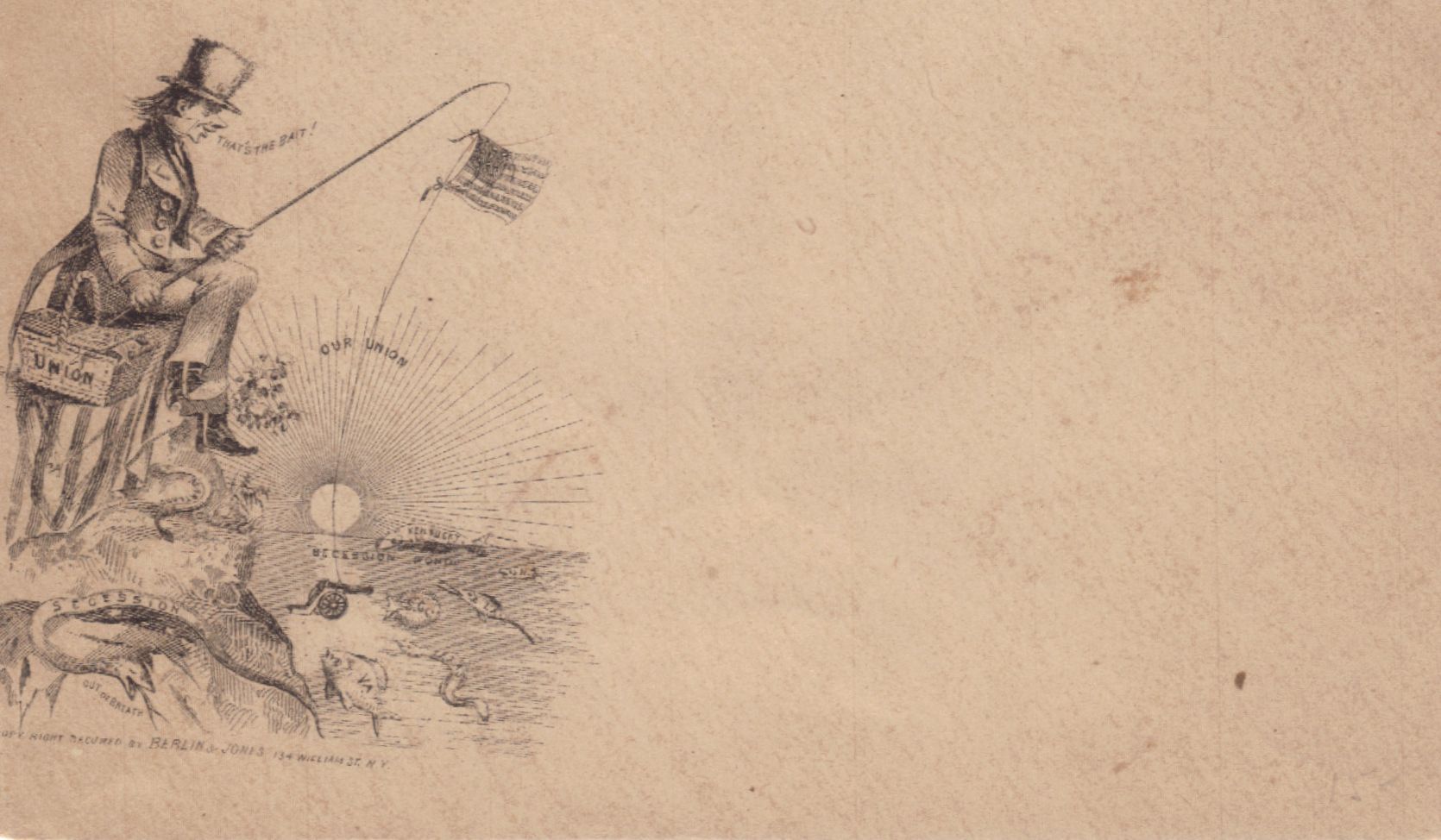
Here is an interesting patriotic cover, which is a bit busier and more detailed than most I've seen (though granted that number is not a large one.) This link provides a larger version that may help you see the details better.

This illustration shows Uncle Sam on a picnic sitting on a bank, with a picnic basket marked "Union" next to him. Both appear to be sitting on a United States flag.

Uncle Sam is saying" Here's the bait" as he holds a fishing pole out over the water, with the United States flag apparently serving as a floater and a cannon in the water as the hook. In the background the sun is setting, with the words "Our Union" among the suns rays. 

In the water, entitled "Secession Pond," await a few fish and other water creatures. The one at the top,  halfway in and halfway out is Kentucky. This may be a symbol of Kentucky's attempt at neutrality - not fully in the secession waters, but not all out of it either.

Swimming deeper are fish called "NC" (at the far right), then "LA" just left and below of NC. "SC", which seems to be in the shape of a puffer-type of fish (is this a reference to South Carolina's reputation as the "fire-eater" and most aggressive of the southern states?) is the one in front of the cannon, while immediately below it sits "Texas" in the shape of a snake or eel. 

The large one below the cannon is "VA." 

Another eel-like creature lies on the ground below Uncle Sam's feet, and is known as "Maryland."

On the bottom of the picture, on the land, is a longer snake-like creature, called "Secession" and below its open mouth are the words "out of breath." 

The only other text on the envelope states "Copy Right Secured by BERLIN & JONES 134 William St N.Y.' No copyright date is apparent.

I honestly am not sure how to interpret this one, though it obviously is a pro-Union, anti-secession piece. On one hand, it looks like it is saying the sun is setting on secession, and the beached serpent appears to show that secession is dying. 

On the other hand, why is Kentucky pictured halfway in the water? If this was late in the war the Confederacy was nearing defeat, Kentucky had already abandoned neutrality.  Then again, maybe this was a very optimistic early-war scene and the artist thought that secession was not going to last very long.

I also refuse to deny the possibility that this cover has some obvious meaning that I'm totally missing. 

Whatever its meaning may or may not be, this is still an interesting image with great detail in it.


Monday, August 1, 2011

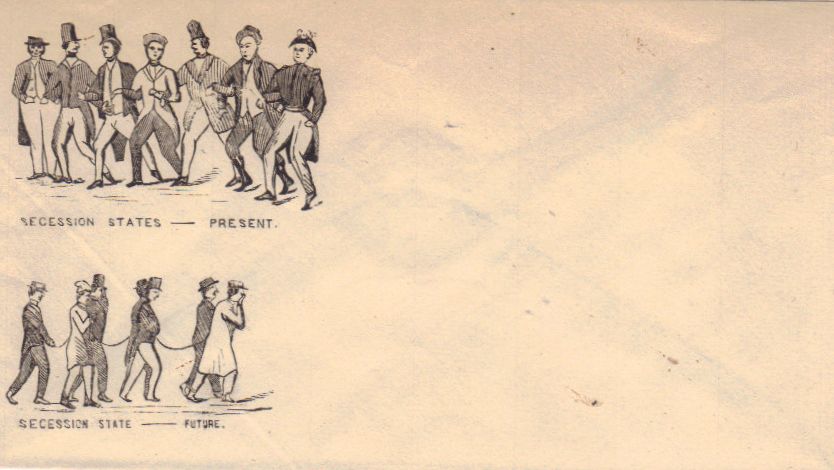
Patriotic Cover: Secession States Now and in the Future


Here is another patriotic cover I recently came across. Unfortunately, it does not have any printer's name, location or date on it, but it is obviously from early in the war, perhaps even 150 years ago this summer

This link should provide a larger view of this cover.

I do have a couple more of these I will be sharing soon and they have more detail in them, so there will be some more interpreting to do on them. I find items like this to be quite fascinating to review.

Monday, November 15, 2010

Another Patriotic Cover: Southern Aristocracy


Earlier this year, I made a post about a patriotic cover in my collection

Here's a copy of the one other such item I have, this one captioned "SOUTHERN ASS-STOCK-CRAZY," another unkind view of Southern culture, especially its leadership and upper-class.

The words "Southern Confederacy" are printed on the donkey, as it is tries to pull away from a post called "Union." The US Flag waves from the post, while the Confederate national flag is tied to the donkey's tail.

The publisher of this piece is unknown, but this link to the Library of Congress says this was printed in 1861. Since this was the first national flag of the Confederacy and it did exist starting in early 1861, that date seems very possible for this unused cover.

Thursday, August 5, 2010

Patriotic Cover: Persuasive Eloquence of the Sunny South

During the Civil War, and even in later wars, such as World War II, one way of displaying American patriotism was through the use of patriotic covers, which were envelopes with a patriotic scene on the front of it. These were envelopes to be used to deliver the mail, as well as a patriotic message. (In current times, one similar collectible item is a "first day" cover, an envelope issued to commemorate a historic place or event, with a stamp and a cancellation mark from the post office on it, though these are issued to be collectible, not to be used as the patriotic covers were).

Not only did these covers display pro-American messages, but they also could show support for the United States by insulting or belittling the opposing side, such as the Confederacy or the South in general. In the one displayed below, entitled "The persuasive eloquence of the Sunny South," an African American is shown tied to a pole, with a whip coming down on his back, serving as an expression of not only anti-slavery sentiments, but also as a commentary about the Confederacy and the printer's perspective of Southern culture and life.

They were simply another form of war propaganda, and not intended to claim any sort of objectivity, since their intended audience was not looking for "fair and balanced" portrayals.


King & Baird, of Cansom Street in Philadelphia,were the printers of this particular cover.I have not been able to determine a date when this one was created, but it could have been at any point during the war.

Also, I did find this blog entry that has more interesting examples and discussion of patriotic covers from the Civil War era.