Showing posts with label secession. Show all posts

Thursday, June 16, 2016

Book Review: Kentucky Confederates


Kentucky Confederates: Secession, Civil War and the Jackson Purchase
By Berry Craig
Copyright 2014
University Press of Kentucky 

The latest book in my recent reading spree was another one focused on Kentucky, this time  specifically on how one region of the state had much stronger ties to the Confederacy than the rest of the Commonwealth. Having just read For Slavery and Union, I was fortunate to follow it with Kentucky Confederates, a book focusing on the loyalties of the Jackson Purchase in far southwestern Kentucky, but that inevitably touched on some of the issues that  contributed to Kentucky's post-war reputation.

Kentucky Confederates is not a book intended to discuss the state's Confederate image. Its goal is to discuss the Jackson Purchase region of the state and how this region was easily the most pro-Confederate section of the state, particularly during the pre-war and early-war years, before many people in the rest of the state adopted similar attitudes as the Purchase residents. It certainly achieves this goal in a well-researched and written study that is very readable and informative. This is a valuable book on Kentucky history, especially of the Civil War era. 

Extant period sources such as letters and diaries from the area are scarce, but the author was able to uncover several of them. He also relied heavily on period newspapers from the region as well as from cities like Louisville, Memphis, Cincinnati and New York to find details on various elections, rallies, speeches and other events in the area. He found many individual names, usually with information about the individual's hometowns or counties and where their loyalties were. He supplemented these sources with information from local and state historians as well as other secondary sources. Craig's efforts in finding so much information on a small portion of the state are very impressive. 

This is a fine book in many ways. It provides a great deal of information about the Jackson Purchase, opening my eyes to just how much support for the Confederacy existed in that region and how that region differed so much from the rest of the state, especially pre-emancipation. Much evidence showing the reality of such a difference fills this book. It also discusses the state's change in mood in the years following the Emancipation Proclamation and the enlistment of African-American soldiers. Opposition to such enlistment was so strong that state officials did not even want the word "Kentucky" included in unit names of African-American regiments (and the Federal government obliged them on this request.) This was not the focus of the book, but was a natural and necessary addition to the main discussion. It gave similar insight as did For Slavery and Union, but added some different details and perspectives to what I had previously read. 

I also like that it includes several photographs of the men and places it discusses, adding an extra dimension to the narrative. Seeing faces to go with names can be a beneficial part of any book.

It is an easy-to-read book, with a nice, smooth flow, organized chronologically. Craig focuses on the political and social issues of the time, adding military information when necessary. It is not a detailed military history of the region, but does show how military events affected the hopes, desires and expectations of the Purchase's population, and vice-versa. 

At times some of the many details - lists of several names or multiple detailed election results - make those sections a bit tedious, but they are important as they provide details which strongly back up the author's thesis. Such details would also be very handy for genealogists or local historians, and they show the thoroughness of the author's research.

I do wish the book had included at least one map showing the counties, towns and rivers in the area, including Tennessee, Illinois and Missouri. 

A potentially interesting addition to this book might have been a quick discussion of Stephen Burbridge's role in the state in 1864 and how his "reign of terror" was similar to or affected Eleazar Paine's brief "reign of terror" in the Purchase region. Perhaps the author determined it would not be a good fit with the book's focus on the Purchase and would have distracted from his main goal.  

Despite those minor quibbles, I really enjoyed this book and learned quite a bit from it, including additional understanding of not only the Jackson Purchase, but of the state as a whole. Anyone interested in Kentucky history should read this book and the story it tells. Others who enjoy the Civil War, especially topics like the "border states" or the " Western Theater" can also gain valuable perspectives from this work. It is simply a good, informative book with a unique perspective on Kentucky and Kentuckians, showing how the population of one part of Civil War Kentucky was far more southern-leaning than the citizens of most other areas of the state. I gladly recommend Kentucky Confederates. 

Tuesday, May 15, 2012

The Effect of Abolition Legislation in Kentucky

Here is an article from the May 17, 1862 Covington Journal, expressing some thoughts about how the progress of abolition in various legislatures was affecting Kentucky. It is a bit long, but I think is a worthwhile read. I have a couple more comments I have added at the end of the article, about the conclusions it reached and my view of them.

The Effect of Abolition Legislation in Kentucky
An Ohio contemporary says:

"We know the mischief that has already been done to the Union cause in Kentucky by the posiferous schemes of the Abolitionists, and we tell the country that a little more of the same sort from those agitators and irreparable injury will have been done to Unionism in that State." 

We are satisfied that all such statements as the above convey an incorrect impression of the effect in Kentucky of Abolition Legislation. When, months ago, the question whether Kentucky should remain as she was or cast her lot with the Southern Confederacy was regarded an open one a very respectable number of her people took the ground that her geographical position as well as her social and commercial interests called upon her to make common cause with her sisters of the South. The will of the majority of the people, as expressed through conventions and by their representatives in the State Legislature, was for a position of neutrality. The record bears us out in the assertion that the acquiescence in this determination was almost unanimous. When, at a later day, the Legislature gave up neutrality and took sides with the Federal government, many of the friends of the South, including nearly all who were  recognized as leaders, left Kentucky to join the Southern Confederacy. We have n o hesitation in saying that of those who remained a vast majority acquiesced in the action of the constituted authorities of the State, thus acknowledging their allegiance to the State Government at Frankfort and the Federal Government at Washington, and from that day to this have regarded the question of separation as closed.


We as freely admit that in thus acquiescing they did not believe they were under obligations to support the Administration in all its measures; nor did they feel bound to give up the opinion that it was the purpose of the leaders of the Republican party to make use of the war of Abolition purposes. Hence, they have not only not united with the so-called Union Party but have opposed, so far as opposition could be made without organization, such of its measures as they deemed objectionable. We need not remind the paper from which we have quoted the sentence at the head of this article that opposition to the measures of the dominant party in the North has been stigmatized as secessionism. So it has been in Kentucky. The charge is not a whit more just in one case than the other.


The men of Kentucky opposed to the policy of the Republican party and distrustful of the Union party - its vascillating course and uncertain principles, at first for a third confederacy, then against separation; for neutrality, then branding as traitors all who favored it; in New York strongly anti-slavery, in some parts of Kentucky strongly pros-slavery; yesterday vouching for the conservatism of Mr. Lincoln, to-day denouncing h is party friends an advisers as Abolitionists; here unconditional Union men, there for the rights of all the people of all the States under the Constitution  - have been looking for the reorganization of the Democratic party as affording the only ground of h ope for displacing the sectionalists and madmen who now control the government and restoring public affairs to their old channels. They believe the time for re-organization is rapidly approaching, and under the banner of the rising party, in the Union, and acknowledging their allegiance to the State and Federal Governments, they propose to make the fight for the Constitution as it is and the Union as it was; for the honorable adjustment of the difficulties which have well-nigh overwhelmed us, and for the restoration of the old fraternal feeling.


Unquestionably the Abolition measures passed and pending in Congress have alarmed the people of Kentucky. Unquestionable changes of opinion are going on; but the changes are the results of doubts as to the will or the ability of the so-called Union Party to resist the aggressive movements, and are from that organization to the Democratic party - not to secessionism. Abolition legislation may be weakening the Union Party, but it is aiding in building up a party for the Constitution and the Union - a party which has set its face like flint against the schemes of the Abolitionists, and which proclaims the same principles East and West, North and South.


Our contemporary will see in this view of the case that his article conveys a wrong impression to the public mind. 

--
I find it interesting that the author insists that the changing mindset in many Kentuckians is simply that of a change of political party, not of a change to support for secession. In the months ahead of this article, emancipation and abolition would become ever more powerful and present, and many have argued that it was the onset of abolition and the use of African-Americans in the army that eventually convinced Kentuckians to "secede after the Civil War." Perhaps the changes this author noticed were the start of that process, waiting for the spark of abolition to truly light it in the future years. Was this author that observant of changes in Kentuckians mindsets, or was it kind of a lucky guess?

Sunday, November 27, 2011

Editorial Cartoon: Lincoln and the Negro Question


I found this editorial cartoon in Albert Shaw's Abraham Lincoln: The Year of His Election (The Review of Reviews Corporation, 1929).

This appears on page 163 and provides a German perspective (presumably translated into English for this book) about the South's attempt to secede from the Union and what motivated it. This drawing and the caption leave no doubt as to what this paper thought motivated the South. 

Here is some information on the cartoonist Wilhelm Scholz, including a link to more details on Kladderadatsch.

Thursday, October 6, 2011

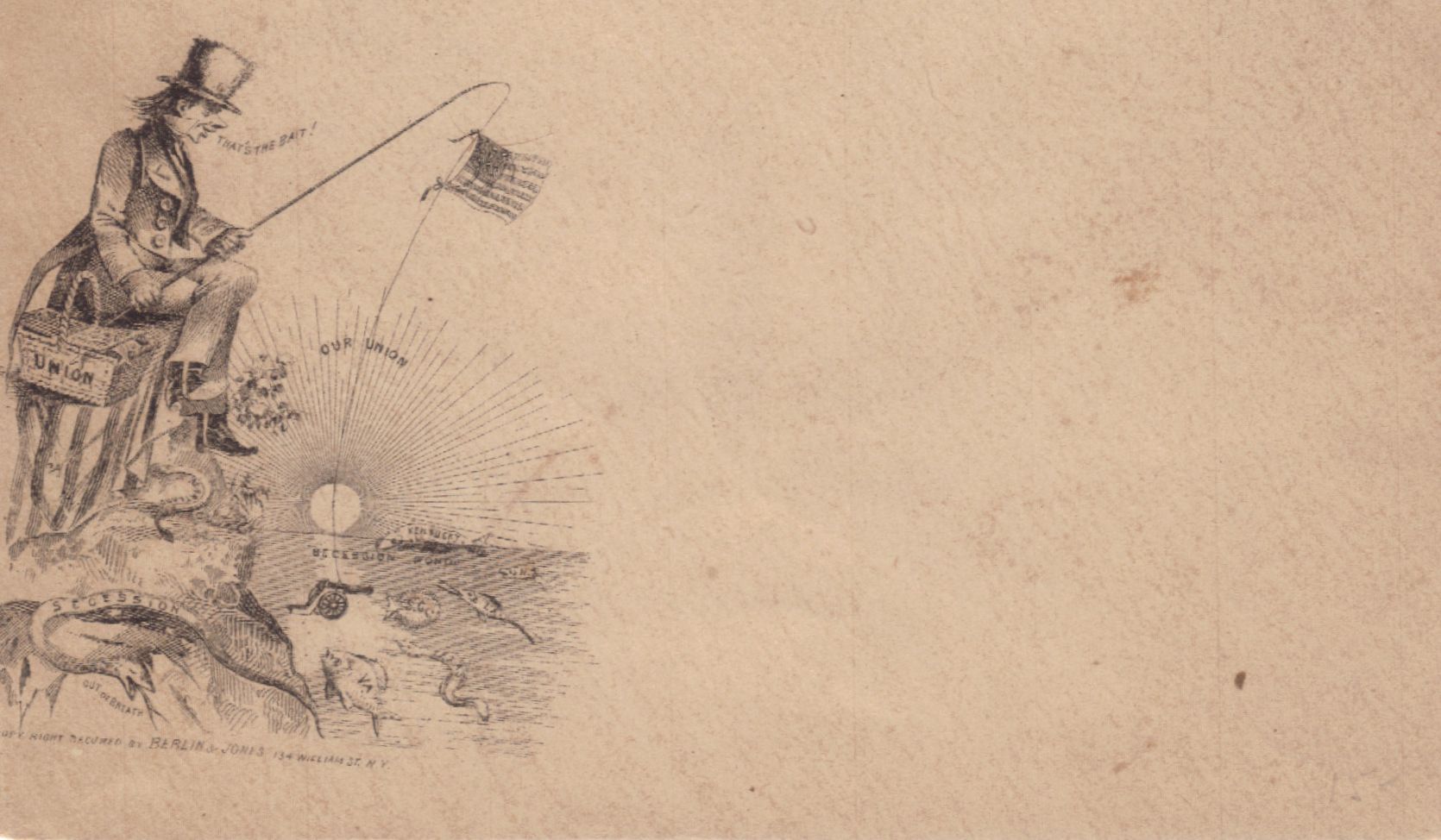
Patriotic Cover: Uncle Sam Goes Fishing


Here is an interesting patriotic cover, which is a bit busier and more detailed than most I've seen (though granted that number is not a large one.) This link provides a larger version that may help you see the details better.

This illustration shows Uncle Sam on a picnic sitting on a bank, with a picnic basket marked "Union" next to him. Both appear to be sitting on a United States flag.

Uncle Sam is saying" Here's the bait" as he holds a fishing pole out over the water, with the United States flag apparently serving as a floater and a cannon in the water as the hook. In the background the sun is setting, with the words "Our Union" among the suns rays. 

In the water, entitled "Secession Pond," await a few fish and other water creatures. The one at the top,  halfway in and halfway out is Kentucky. This may be a symbol of Kentucky's attempt at neutrality - not fully in the secession waters, but not all out of it either.

Swimming deeper are fish called "NC" (at the far right), then "LA" just left and below of NC. "SC", which seems to be in the shape of a puffer-type of fish (is this a reference to South Carolina's reputation as the "fire-eater" and most aggressive of the southern states?) is the one in front of the cannon, while immediately below it sits "Texas" in the shape of a snake or eel. 

The large one below the cannon is "VA." 

Another eel-like creature lies on the ground below Uncle Sam's feet, and is known as "Maryland."

On the bottom of the picture, on the land, is a longer snake-like creature, called "Secession" and below its open mouth are the words "out of breath." 

The only other text on the envelope states "Copy Right Secured by BERLIN & JONES 134 William St N.Y.' No copyright date is apparent.

I honestly am not sure how to interpret this one, though it obviously is a pro-Union, anti-secession piece. On one hand, it looks like it is saying the sun is setting on secession, and the beached serpent appears to show that secession is dying. 

On the other hand, why is Kentucky pictured halfway in the water? If this was late in the war the Confederacy was nearing defeat, Kentucky had already abandoned neutrality.  Then again, maybe this was a very optimistic early-war scene and the artist thought that secession was not going to last very long.

I also refuse to deny the possibility that this cover has some obvious meaning that I'm totally missing. 

Whatever its meaning may or may not be, this is still an interesting image with great detail in it.


Monday, August 1, 2011

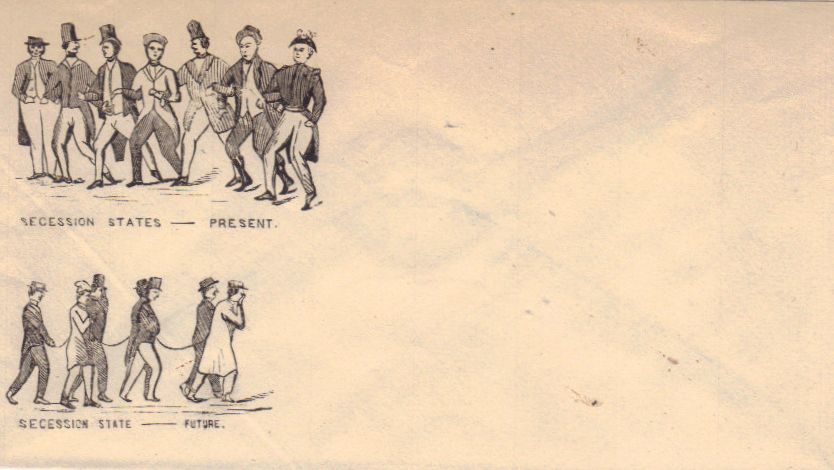
Patriotic Cover: Secession States Now and in the Future


Here is another patriotic cover I recently came across. Unfortunately, it does not have any printer's name, location or date on it, but it is obviously from early in the war, perhaps even 150 years ago this summer

This link should provide a larger view of this cover.

I do have a couple more of these I will be sharing soon and they have more detail in them, so there will be some more interpreting to do on them. I find items like this to be quite fascinating to review.

Tuesday, April 19, 2011

April 20, 1861 - Some Opinions on the future of Kentucky

Here is another commentary from the Covington Journal about its perceptions of Kentucky's future as the Civil War unfolded, as well as a few other other comments published in this same edition, from papers around the state. It includes more comments than I republish here.

Here is Governor Beriah Magoffin's reply to the War Department's request for troops, also published in this paper, and which is referred to in some of the following commentaries.

Hon. Simon Cameron, Secretary of War, Washington, D.C.:
Your dispatch is received. In answer, I say emphatically, Kentucky will furnish no troops for the wicked purpose of subduing her sister Southern States.
Yours truly, 
B. Magoffin
Governor of Kentucky


---

The Position of Kentucky

There is no longer room to doubt the position of Kentucky. She will give no aid to the North in its war upon the South - NOT A MAN, NOT A DOLLAR. The reply of the governor of the State to the requisition of the Black Republican authorities at Washington is heartily endorsed as a fitting response to an insulting demand. 


NO AID TO THE NORTHERN SECTIONALISTS! Upon this vital point Kentucky prevents an undivided front, and she will maintain it at any sacrifice that may be demanded. Beyond this, as we view the case, she is not at present prepared to go.

---
This same edition publishes the following comments from the Frankfort Yeoman:
Lincoln has no chance to get his four regiments from Kentucky. She is a sound Southern State to the core, and abhors Abolitionism as she does the devil.

From the Lexington Observer:
The reply of the Governor will meet the sanction of our people. The Government need calculate upon no aid from Kentucky in any purposes of military coercion that it may entertain.

The following excerpt is in a column of various topics, with no author noted, so it may be another commentary from the Covington paper.
Kentucky, glorious old Kentucky, loyal as ever, to the principles of Justice and Freedom, heartily and unanimously endorses her Governor's response to the impudent demand of the Northern sectionalists for four thousand Kentuckians to aid in subjugating the people of the South.

---
Again, much of this seems like wishful thinking on the parts of the writers, but at that time they probably had good reason to believe what they wrote. Also, given how Kentucky's reputation and links to the Confederacy grew at the end of the war and in the years following it, maybe these writers were more right about this topic than I realized, though a spirit of staying in the Union did rule the state for most of the war.

Tuesday, December 21, 2010

A Secret Society in Kentucky

The Secession Ball in Charleston has been generating a lot of interest in the blogosphere, and even in the mainstream press to some extent, recently. Secession was, obviously, a topic of much discussion and debate 150 years ago as well, as South Carolina's declaration was soon followed by similar pledges from other states in the deep south. The future of  the upper south and border states was not so clear, at least until the attack on Fort Sumter and President Lincoln's call for 75,000 troops, after which the upper south states decided to leave the Union as well.

This question still remained unsettled in the border states of Delaware, Maryland, Missouri and Kentucky, however.  Below is an article I found which discusses Kentucky's possible secession and potential reaction to such a decision. Newport is in the very northern part of the state, along the Ohio River, just across the river from Cincinnati, and just east of Covington, across the Licking River.
 
From the Covington Journal of May 18, 1861, this letter mentions an interesting rumor that never had the chance to come to fruition. This is an example of the mixed sentiment in this area at the time, as well as the uncertainty of how the state would proceed. All three men mentioned here, including the letter-writer, were lawyers and politicians in Campbell County (which includes Newport), so they likely knew each other, though Boyd obviously took a different view of national politics than the other two did. 

Below the letter I have included the biographical information I have been able to find about each of these men.

Newport, Ky., May 17, 1861

To the Editor of the Covington Journal: 

Sir: I am informed that there is a secret society in this city, who have taken an oath, that in the event that Kentucky, by a legitimate vote of her citizens, should determine to go with her sister States of the South, they, the members of this association, are to take up arms against the State, and join their friends of the border free States, in a raid upon the loyal sons of Kentucky. G.P. Webster and Gus Artsman, are two of the prominent leaders. I have the names of others; but withhold them for the present. I have also the names of gentlemen from Covington, who have been officiating in this matter. It is proposed to extend this anti-Southern or Abolition association throughout this county, and other border counties. These men will be remembered by the people of Kentucky for their wicked and hidden designs upon their peace.


F. A. Boyd


F.A. (Frederick) Boyd
Boyd, was born in Mason County Kentucky in 1815 and moved to Campbell County as a boy, along with his father. He graduated at the top of his law school class at the Cincinnati Law School in 1836, where he was highly regarded, and h became a lawyer in Newport. Health issues eventually slowed him down, and affected how much work he was able to do, but he was elected to the Kentucky Legislature in 1849, where  he served two terms. He then was chosen mayor of Newport in 1853, before becoming County Judge when his four-year term in Newport expired.  In 1868, he was a Kentucky representative at the Democratic National Convention in New York, where Horatio Seymour was nominated for President.

Judge Boyd passed away in 1891, as the oldest member of the Campbell County Bar, and apparently had earned much respect during his life based on resolutions passed by the County Bar and its members.

I did find it interesting that none of the articles I could find mentioned his apparent sympathy towards the South. Perhaps this was a sign of reconciliation and respect, or perhaps the coming of the war and Kentucky's insistence on remaining in the Union convinced him to keep his views to himself.

Gustave Artsman
Colonel Gustave "Gus" Artsman was born in Germany in 1829 and came to the United States in the mid-1840s before settling in Newport around 1854. He was elected Campbell County Circuit Court Clerk in 1856 and remained in that position until 1863. His obituary says he resigned in 1863 to become a Major in the 23rd Kentucky Volunteers during the Civil War, but I have not been able to find his name in that unit's records. I do wonder if there was another spelling (perhaps Anglicized somehow) that might show up in the records, but I have not yet found it.

Another article mentions that he was placed in charge of the Home Guard units in the area in 1863.

In 1872, he became Master Commissioner of the Campbell County Chancery Court, a position he held for 20 years.  His obituary says he was a Mason, dedicated to his church and a member of the "Loyal Legion" by which I believe it means the Military Order of the Loyal Legion of the United States

He passed away in 1902. Among his pallbearers were Samuel Bigstaff and Colonel A.S. Berry, both of whom were Confederate soldiers in the Civil War.

George P. Webster
I have found less information about him than the others, but in 1862, the Covington Journal reported that: "George P. Webster of Campbell county, has resigned his seat in the Legislature, to accept the office of Assistant Quartermaster General."  Several other articles in the war years mention him performing his duty in this role from Covington and even moving to Cincinnati and then St. Louis after the war.

He had also served as the Campbell County Attorney, at least in 1856, as well, so it is likely that his profession enabled him to become acquainted with Boyd and Artsman.

Thursday, September 23, 2010

Little Bo-Peep and Her Foolish Sheep: an Anti-Secession Editorial Cartoon


This anti-secession cartoon is from page 167 of Abraham Lincoln: The Year of His Election by Albert Shaw (The Review of Reviews Corporation, 1929). It is listed under "Strong's Dime Caricatures. - No. 2."
 
The small line above the cartoon title reads "Entered according to Act of Congress, in the year 1861, by T W Strong, in the Clerk's Office of the District Court of the United State for the Southern District of New York."

Immediately under the editorial's title are the lines from the nursery rhyme:  "Little Bo-peep, she lost her sheep, And didn't know where to find 'em; Let 'em alone, and they'll all come home, With their tails hanging down behind 'em."  

The description reads: "Miss Columbia observes her sheep as they leave the pack, one by one, and regrets that her old watchdog, "Hickory" (Andrew Jackson) is no longer alive. Her new watchdog, "Old Buck" (President Buchanan), refuses to bring back the wandering sheep. Off in the distance are the wolves of Europe, waiting their opportunity to pick the bones of the sheep that have strayed.

In the cartoon, Columbia is saying "Sic 'em, Buck! sic 'em! I wish poor old Hickory was alive. He'd bring 'em back in no time." 

The "wolves of Europe" are saying "If we can only get them separated from teh flock, we can pick their bones at our leisure."

It is hard to see on this scanned image, but the dog immediately at Columbia's side has a collar with "Old Buck" on it, while the collar on the one lying down reads "Hickory."

On the sheep, the only labels are "Virginia" with "Kansas" imprinted on the black sheep.  

Here is a link to information from the Library of Congress about this cartoon.