Showing posts with label Covington. Show all posts

Sunday, March 5, 2023

Charles Mount, 20th Ohio, Letters Home

I recently posted about a soldier in the 20th Ohio named Charles Mount

Four of his letters home survived the war and are in his widow’s pension file on Fold3.

Here are my attempts to transcribe them, though some words are unclear. I tried to add modern spelling, spacing, and punctuation to help make them easier to read. 

On the final letter, he wrote the start of it on the bottom half of the page, then the last half from bottom to top of the top half. It was a mess, and he also had a habit of writing in the margins, both on the sides and then back at the very top. I tried to put everything in a sensible order but could not find another closing that fit, so those lines seem to dangle, but at least they were generally legible and sensible.

Emphasis (underlining) is in the originals. I used italics for illegible words.  

—Letter 1
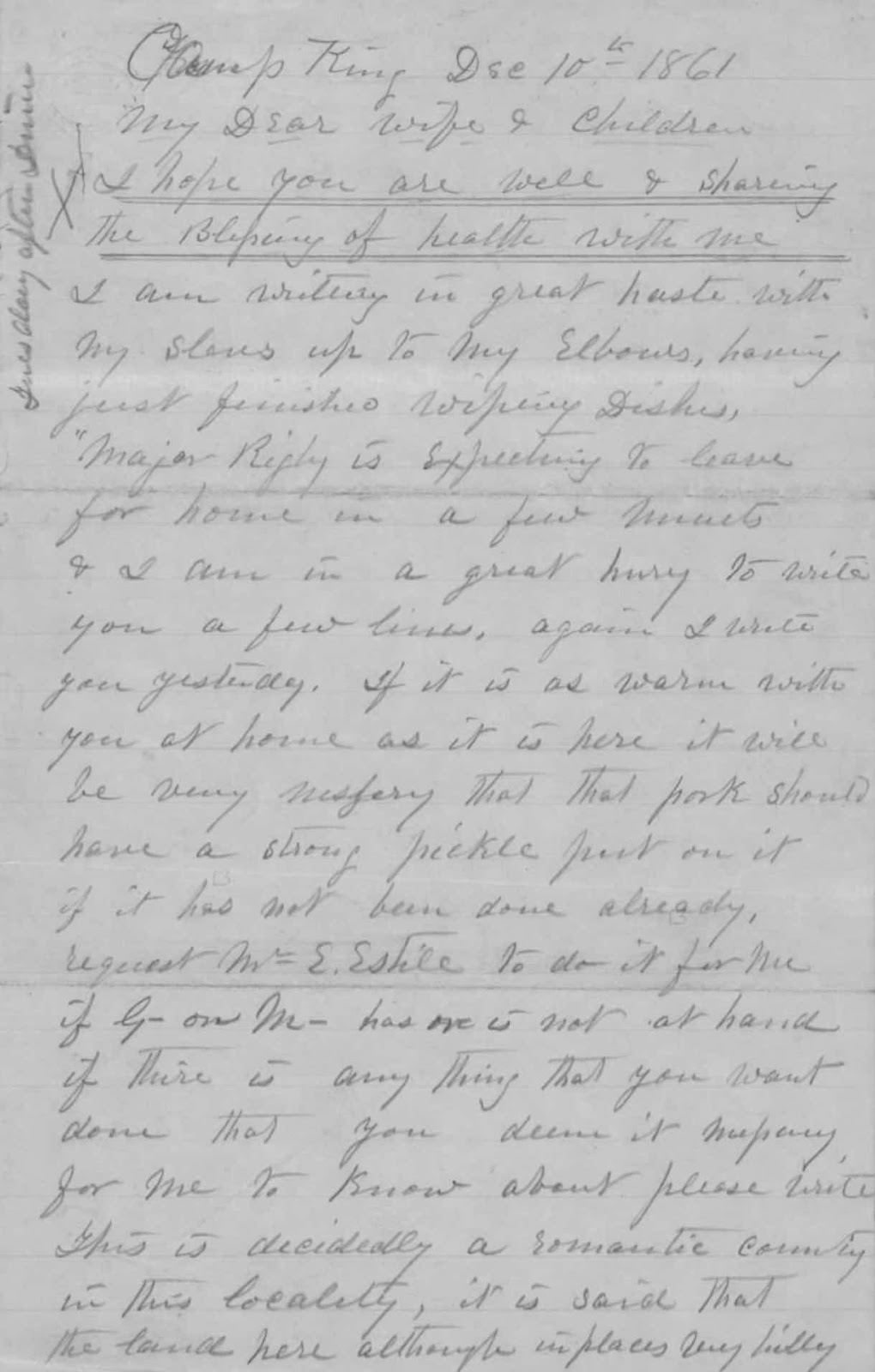
    

Camp King Dec. 10, 1861, Tuesday afternoon

My Dear Wife & Children

I hope you are well & sharing the blessing of health with me. I am writing in great haste with my sleeves up to my elbows, having just finished wiping dishes. Major Rigby is expecting to leave for home in a few minutes & I am in a great hurry to write you a few lines again. I wrote you yesterday. If it is as warm with you at home as it is here it will be very necessary that that pork should have a strong pickle put on it. If it has not been done already, request Mr. E. Estill to do it for me if G or Mr. – has one is not at hand. 

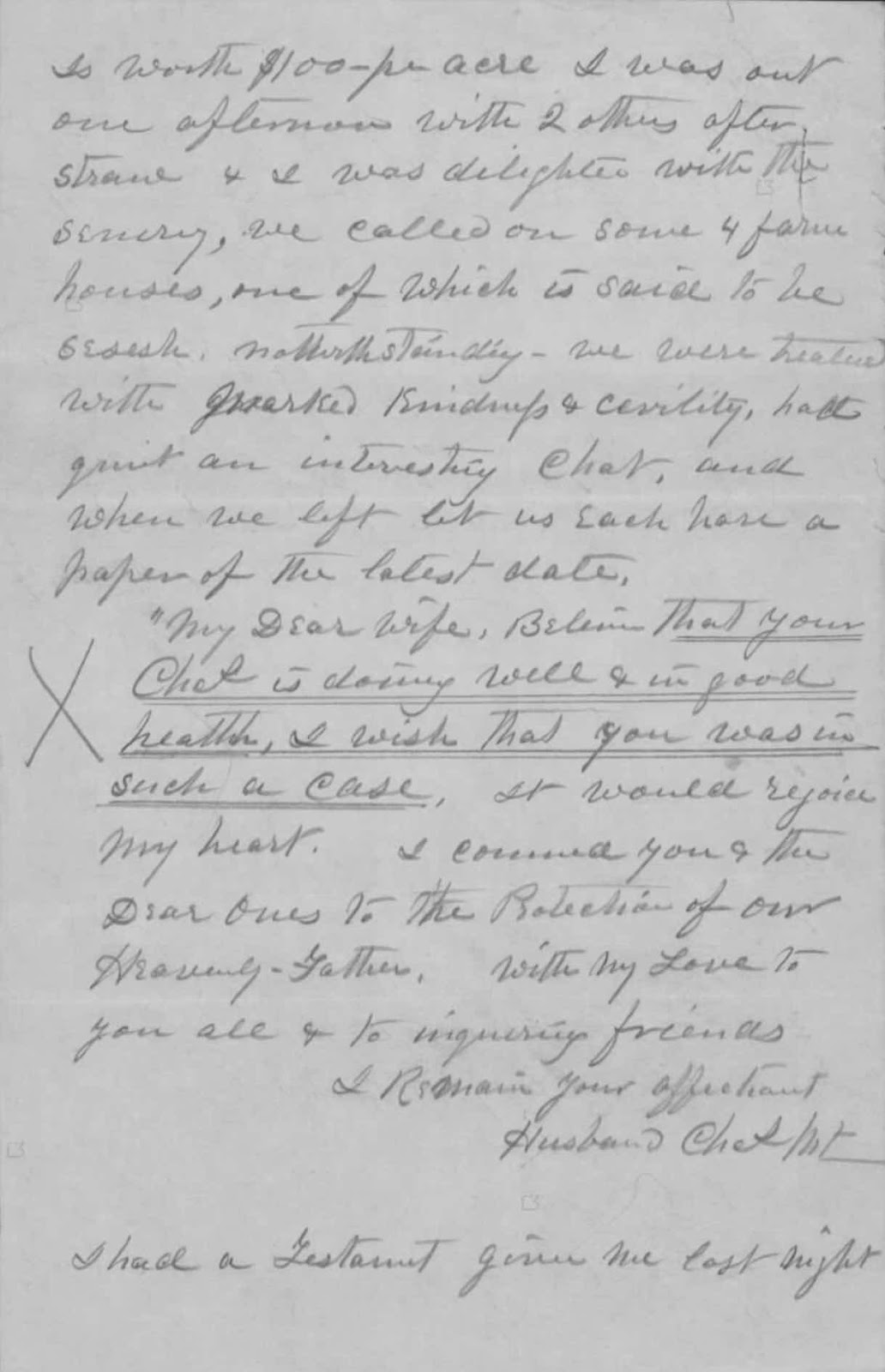
If there is anything that you want done that you deem it necessary for me to know about, please write. This is decidedly a romantic county in this locality. It is said that the land here, although in places very hilly, is worth $100 per acre. I was out one afternoon with 2 others after straw & I was delighted with the scenery. We called on some 4 farmhouses, one of which is said to be sesesh, notwithstanding we were treated with marked kindness & civility, had quite an interesting chat and when we left let us each have a paper of the latest date. 

My dear wife, believe that your Chas. is doing well & in good health. I wish that you was in such a case. It would rejoice my heart. 

I commend you & the dear ones to the protection of our Heavenly Father. 

With my love to you all & to inquiring friends, I remain your affectionate husband, Chas. Mt. 

I had a testament given me last night.


— Letter 2
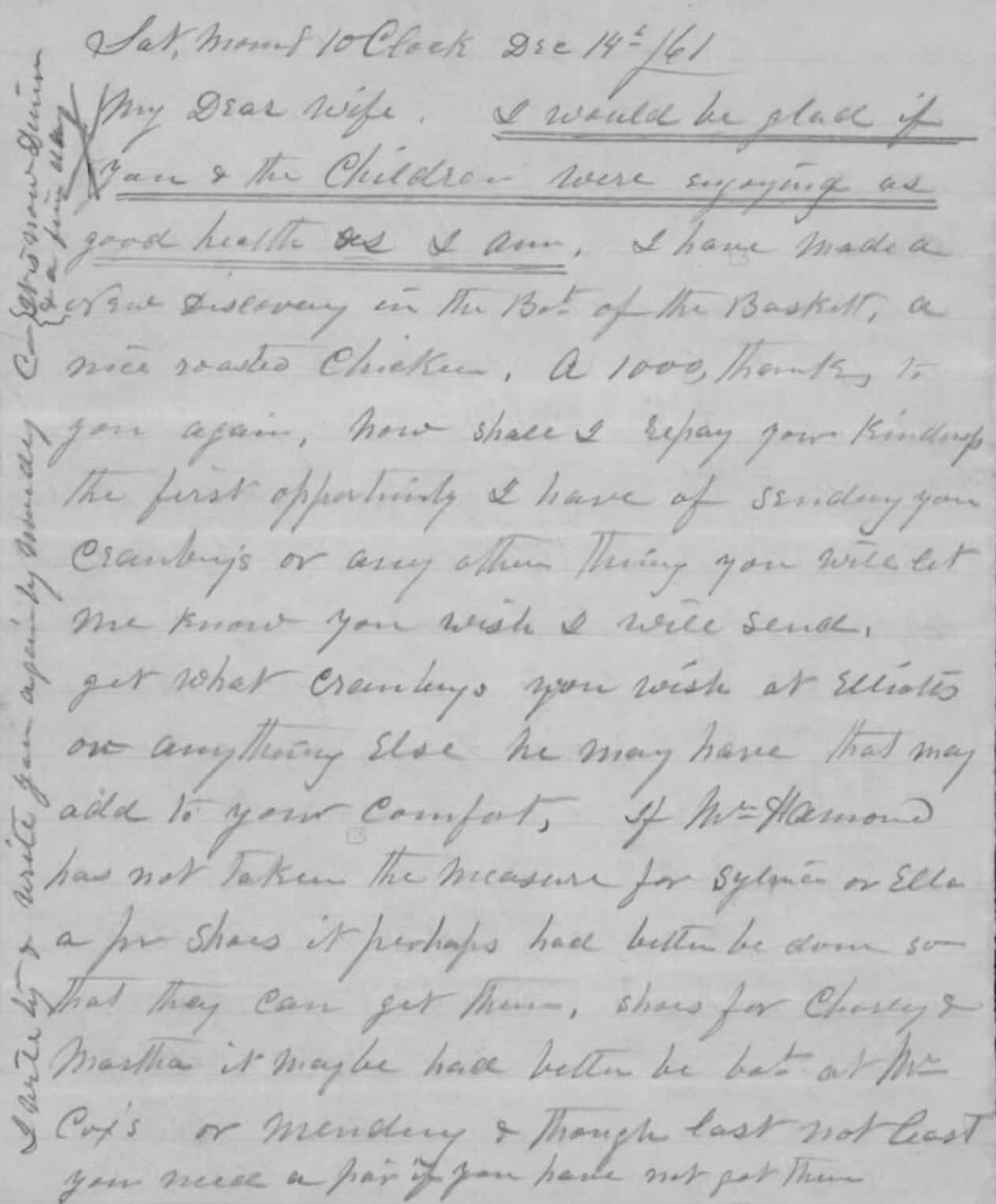
   

Sat. Morning 10 o’clock, Dec. 14, 61

 My dear wife I would be glad if you & the children as good health as I am.

I made a great discovery in the bottom of the basket, a nice roasted chicken. A 1,000 thanks to you again. How shall I repay your kindness? The first opportunity I have of sending you cranberries or any other thing you will let me know you wish, I will send.

Get what cranberries you wish at Elliott’s or anything else he may have that may add to your comfort.

If Mr. Harmon has not taken the measure Sylvia or Ella a pair of shoes, it perhaps had better be done so that they can get them.

Shoes for Charley & Martha it may be had better be bought at Mr. Cox’ or illegible & though last not least you need a pair if you have not got them, you will please get. If you need money let me know, or there is a few accounts which if not paid in soon Gideon will look to these things. I hope you will not be backwards about writing to me in time, that you may be cared for in time. 

Those cakes which were put in my satchel, I have them except one. You will think it strange perhaps that I loved them so well at home & get here, have cared so little for them. Their turn will come by & by perhaps.

I would say that when Lieut. Rogers got in camp, it was night & had no supper & the men that came with him had no supper. I done what I could for their comfort & took W.R. into our tent & opened the basket of good things which you sent. He partook of the biscuit, butter & cakes & divided most of the apples to the boys that there happened to be in. I had not discovered the chicken there.

Mr. Dunedin(???)  gave us a pail full of apples as we passed his house. I have a few yet. We can get them here in camp 2 large ones for 5 cents, or small ones for 1 cent apiece.

I remain your affectionate husband, Chas.


— Letter 3
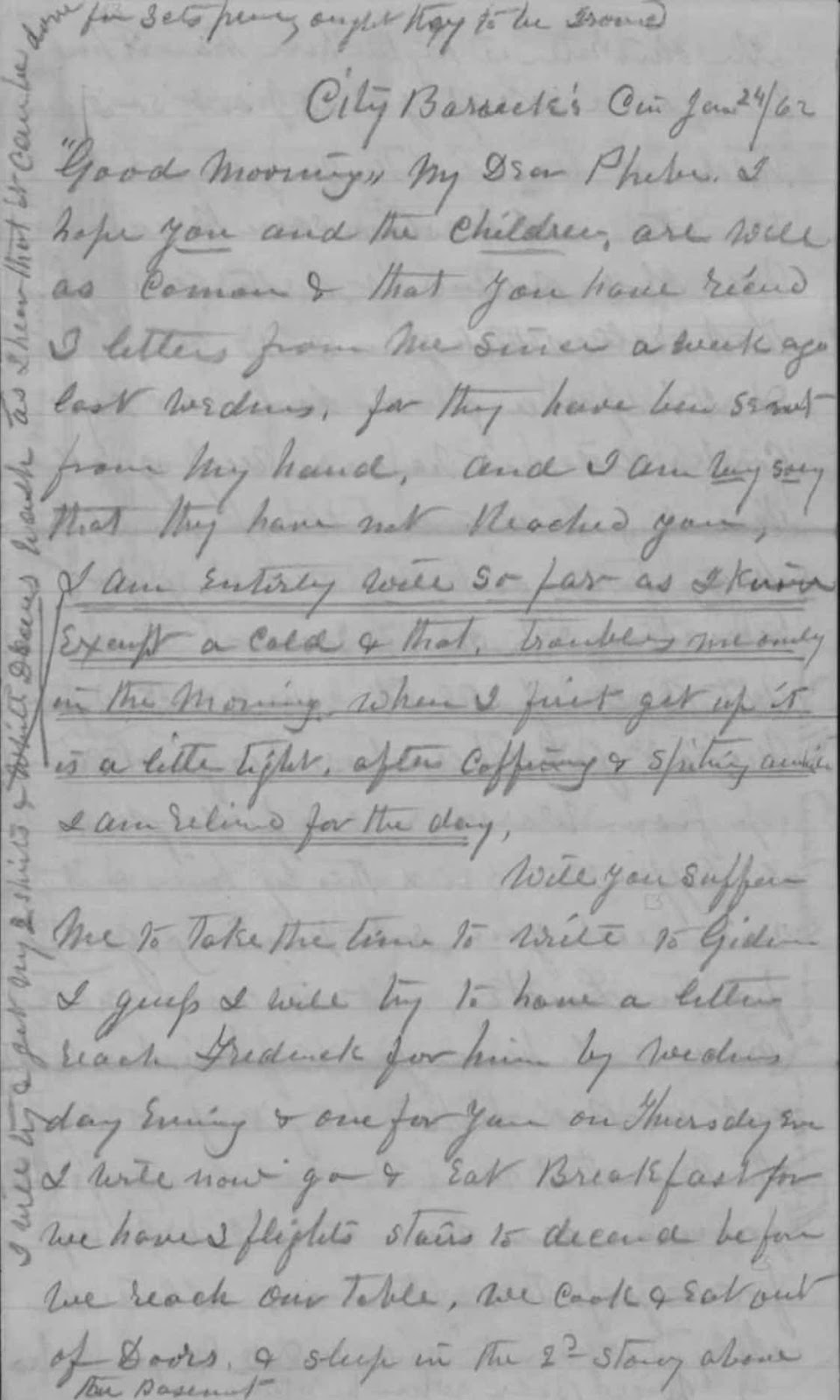


City Barracks – Cincinnati – January 24, 62

Good morning my dear Phebe. I hope you and the children are well as Corman & that you have rec’d 3 letters from me since a week ago last Wednesday, for they have been sent from my hand, and I am very sorry that they have not reached you. I am entirely well so far as I know except a cold & that, after coughing & spitting a while I am relieved for the day.

Will you suffer me to take the time to write to Gideon. I guess I will try to have a letter each for Frederick for him by Wednesday evening & one for you on Thursday evening. 

I write now go & eat breakfast for we have flights of stairs to descend before we reach our table. We cook & eat out-of-doors & sleep in the 2nd story above the basement.

I will try & get my 2 shirts & white gloves washed as I hear that it can be done for 3 cents illegible to be illegible.

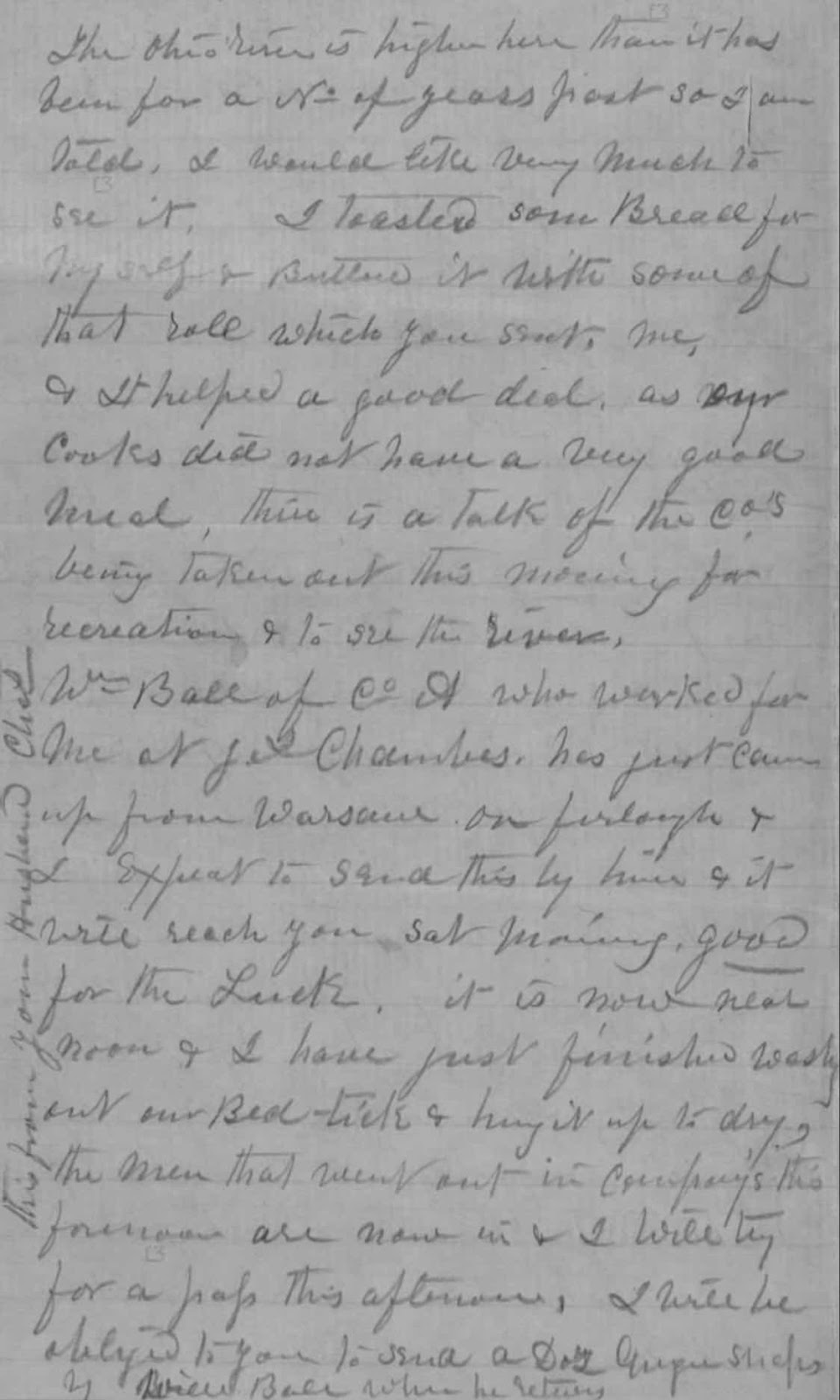
The Ohio River is higher than it has been for a number of years past, so I am told. I would like very much to see it.

I toasted some bread for myself & buttered it with some of that roll which you sent me & it helped a good deal as our cooks did not have a very good meal. 

There is a talk of the company being taken out this morning for recreation & to see the rivers.

Wm. Ball of Co. A who worked for me at Jms. Chambers has just come up from Warsaw on furlough & I expect to send this by him & it will reach you Saturday morning. Good for the luck.

It is now near noon & I have just finished washing our new bed tick & hung it up to dry. 

The men that went out in Company’s this forenoon are now in & I will try for a nap this afternoon.

I will be obliged to you to send a dozen illegible sticks by Will Baer when he returns. 

This from your husband Chas. 


— Letter 4 (it begins in middle of the first page)
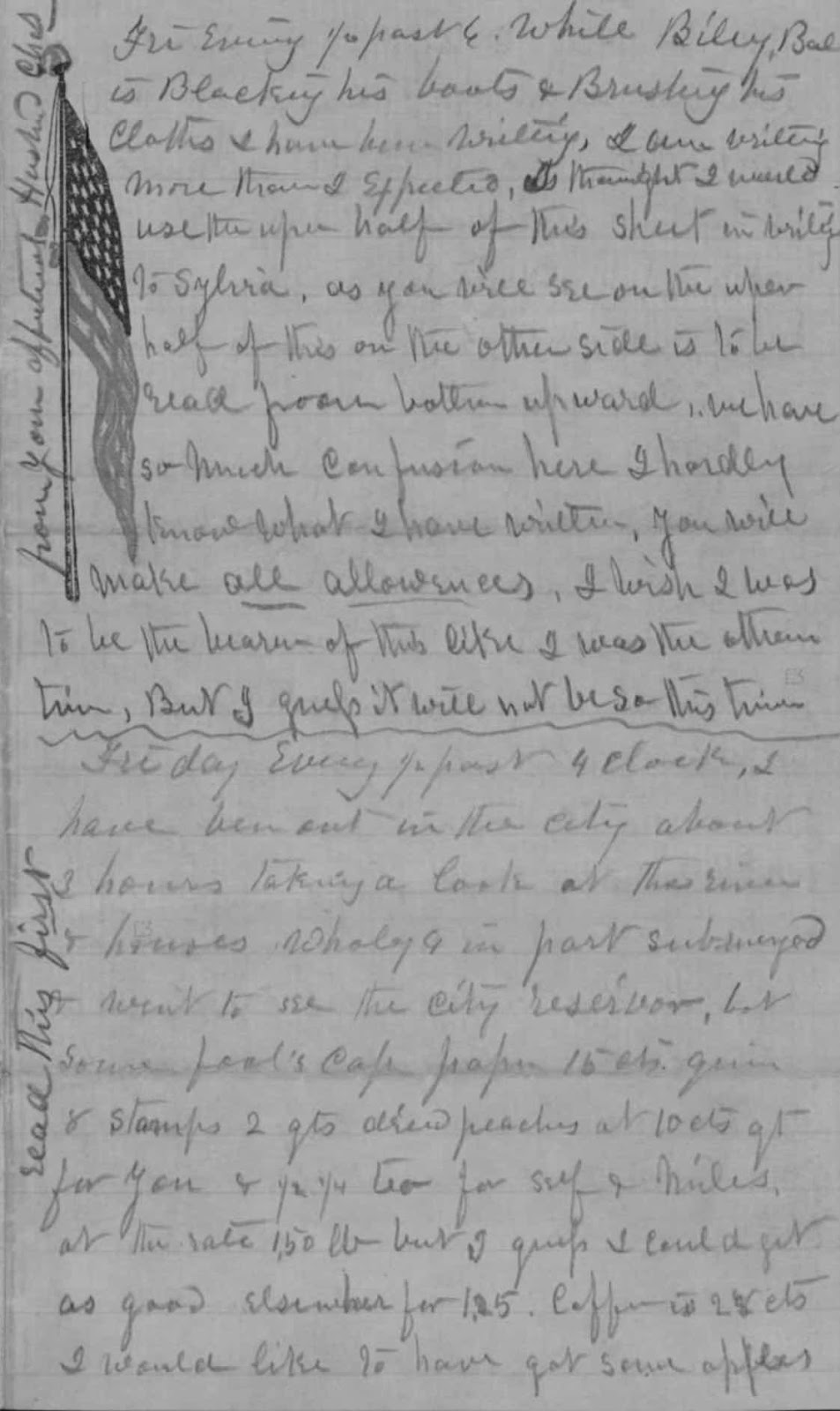


Friday evening ½ past 4 o’clock

I have been out in the city about 3 hours taking a look at the river wholly & in part submerged.

Went to see the city reservoir, bought some foolscap paper 15 cents, illegible 8 stamps, 2 quarts dried peaches, at 10 cents a quart for you & ½ ¼ tea for self & Miles at the rate 1.50 lb., but I guess I could get as good elsewhere for 1.25. 

Coffee is 2 cents.

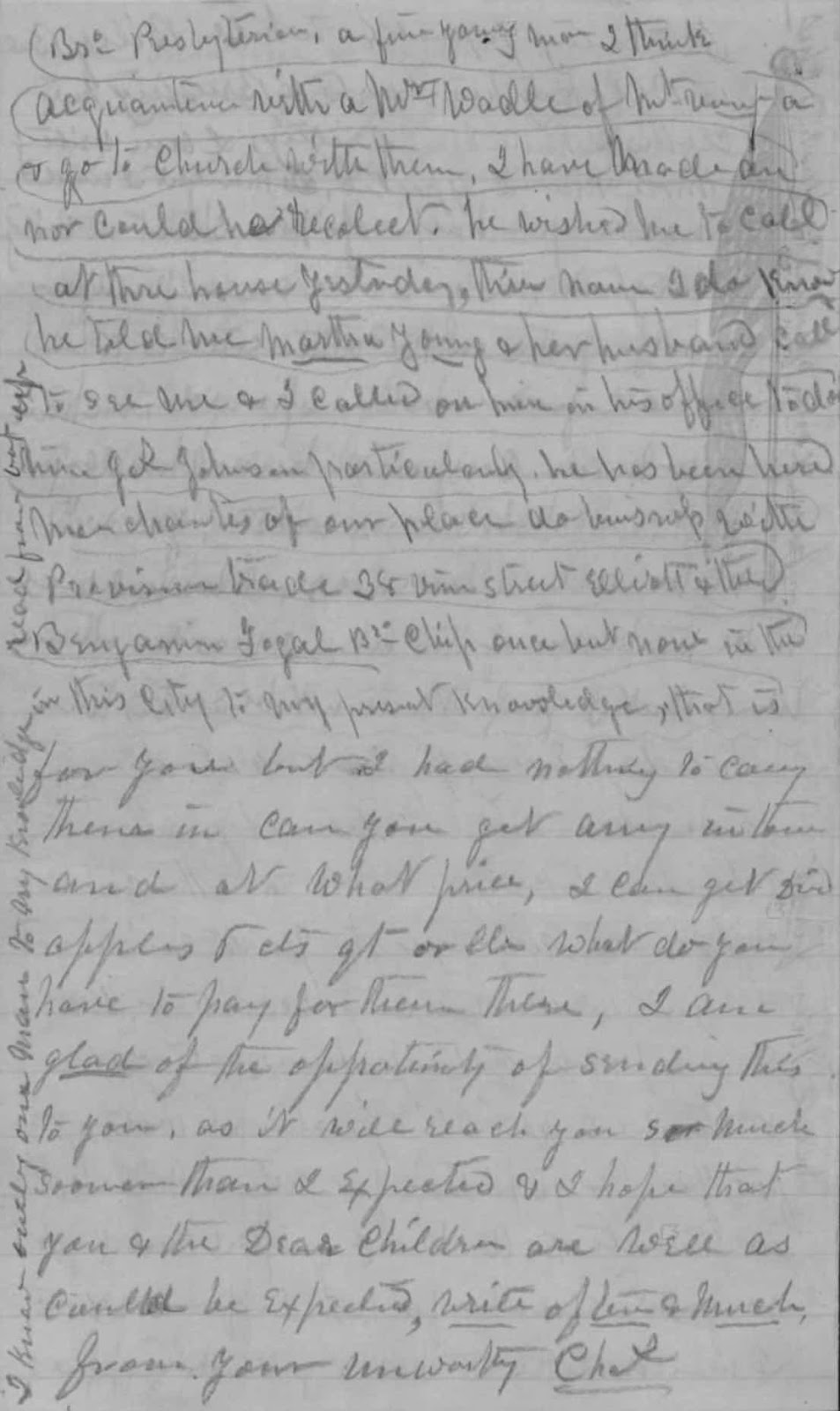
I would like to have got some apples  (move to middle of last page) for you, but I had nothing to carry them in. Can you get any in town & at what price? I can get fine apples 5 cents t or lb. What do you have to pay for them there?

I am glad of the opportunity of sending this to you as it will reach you so much sooner than I expected & I hope that you and the dear children are well as could be expected. 

Write often & much.

From your unworthy, Chas.

Top of first page: Friday evening ½ past 6.

While Billy Ball is blacking his boots & brushing his clothes I have been writing. I am writing more than I expected. I thought I would use the upper half of this sheet in writing to Sylvia, as you will see on the upper half of this on the other side is to be read from the bottom upward. 

We have so much confusion here I hardly know what I have written. 

You will make all allowances.  

I wish I was to be the bearer of this like I was the other time, but I guess it will not be so this time. 

From your affectionate husband, Chas. 

(Last section starts in left margin on final page, then moves to the middle of page and goes upward.)

I know exactly one man to my knowledge in this city to my present knowledge, that is Benjamin Fogal, illegible once but now in the provisions trade 39 Vine Street. Elliott & the merchants of our place do business with him J. Johnson particularly. 

He has been here to see me & I called on him in his office today. He told me Martha Young & her husband called at their house yesterday. Illegible – perhaps his? name I do (not) know nor could he recollect. He wished me to call & go to church with them. 

I have made an acquaintance with Wm. Waddle of Mt. Vernon, an illegible Presbyterian, a fine young man, I think.


Tuesday, October 27, 2020

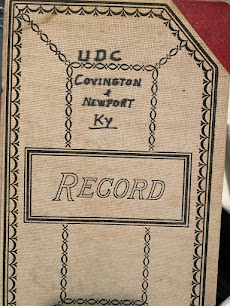
United Daughters of the Confederacy Meeting Minutes Book

 As I continue to plug along on my book project, a new, shorter-term but still intriguing idea has caught my attention.

At my local historical society, I found an old notebook of meeting minutes from the Henrietta Hunt Morgan Chapter of the United Daughters of the Confederacy. This chapter was in Newport and Covington, Kentucky, and this book covers late 1936 to the early 1940s. 

I am transcribing these minutes of the meetings which usually occurred  monthly, though some were cancelled. Once done, I may do some research on some of the ladies whose names are in the book, perhaps to figure out which of their ancestors were Confederate soldiers. This research may even turn up new names of local soldiers for my book or posts for this blog.

The minutes are generally unremarkable, filled with details of when and where the meeting was and how the meeting opened and proceeded. Most of this is pretty similar to other meeting minutes even from  today, but I might have a post or two with observations about some of the traditions they followed to open their meetings.

A few of the entries make mention of topics still of note today, such as contributions to fundraising efforts for statues of Jefferson Davis and even one about donating southern literature to a local high school library, perhaps part of the "Creating a Confederate Kentucky" phenomenon that happened in the post-war decades. (Thanks to Anne Marshall's wonderful book for the title that describes this period so well.)  I may go into further details on those topics and perhaps others once I have finished transcribed the entire book. I am about halfway through and am going through about one entry every day or two, so I probably still have a few weeks left before this will be finished. 

 I have also seen a couple of mentions of soldiers' names, one who had passed away in a neighboring county and another who was supposed to go to the 75th anniversary of the Battle of Gettysburg. Those names may deserve more investigation also. 

I am still working on my book, but this is a nice distraction and hopefully I can continue to work on both and make progress. This notebook is something different than anything I have done before and even the minutia of meeting details and the various motions made is intriguing to me. I started this post thinking I would say there was not much worth discussing in those minutes, but as I write this and describe what I’ve seen, the more I write, the more I believe will come from this. It won't be any groundbreaking  news on the Civil War era but may add to the (or at least my) understanding of this region in the post-war years and decades. This is something I will continue to pursue and see where it leads me. 

This book also includes a couple of loose papers and a newspaper clipping. The loose forms include two applications (each marked "duplicate")  to join a different chapter of the U.D.C. and correspondence about opening a new grave in the Confederate section of a local cemetery.

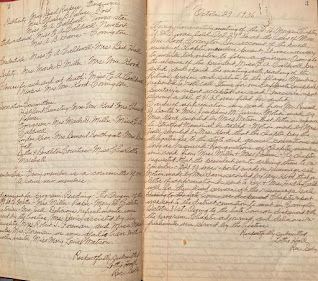
Here are a couple photos of the book.


Wednesday, August 3, 2016

1862 Letter from the Siege of Cincinnati: Private William G.Johnson, 97th Ohio

Several months ago, I posted about an envelope I had acquired along with the letter inside. My intent was to follow that post up quickly with the transcription of the letter and some research on it. I clearly failed to follow up on that intention, for no one particular reason, but now I have fixed that and here is the text of the three-page letter as followed by my research and thoughts on it. (I have left the spelling and grammatical errors as they appear on the original, as they make it feel more genuine and do not hurt its readability. I did not add the distracting "sic" either, but did, however, break it up into paragraphs.)

Page 1 of letter

----
Covington, Kentucky
September 8, 1862

My dear wife. I sit down this after noon in the enemy country to write you a few lines to let you no how I am getting along. I am well and hope these few lines will find you injoing the same blessing.  

We left Zanesville yesterday morning and arrived here about three o’clock last night. Sabers were left in Zanesville and Walter Barnett allso Matt left camp with out leave and has not been heard of since. 

I do not no how long we will be here. We may leave in one hour’s time and we may not leave for one week. I heard that the 85th Ohio was here and I have been out looking for James and the rest of the (illegible - army?)  but I could not find any of them nor hear from them. 

Dear Mary. I suppose you have got my likeness. I sent it you you by CAS last  Saturday. Mary, I told CAS to tell you to give mother three dollars. Do so if you have not. 

Dear Mary I would love to have seen you once more before I left but I could not. Now Mary cheer up and keep in good spirits for I will take good care of my self and I do want you to do the same.

I must close for my time is limited. You need not write to me untill you here from me again. May God bless you Mary. 

Fare well, from your true and affectionate husband,

W.G. Johnson 
----

William Johnson had been born in Ohio in 1840, probably in Guernsey County. He enlisted as a private in Company B of the 97th Ohio Infantry regiment, on August 1, 1862, for a three-year term. (The company mustered in on September 1, 1862 at Camp Zanesville, Ohio.) He did not serve the entire term however as he was discharged on January 15, 1863 in Gallatin, Tennessee on a surgeon's certificate of disability, just a couple weeks after the Battle of Stone's River. Records do not indicate what caused the disability.

The Walter Barnett mentioned in the letter was a sergeant in the same company and a neighbor of the Johnson family. He was wounded at Kenesaw Mountain in 1864 and was promoted to 1st Lieutenant, so he obviously did not desert as the letter indicated he may have done. 

"James" was likely William’s younger brother. He was a private in company I of the 85th Ohio, a three-month regiment that was also involved in the defense of Cincinnati.  

The identities of "Matt" and "CAS" are unknown. A search of the 1860 census showed one "Mathew Lennon" as a neighbor of the Johnson household. The only military record for him, however, shows he joined the 122nd Ohio Infantry.  It was also organized in Zanesville, but not until September 30, after this letter was written. Might Mathew have joined a three-month regiment like the 85th Ohio and then changed to the 122nd somehow? Perhaps his paperwork was incomplete or lost? Or, probably, "Matt" was someone else. 

No candidate for "CAS" seems obvious. (I capitalized it in my transcription, but it was in small letters in the document. My assumption is they are a person's initials, based on the context.)

I also wonder about the "likeness" he sent home. Did it make it there? How long did it survive? Perhaps it is still in someone's collection, stuck in a pile of old photographs of unidentified men and women. Or maybe one of his descendants still has it.

Anyway, Ohio Civil War Central tells the story of how Johnson and his comrades in the 97th Ohio ended up in Covington and its actions following this scare to Cincinnati, then the country's sixth largest city.

"On September 7, 1862, officials dispatched the 97th via railroad to Covington, Kentucky, where, the following day, the regiment took up a position near Fort Mitchel. Confederate General Kirby Smith was currently leading a raid in northern Kentucky, and authorities believed his goal was to capture Cincinnati, Ohio, which was located just north of Covington and across the Ohio River. The attack never materialized, and on September 20, 1862, the 97th boarded the steamer Emma Duncan and sailed for Louisville, Kentucky, arriving two days later. The regiment immediately joined the Army of the Ohio, which was preparing to pursue Confederate General Braxton Bragg’s army.  The Army of the Ohio departed Louisville on October 2, 1862 and engaged a portion of Bragg’s command on October 4, 1862 in a small skirmish at Bardstown, Kentucky. On October 8, 1862, the Battle of Perryville, Kentucky occurred. The 97th fought well in this engagement."
Fort Mitchel, courtesy sonofthesouth.net
It is noteworthy that he referred to Covington as "enemy country." It is part of Kentucky, which was a slave state, but also remained in the United States. Covington lies along the northernmost border of Kentucky, on the south side of the Ohio River, the unofficial border between north and south at the time, at least west of the Mason-Dixon Line. Underground Railroad stations existed throughout the region, but, on the other hand, when John Hunt Morgan escaped from prison in Columbus, Ohio, he supposedly found a safe house one night in the Covington/Fort Mitchel area. Both sides of the war enjoyed support in the area, so it was not unreasonable for a northerner, even one from a state bordering Kentucky, to think of it as "enemy country," though it certainly caught my attention.

William married Mary Harper in 1865. They had eight or nine children, as records I found varied. He spent much of his life in Ohio, but by 1895 lived in St. Paul, Minnesota. He was in Minneapolis in 1905 and in the Minnesota Soldier's Home in the same city by 1910.

MN Soldier's Home, courtesy cityhistory.us


Mary passed away in 1916 and William lived until January 5, 1921 when he died at the soldier's home. He is buried in section C, lot 204 at Hillside Cemetery in Minneapolis.

Rest in peace, private William Johnson.

Courtesy findagrave.com

Saturday, July 21, 2012

Provost Marshall Takes Action in Covington

From the Covington Journal of July 19, 1862 comes this untitled notice, again showing that even this town on the very northern border of this Union state (just across the Ohio River from Cincinnati) faced the challenge of dealing with southern sympathizers. 

Several citizens of Covington were served with the following notice on Tuesday last: 

Provost Marshall's Office,
Covington, July 14, 1862

"Information having been furnished me, that your house has been for months past the rendezvous of rebel sympathizers, it is, therefore, ordered, for the maintenance of peace and good order, that all crowds congregating within the limits of my supervision, whose actions and conduct place them as enemies to their country, and whose sentiments and sympathies are known to be in opposition to the Government, be warned that such connivance on heir part will be considered as a direct violation of the orders of General J. T. Boyle, for the government of this Department.

James L. Foley,
Provost Marshal of Kenton County"

google map showing location of Covingtion

Wednesday, March 21, 2012

War-time Entertainment Comes to Covington Ky

This is not exactly a "Civil War" post, but I found this advertisement in the March 22, 1862 Covington Journal to be worth publishing here. Tom Thumb was one of P.T. Barnum's most famous characters and attractions. It probably was just a case of exploitation of his condition, but that was not necessarily a bad thing in that era. Anything for a buck was pretty much fine (especially considering people still bought and sold other people as if they were cattle or other property.)
--


 The Original, Celebrated and World-Renowned American Man  in Miniature,
GEN. TOM THUMB!
The Smallest Man Alive.
At Odd Fellows Hall, Covington
Positively for Two Days Only
Wednesday and Thursday April 2nd and 3rd

Two brilliant entertainments each day - afternoon at 3 o'clock, evening at 8.
Doors open half an hour previous

The General will appear for the first time in Covington in many years, in all his new and wonderful Impersonations, Songs, Dances, Grecian Statue &c., assisted by:
MR. W. TOMLIN, the great English Baritone and Buffo, from the Nobility's Concerts, London;
MR. W. DEVERE, the American Tenor, and
MR. TITCOMB, brilliant pianist.

The General will ride in his beautiful Miniature Carriage, drawn by Lilliputian ponies, and attended by Elfin Coachmen and Footman, from the Madison House to the Hall, previous to each entertainment.

Admission
Day Entertainment 25 cents                Evening Entertainment 15 cents
Children under 10  15 cents               Children under 10   10 cents
Schools admitted on liberal terms       Reserved Seats 25 cents

Alfred Cately, business agent
---
This was about a year before his celebrated marriage to Lavinia Warren, as seen in their wedding photo below, courtesy, click.si.edu.


Sunday, February 5, 2012

Party Proscription

Here is another article from the February 1, 1862 Covington Journal. This has nothing relevant to national - or perhaps even statewide - news, but it's an interesting example of how politics, political feelings and maybe even pure rumors started to play a role in how a local government conducted business and how people's lives were affected. (I must also admit that it does seem unlikely that political sentiments had never been involved in such a decision before, especially in an era where politics was a dominant topic, but allowing a relative's possible beliefs to be the reason to deny someone a job was probably new.)

In selecting teaches for the Public Schools of Covington, a few days since, the Board, for the first time in the history of its transactions allowed party feeling to control the appointments. Four lady teachers - experienced, popular and thoroughly competent - were denied a re-appointment, not because they had taken any part in politics, but because a father or brother was supposed to entertain States Rights opinions. The day is not distant when the members of the Board will be heartily ashamed of the transaction.

Wednesday, December 22, 2010

Tuesday, December 21, 2010

A Secret Society in Kentucky

The Secession Ball in Charleston has been generating a lot of interest in the blogosphere, and even in the mainstream press to some extent, recently. Secession was, obviously, a topic of much discussion and debate 150 years ago as well, as South Carolina's declaration was soon followed by similar pledges from other states in the deep south. The future of  the upper south and border states was not so clear, at least until the attack on Fort Sumter and President Lincoln's call for 75,000 troops, after which the upper south states decided to leave the Union as well.

This question still remained unsettled in the border states of Delaware, Maryland, Missouri and Kentucky, however.  Below is an article I found which discusses Kentucky's possible secession and potential reaction to such a decision. Newport is in the very northern part of the state, along the Ohio River, just across the river from Cincinnati, and just east of Covington, across the Licking River.
 
From the Covington Journal of May 18, 1861, this letter mentions an interesting rumor that never had the chance to come to fruition. This is an example of the mixed sentiment in this area at the time, as well as the uncertainty of how the state would proceed. All three men mentioned here, including the letter-writer, were lawyers and politicians in Campbell County (which includes Newport), so they likely knew each other, though Boyd obviously took a different view of national politics than the other two did. 

Below the letter I have included the biographical information I have been able to find about each of these men.

Newport, Ky., May 17, 1861

To the Editor of the Covington Journal: 

Sir: I am informed that there is a secret society in this city, who have taken an oath, that in the event that Kentucky, by a legitimate vote of her citizens, should determine to go with her sister States of the South, they, the members of this association, are to take up arms against the State, and join their friends of the border free States, in a raid upon the loyal sons of Kentucky. G.P. Webster and Gus Artsman, are two of the prominent leaders. I have the names of others; but withhold them for the present. I have also the names of gentlemen from Covington, who have been officiating in this matter. It is proposed to extend this anti-Southern or Abolition association throughout this county, and other border counties. These men will be remembered by the people of Kentucky for their wicked and hidden designs upon their peace.


F. A. Boyd


F.A. (Frederick) Boyd
Boyd, was born in Mason County Kentucky in 1815 and moved to Campbell County as a boy, along with his father. He graduated at the top of his law school class at the Cincinnati Law School in 1836, where he was highly regarded, and h became a lawyer in Newport. Health issues eventually slowed him down, and affected how much work he was able to do, but he was elected to the Kentucky Legislature in 1849, where  he served two terms. He then was chosen mayor of Newport in 1853, before becoming County Judge when his four-year term in Newport expired.  In 1868, he was a Kentucky representative at the Democratic National Convention in New York, where Horatio Seymour was nominated for President.

Judge Boyd passed away in 1891, as the oldest member of the Campbell County Bar, and apparently had earned much respect during his life based on resolutions passed by the County Bar and its members.

I did find it interesting that none of the articles I could find mentioned his apparent sympathy towards the South. Perhaps this was a sign of reconciliation and respect, or perhaps the coming of the war and Kentucky's insistence on remaining in the Union convinced him to keep his views to himself.

Gustave Artsman
Colonel Gustave "Gus" Artsman was born in Germany in 1829 and came to the United States in the mid-1840s before settling in Newport around 1854. He was elected Campbell County Circuit Court Clerk in 1856 and remained in that position until 1863. His obituary says he resigned in 1863 to become a Major in the 23rd Kentucky Volunteers during the Civil War, but I have not been able to find his name in that unit's records. I do wonder if there was another spelling (perhaps Anglicized somehow) that might show up in the records, but I have not yet found it.

Another article mentions that he was placed in charge of the Home Guard units in the area in 1863.

In 1872, he became Master Commissioner of the Campbell County Chancery Court, a position he held for 20 years.  His obituary says he was a Mason, dedicated to his church and a member of the "Loyal Legion" by which I believe it means the Military Order of the Loyal Legion of the United States

He passed away in 1902. Among his pallbearers were Samuel Bigstaff and Colonel A.S. Berry, both of whom were Confederate soldiers in the Civil War.

George P. Webster
I have found less information about him than the others, but in 1862, the Covington Journal reported that: "George P. Webster of Campbell county, has resigned his seat in the Legislature, to accept the office of Assistant Quartermaster General."  Several other articles in the war years mention him performing his duty in this role from Covington and even moving to Cincinnati and then St. Louis after the war.

He had also served as the Campbell County Attorney, at least in 1856, as well, so it is likely that his profession enabled him to become acquainted with Boyd and Artsman.