Showing posts with label newport. Show all posts

Thursday, May 29, 2025

Committed to the Union: John A. Arthur, Soldier

In war as in life, some people act more decisively than others, making quick, even rash, choices, while others prefer to proceed more cautiously, watch their steps, and let life play out before deciding what to do next. In April of 1861, after events in Charleston, South Carolina started the Civil War, Newport resident John Arthur joined those in the former category, signing up early and often to fight on behalf of the United States. Fortunately for him, his aggressive thinking proved not to be mere carelessness.

John had been born on February 6, 1837, in Cincinnati, Ohio.

He and his family were in Newport, Kentucky by 1850, and when the Civil War started just more than a decade later, John immediately decided to answer the call to defend his home country while other men waited for months or years to do the same if they did so at all. On April 17, 1861, just five days after the Confederate attack on Fort Sumter, John enlisted in a three-month unit, company D of the 2nd Ohio Infantry, signing up in Cincinnati. One of the leaders of the unit, then Lieutenant-Colonel Rodney Mason, later earned infamy due to his actions and alleged cowardliness as colonel of the 71st Ohio at Shiloh and then Clarksville, Tennessee. Other Campbell County men served under Mason in that regiment, but not John.

After his brief service in the 2nd Ohio, which included action at First Bull Run, John could have joined the three-year version of that regiment but instead decided to recruit and captain a military unit he called the Newport Company or Newport Home Guards, which saw action in the first Battle of Cynthiana against the troops of Confederate General John H. Morgan on July 17, 1862. 

During this battle, his troops remained near the artillery battery of Captain Billy Glass and his men from the Cincinnati Fire Department, and reportedly helped those comrades handle their cannon.1 

1st Battle of Cynthiana, 1862  
 
John’s company, which rumors exaggerated as being “badly cut up” or “all either killed or taken prisoners” actually lost two men killed, four wounded and two missing in this engagement, with Louis Wolff and William H. Shipman being the unfortunate duo who lost their lives in the Confederate victory. Those numbers represented a small but still significant loss in a company of men from the same town, showing that even Home Guardsmen could suffer the cruel fates of combat.2

William Shipman had been medically discharged from the 23rd Ky before joining the Home Guards

Morgan and his men went on to complete the rest of their raid while the Union troops also carried on with the war and their lives. The remaining Newport men returned home after Morgan paroled them.3 The survivors reportedly walked from Cynthiana to Falmouth, a town about 20 miles to the north, before boarding a train that arrived in Newport about 3:00 in the morning.4

Two days after this battle, the company assembled on July 19 and collected more than $500 for the benefit of the families of their deceased colleagues. They passed a resolution of sympathy for those families and a thank you “to the citizens of Cynthiana, who befriended the company, while in that city.”

Their statement read:

Whereas Divine Providence, in its wise dispensation, has been pleased to remove from our midst, in the late fight at Cynthiana, our gallant comrades and brothers-in-arms Louis Wolff and W. H. Shipman, and whereas, we, in common with their many relatives and friends, are called upon to mourn their loss, therefore, be it

Resolved, that in the fall of these gallant spirits – our brave comrades, fighting valiantly in defense of our common country, our company has met a sad and irreparable loss, and our community has been deprived of two of its most worthy citizens and that we will ever cherish their memories.

Resolved, that we sincerely sympathize with the brave parent of one, and the widowed wife of the other, and the many friends of both, and that remembering the parents and widow we will ever be to them sons and brothers, extending to them helping and protecting hands.

Resolved, that a copy of these resolutions be sent to the families of our deceased comrades and published in the daily papers.5

Louis Wolff’s family later offered its “most grateful thanks to the member of the Newport Home Guards, the citizens of the Third Ward, and to the Cincinnati Young Men’s Choir for the kind attention and respect of the remains of their most lamented son and brother.”6

John, who had played “so gallant a part in the Cynthiana fight,” still desired to aid his nation and the war effort, so he opened a recruiting office on York and 4th Streets in Newport where he was “enlisting a cavalry company for the regiment of Colonel (Richard) Jacob, to be assigned to the twelve months service in Kentucky.” A story discussed his service with the 2nd Ohio, an experience which meant that John was “well acquainted with the vicissitudes of the soldier’s life.” The writer was confident John would “make a good officer.”7

Recruiting soldiers was a serious concern for the government, military men like John, and even local communities who hoped enough men would volunteer to support the Union and perhaps avoid the necessity of resorting to drafts, so a “large and enthusiastic” meeting took place at the Newport Courthouse on Friday, August 15, in an effort to generate more pledges for John’s unit and others. As customary on such occasions, patriotic speeches were made and following these addresses, John stood up to announce a few financial awards that local citizens were offering to prospective recruits. One man promised to pay $5 a week for one year to the family of a married man who joined John’s company. Another offered to donate $100, which was to be split equally among five recruits, while a pair of men donated $50 each, to be divided likewise. John Fenzell gave $100, with half going to two pledges to John’s company and the other half to two new members of a company George Crist was planning to raise. Another man graciously gave $100 to be shared by seven recruits, and one final proposal came from a man who agreed to “supply the family of a volunteer with one dollar’s worth of meat per week for one year.” Besides these promises, a “patriotic individual” wishing to remain anonymous gave John $100 to split among “five of the most ready recruits” who enlisted in his company.

Ten new recruits pledged their services during the assembly “and a number more” joined one day later.

The meeting attendees concluded their gathering by forming a committee to seek donations “to a fund for the benefit of the wives and families of volunteers.”8

In addition to those financial rewards, men who willingly signed up to join this unit would receive a benefit that provided more motivation to enlist. A draft was still necessary in order to enlist enough men, and Campbell County’s quota of men was set at around 500 men, approximately 250 of which would come from Newport. According to the Cincinnati Daily Gazette, men who joined Arthur’s company “will have but one year’s military service to perform and will escape the draft.” A short term and avoiding the embarrassment of being drafted and forced to fight were effective incentives for this company. This same report noted that only about 20 available spots remained in the unit, and it expected the company to be full by the end of August 16.9

The report was accurate, as John’s company quickly filled its ranks so successfully that he even rejected twelve men who offered to join the group after he had met his requirements.10

Once full, the company consisted of 103 men. These soon-to-be warriors who had secured their places in the army were soon happy and lucky enough to enjoy a “fine dinner” that local women prepared in the fire house on York Street.11 The men then departed on the steamship Florence traveling first to Louisville, from where they were to move to Eminence, Kentucky, “where they will go into camp for a short time.”

Eminence was where Jacob’s 9th Kentucky Cavalry unit was forming.

The men arrived safely at Louisville and settled into camp near that city but soon learned they would now be joining the 1st Battalion of James Shackelford’s 8th Kentucky Cavalry since Jacob’s unit had already filled up before their arrival, much like the issue this company experienced.12 Patriotism and a willingness to fight were still strong at this point of the war.

Shackelford, a “prominent” guerrilla hunter in western Kentucky, later was promoted to Brigadier General of U.S. Volunteers.13 

James M. Shackelford

Just a few weeks after John’s company joined the 8th Kentucky, back in Newport, “fears have been felt for the safety of Captain John Arthur who left here a few weeks ago with a cavalry company for Louisville, nothing having been heard from him since his departure from there.”

Those worries dissipated in mid-September. George W. Sarver, mistakenly described as a member of Arthur's company, arrived at his home in Newport, where he reported that Arthur’s men were in “excellent health and spirits” in Henderson, Kentucky. He also brought the news that the company had mustered into the service and the men had received their bounty money. Like many new, innocent, and perhaps naïve troops, they were now “eager for the fray.”14, 15 


Just how and why Sarver had this information is uncertain. Had he joined the unit, but not been officially added to the roster? Was he a friend of one of the company officers?

The regiment these men joined, the 8th Kentucky Cavalry, formed in Russellville, Kentucky for one year and mustered in on August 13, 1862. It remained in Kentucky and Tennessee for most of its existence, seeing service combating irregular Confederate soldiers, perhaps partisan rangers, or guerrillas, as Union officials frequently labeled them, and joined in the pursuit of Morgan and his Confederates during his “Great Raid” during the summer of 1863, ending with Confederate defeat at Buffington Island, Ohio, on July 19, 1863,16 a week before Shackelford led another group of men who captured Morgan at the Battle of Salineville.   

John H. Morgan 
       
Once his company had found its military home in this regiment, John’s fortunes changed for the worse when alleged Confederate guerrillas  captured him at Elkton, Floyd County, Kentucky on August 5, 1863. The unit had been in western Kentucky for much of its service, but John and others were on a hunting expedition for such men in the eastern part of the state at this moment. He spent time in Confederate prisons in Columbia, South Carolina (where he suffered a hip contusion) and Virginia, including Richmond’s well-known Libby Prison, where he arrived in late August of 1864, along with David Lock, another Newport resident in the company.17

Libby Prison 

Weeks later, the Confederates moved him to another facility this one in Macon, Georgia.18

As the war neared its end, his enemies released John from prison and paroled him on March 1, 1865, in North Carolina. The Cincinnati Daily Times of March 13 noted that he had been “long confined in the Rebel prisons,” but now his friends could “rejoice to learn that he has been exchanged,” which technically allowed him to fight again, though his term had expired and the war was almost over. It also said that prior to the war, he had been “long connected with the Times’ office.” 

By the time of this report, John had already arrived in Annapolis, Maryland, likely at a camp for paroled Union soldiers, for a quick health check and verification of his new status on his way home.19

He finally did make his way back to Newport, knowing  he had done enough military service to fulfill any obligations he felt, especially as tge end of the war appeared close, but a controversy that was minor in scope yet important symbolically occurred in the months after the fighting ceased.

In September 1865, the Cincinnati Daily Gazette reported that members of the Taylor Street Church in Newport would apply for an injunction against several Union supporters, including John, James R. Morin, formerly a lieutenant in the 8th Kentucky Cavalry, prominent attorney Ira Root, and more, to stop them

from interrupting or in any manner interfering to prevent the free use of the Taylor Street Methodist Episcopal Church by Rev L D Huston and the congregation usually attending there for the purpose of religious worship. Notice to the above effect have been served on the parties named. The church is now held by civil authorities.20 

Another account specified that these men had attended a meeting at the church on September 15 and had resolved to close the house of worship that they found to be disloyal even after the major Confederate armies had surrendered. That decision led the churchgoers to pursue the legal action.21

This church had been known as the Taylor Street Methodist Church South for years until they removed that final word in April of that fateful year.22 Though not explicitly stated in the newspapers, it appears that these men were harassing people they believed were sympathetic towards the South. Given the happenings at the time nationally and in Kentucky, that is not surprising. Dozens of Campbell County men suspected of supporting the Confederacy had been arrested during the war, and others joined Confederate units, so such sentiment certainly existed throughout the county. 

Even some church members recognized that outsiders might question the institution’s reputation. In August of 1864, eleven months before the request for the injunction, and while the war was still ongoing, “Union members” of the church board had proposed a set of resolutions concerning “the reputed disloyalty of the church toward the United States Government” and urged that the state conference of the Methodist church adopt “a decided loyal position and separate themselves from all disloyal connections.”

Surprisingly, however, the preacher in control of the church refused to adopt these resolutions and the church members, despite being having the power to pass them without his permission, let them quietly fade into oblivion. Those members still felt “much dissatisfaction” with their leader, but instead of pursuing the issue further, they let it go for the time being, expecting to hire an “unconditional Union minister” one year later, a delay which perhaps led to the harassment from men like John.23

Since the actual members of the institution had questions about its faithfulness to the national government, it was only natural that strong Union supporters would notice the same issues. Such division between Unionists and Southern supporters remains a major part of the legacy of the Civil War in Kentucky, even of the postwar years, when some people claimed that the state had “joined the Confederacy after the Civil War.” It was a complicated era in the state, and Campbell County was not immune to such difficulties.

In his postwar years, John spent most of his time in Newport, where he also served a term on City Council.24 At some point, though, he left the city, but only temporarily, as an 1869 story reports that he returned “to his home in Newport yesterday, after several years absence in the Far West.”25

One year later, he lived there with his parents Robert and Elizabeth, and two older brothers. He worked as a reporter according to that year’s census, agreeing with an 1864 story that had mentioned that he was “connected with the (Cincinnati) Daily Times.”26  

At this point, this story took some unexpected turns as ensuring its accuracy became a bigger challenge to me when I noticed a second John Arthur on the 1870 census, this one living in nearby Covington and working as a steam engineer, making it reasonable to think it could be the same man. The findagrave record of this man (created by a man I know and trust) showed this John Arthur (the engineer) as the soldier I had been studying. That page also mentioned that he had died in 1884 in St. Albans, West Virginia, and I found a newspaper record that mentioned the same death date and place for a John Arthur. 

Continued research, however, showed that this was a different John Arthur, one without the middle initial or the military experience. A pension index card for a widow’s pension finally confirmed the death information of the soldier John Arthur, then a cemetery record attached to his findagrave page verified the information on the pension card. It even shows a date and place of birth for him as well. With this new information, I was then able to find newspaper stories providing more details on his life and death. (I admit I'm just more than a little relieved to have found this information before hitting the "publish" button.)

In addition to being a soldier, John A. Arthur had a long snd respected career in journalism, mostly in Cincinnati, but eventually landing him a bit north in Columbus, Ohio, where he passed away on February 9, 1875.

His previously mentioned findagrave page claims that he “was assaulted for something he wrote in the Sunday News,” which more formal accounts from the time mostly support. 

The Cincinnati Commercial described John as “well known as a newspaper man” in Cincinnati, then Columbus. It reported that on the night of February 5 he was on the street  outside his house, when a group of “ruffians” assaulted and robbed him. “His wife heard his cries” and quickly exited the house only to find him “in a pool of blood, which glowed from a wound in the face.” 

In the days following that attack, John was constantly “growing worse” and had been unconscious for most of that time. He could barely recognize his friends when he was awake. He finally succumbed to injuries at midnight on the 10th.27

 The Cincinnati Daily Star offered a similar account of his death but added a few details about his career.  He had worked for the Cincinnati Gazette at one time, including a stint as editor. He then was editor of "the old Cincinnati Times," and then the Columbus correspondent of the Daily Star.

He had been "highly esteemed by all his associates," who found him to be a "most competent and reliable man in his profession."

This story mentioned his time in the Civil War, where he "served with distinction," and claimed that he had been in Libby Prison for 18 months. This exaggeration was an error as the paper may have heard he was in Libby and assumed that was his only prison home since it had a notorious reputation.

John's body was laid to rest in an unmarked grave in Green Lawn Cemetery in Columbus.

Despite his career in the newspaper business, I have found no wartime reports from him in the local newspapers. Perhaps future research will uncover some such writings, or maybe he had them published anonymously, though I’ve not yet found any such possibilities. Then again, he may have chosen to focus on his military duties instead of writing, especially in his role as captain. His time in prison may have also prevented him from being able to send such work back home. 

John had been a strong and unquestioned supporter of the Union cause during the Civil War, serving in multiple units (as captain in two of them), risking his health and life, and even surviving capture by the Confederates. He was one of the truest of patriots in Campbell County during these bloody years, a man who let his actions speak about his beliefs. He earned no fame for his service, but his story deserves a place in county memory.

1Cincinnati Daily Commercial, July 22, 1862
2Cincinnati Daily Enquirer, July 19, 1862
3Cincinnati Daily Enquirer, July 22, 1862
4Cincinnati Daily Commercial, July 21, 1862
5Cincinnati Daily Gazette, July 22, 1862
6Cincinnati Daily Commercial, July 25, 1862
7Cincinnati Daily Commercial, August 7, 1862
8Cincinnati Daily Enquirer, August 17, 1862
9Cincinnati Daily Gazette, August 16, 1862
10Cincinnati Daily Commercial, August 19, 1862
11Cincinnati Daily Enquirer, August 22, 1862
12Ibid
13Lindow, Derrick. We Shall Conquer or Die: Partisan Warfare in 1862 Western Kentucky. Savas Beatie. 2024 p. x
14Cincinnati Daily Enquirer, September 20, 1862
15Cincinnati Daily Commercial, September 20, 1862
16https://www.nps.gov/civilwar/search-battle-units-detail.htm?battleUnitCode=UKY0008RC, Accessed January 28, 2025
17Richmond Daily Dispatch, August 24, 1863
18Cincinnati Daily Commercial, September 24, 1864
19Cincinnati Daily Times, March 13, 1865
20Cincinnati Daily Gazette, September 26, 1865
21Cincinnati Daily Times, September 19, 1865
22Cincinnati Daily Enquirer, April 22, 1865
23Cincinnati Daily Commercial, August 26, 1864
24Cincinnati Daily Times, November 24, 1865
25Cincinnati Daily Enquirer, May 25, 1869
26Cincinnati Daily Commercial, September 24, 1864

27Cincinnati Commercial, February 10, 1875

Tuesday, October 27, 2020

United Daughters of the Confederacy Meeting Minutes Book

 As I continue to plug along on my book project, a new, shorter-term but still intriguing idea has caught my attention.

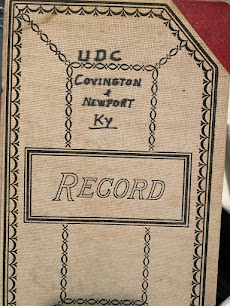
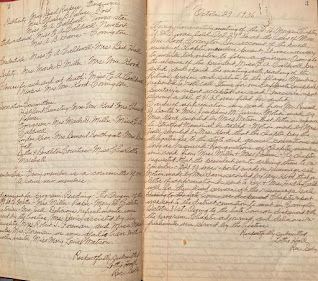
At my local historical society, I found an old notebook of meeting minutes from the Henrietta Hunt Morgan Chapter of the United Daughters of the Confederacy. This chapter was in Newport and Covington, Kentucky, and this book covers late 1936 to the early 1940s. 

I am transcribing these minutes of the meetings which usually occurred  monthly, though some were cancelled. Once done, I may do some research on some of the ladies whose names are in the book, perhaps to figure out which of their ancestors were Confederate soldiers. This research may even turn up new names of local soldiers for my book or posts for this blog.

The minutes are generally unremarkable, filled with details of when and where the meeting was and how the meeting opened and proceeded. Most of this is pretty similar to other meeting minutes even from  today, but I might have a post or two with observations about some of the traditions they followed to open their meetings.

A few of the entries make mention of topics still of note today, such as contributions to fundraising efforts for statues of Jefferson Davis and even one about donating southern literature to a local high school library, perhaps part of the "Creating a Confederate Kentucky" phenomenon that happened in the post-war decades. (Thanks to Anne Marshall's wonderful book for the title that describes this period so well.)  I may go into further details on those topics and perhaps others once I have finished transcribed the entire book. I am about halfway through and am going through about one entry every day or two, so I probably still have a few weeks left before this will be finished. 

 I have also seen a couple of mentions of soldiers' names, one who had passed away in a neighboring county and another who was supposed to go to the 75th anniversary of the Battle of Gettysburg. Those names may deserve more investigation also. 

I am still working on my book, but this is a nice distraction and hopefully I can continue to work on both and make progress. This notebook is something different than anything I have done before and even the minutia of meeting details and the various motions made is intriguing to me. I started this post thinking I would say there was not much worth discussing in those minutes, but as I write this and describe what I’ve seen, the more I write, the more I believe will come from this. It won't be any groundbreaking  news on the Civil War era but may add to the (or at least my) understanding of this region in the post-war years and decades. This is something I will continue to pursue and see where it leads me. 

This book also includes a couple of loose papers and a newspaper clipping. The loose forms include two applications (each marked "duplicate")  to join a different chapter of the U.D.C. and correspondence about opening a new grave in the Confederate section of a local cemetery.

Here are a couple photos of the book.


Friday, July 12, 2019

The Murder of Civil War Veteran James M. Carr

A few years ago, I had another blog, (www.civilwarheadstones.blogspot.com) for which I searched in local cemeteries for headstones of Civil War veterans and then researched these men. I found a few interesting stories, and a couple stood out more than others in my memory. For one of these, I actually made a few posts about it, though they were pretty bare-bones, with a transcription of newspaper articles and only a few of my own comments.

Even as years and years passed, I never forgot about this particular story and, a few months ago, I decided to look into it more closely. I ended up doing more research, analysis, and writing on it and published it in the Campbell County Historical and Genealogical Society newsletter. I thought it turned out well, probably the most interesting article I had ever written for that newsletter, at least from my own biased perspective, so I decided to put it back into blog format, edit it some and then post it here, though much of it involves the post-Civil War years.

It is a long story, but that should work better as a blog entry than in the paper newsletter. I find it to be a fascinating, though sad, story. I really felt like I came to know this "kind old man" based on various newspaper reports. I hope readers will enjoy reading it as much as I enjoyed finding, researching, and writing what will likely remain one of my favorite stories.

EVEN THE HEAVENS WEPT: THE BRUTAL MURDER OF JAMES M. CARR

The pitter-patter of the rain falling on the tin roof echoed loudly throughout the tiny shelter as investigators gazed in disbelief at the unforgettable scene before them on a SAD, DREARY FEBRUARY MORNING…

----

James Madison Carr was born in Kanawha County, Virginia, now part of West Virginia, on December 29, 1844. His parents likely named him for the 4th President of the United States, the “Father of the Constitution,” James Madison. (The 1850 census showed his first name as “Maddison” but “James” or “James M” appeared on all other records and the second “D” in Maddison seems like a mistake. On the same page of that record, the word “wagon” was misspelled “waggon.”)

Location of Kanawha County, courtesy wikipedia

He was born to lead a blue-collar life. His father William worked as a wagon maker and mechanic according to census records, and various records listed James as a laborer.

On April 12, 1861, civil war disrupted the nation, and many thousands of men rushed to volunteer for their preferred side. William hesitated briefly, but on September 2, 1861, in Boone County, Virginia, he joined company B of the 8th Virginia Infantry (U.S.), which was soon re-designated the 8th Virginia Mounted Infantry. 

More than a year later, on December 1,1862, James enlisted in Company K of the same unit, which officials renamed the 7th West Virginia Cavalry on January 26, 1864. The minimum age to join the army was 18 years and James still four weeks shy of that milestone, but found his way into the service, like many others at that time.

At the time of his enlistment, James stood five feet, nine inches tall, with a fair complexion, brown hair, and hazel eyes. He was working as a laborer and signed up for a standard three year term.

Their regiment participated in the Shenandoah Valley Campaign against Stonewall Jackson, the Battle of Cross Keys, and the Battle of Second Bull Run, among other expeditions, all before James enlisted. Once James had joined, it served on outpost duty throughout Virginia and the new state of West Virginia, and saw fighting at the Battles of Cloyd’s Mountain and New River Bridge. (One article claimed that James had served under U.S. Grant, but that is incorrect unless they referred to Grant’s time as General-in-Chief, in which he was in charge of all U.S. forces. The reporter may have included that line to inflate Carr’s record in the readers’ minds.)

War was more than just glory, fame and honor. In December of 1863, Confederate soldiers captured William in a skirmish near the Jackson River in Virginia. This was part of a raid on the Virginia and Tennessee Railroad by the troops of Brigadier General William Averell, a raid noted for its “extreme difficulty, the tenacity of (its) commanders and the courage of the soldiers involved.”

The Confederates sent William to Andersonville. General Averell reported that the enemy had captured 97 of his men on this expedition. A staggering 71 of those poor souls died at Andersonville. William was among this group, passing away from typhus fever and chronic diarrhea on April 6, 1864. He is buried at Andersonville National Cemetery.

William Carr's Andersonville headstone, courtesy findagrave.com
James was still only 19 years old when his father died. The news of his father’s fate must have been especially devastating to him since his mother had died when he was just five.

James served out his term like a good soldier. His regiment spent much of the last part of the war in and around the Kanawha Valley. Its men policed the region and paroled former Confederate soldiers who returned to the area following Robert E. Lee's surrender at Appomattox.

After the unit mustered out on August 1, 1865, James moved on to post-war life. He married Mary Ann Scraggs in Wellsville, Ohio on Christmas Day 1879, and in the next year was still working as a laborer in Ironton, Ohio.

The 1890 U.S. Veterans’ Census shows that the couple was living in Cincinnati at that time. Ten years later, James and Mary had moved to Newport, Kentucky, a city along the southern side of the Ohio River, across from Cincinnati. He worked as a general laborer and could read and write.

In 1910, the couple still resided in Newport, and his occupation was now “rag picker” with his industry (referring to place of work) shown as “around dump.”

Unfortunately, the 1910 census was the last which included this couple. Mary passed away on April 19, 1914, and James lived less than a year longer.

----

...FRIDAY FEBRUARY 5, 1915 dawned as an ordinary winter day, but things changed drastically about 7:00 that morning when Mrs. Samuel Mackkenzie, a resident of Newport (probably the Mamie McKinsey whom the 1910 census shows as a 30-year-old at-home laundress) stopped by the home of her friend James Carr to see how he was doing. A quartet of dogs, near their owner’s bed as if guarding him, greeted her with their whining. She looked past them and saw her neighbor on his bed. Believing him asleep, she yelled out to him. He failed to respond or stir, and, while looking at him ever more intently, she noticed dried blood smeared on his face, his body lying in a pool of blood. She inched nearer the lifeless body, and once more spoke to him, desperately asking what was wrong. When again he did not answer, Mackkenzie, also observing his crushed skull and other morbid details of the scene, finally accepted the unthinkable - her friend was dead! - and immediately notified the police, who came to investigate.

What the police found was beyond disturbing. “The upper portion of the man’s body lay on the bed, his feet and legs extended, supported by a broken chair, allowing the body to sag in the middle.” His corpse looked to be “cold in death.”

“A short-handled sledge hammer, clotted with blood, probably the one used in the killing, lay by the side of the bed. A stove lid lay by the side of the hammer,” reported The Kentucky Post. The Cincinnati Enquirer, meanwhile, relayed that the hammer weighed 8.25 pounds and was “covered with blood and some of Carr’s gray hairs.”

This was a gruesome scene, and an article bluntly stated its cause: “during the night someone had entered his poor dwelling and beaten his brains out.”

The official cause of death was obvious: “concussion (of) brain…head mashed by hammer.” His death certificate further noted: “death was sudden.”

James Carr's Death Certificate

Police scoured his tiny abode for clues, finding only a life insurance policy in Carr’s pockets, and some women’s clothing and a hat. Any money he possessed was completely gone, even though neighbors told police the old man had collected a $54 pension a few days previously. They said he had paid some bills and speculated that he likely had around $30 on him as Thursday ended. Robbery was the obvious motive of this crime.

A local resident found Carr’s military discharge papers on a nearby street.

Carr’s life had been far from luxurious. He “lived the life of a hermit,” while his “dwelling was poor and his living cheap.” His home was certainly small, in size about eight feet by ten feet; newspaper accounts referred to it as a “hut,” “a meager hovel,” “a poor, dingy hovel,” a "desolate hut," “a poor dwelling,” and a “battered little shack.” Carr had built it using old pieces of wood with scrap tin nailed to it, perhaps finding materials at a nearby dump. It stood “on the very banks where the Licking (River) and Ohio River meet.”

Inside the building, a support beam, resembling an “Indian totem pole” because of the moccasins, animal skins, and beads attached to it, helped hold up the roof, and a bed rested in the northwest corner of the single room. Other small items filled the place.

Pictures of exterior and interior of hut, KY Post 2-6-15. The quality is poor, but they give some idea of his small home. In the interior picture, note the support pole. Behind it, to the left is the bed and the chair is to the right. His body rested on those two pieces of furniture.
After viewing the awful scene, the police proceeded with their investigation. The unhelpful eyewitnesses Mackkenzie had disturbed remained in the home: “Four dogs lay on the bed by the side of the dead man. One huge white canine lay within a few inches of his master’s shattered skull. The white hair on the dog’s back was dyed to a clotted brown, where his master’s life’s blood had escaped over his back, as it seeped from the ugly wound in his skull.” It is difficult to comprehend the sheer horror the four pets had witnessed or what they may have understood or remembered about this heinous crime. (The fate of the dogs - did a kind local resident give them a home or did they become strays? - escaped notice from the reporters and probably will forever remain unknown.)

The investigators tracked down a few two-legged witnesses. A man named John King stated he had talked to Carr on late Thursday afternoon, helping place the time of the murder as later that night.

Mrs. Mackkenzie was another person of interest. Police spoke to her about the crime, but she provided no more help, claiming she often visited Carr, though without particular reason that sad day.

Three officers working the case, Lieutenant Lieberth and Detectives Burnside and Howe, questioned another woman, but received little information from her.

Police did locate two other potential witnesses, using a statutory charge of living together (a sign of how times have changed) to pick up Ella Owens and Owen McClaughlin. Interviews produced conflicting alibis from these two, who did, however, agree in denying knowledge of the crime.

Owens eventually claimed to be a distant relative of Carr, saying she sometimes visited him and occasionally cleaned his house and cooked his meals, though she had not visited Thursday night.

Investigators also discovered that Carr had given the 18-year-old Owens clothing and money and that when he visited her home, McClaughlin would hide behind a bed to make it appear Owens was alone.

The duo apparently provided no information relevant to the investigation, but another pair of neighbors shared more helpful stories.

The Kentucky Post reported that “a negro woman giving her name as Bassett,” who lived near Carr, said that about midnight on Thursday two men knocked on her door, waking and frightening her. She spoke to them through the closed door, leaving her unable to furnish a description of the unexpected visitors. She stated they wanted to know where Owens was, and then asked where Carr lived, which she told them. She soon thereafter heard a loud crash, then only a deafening silence. She heard nothing else, so she returned to bed. (This lady may have been Nancy Basset, a 67-year-old widow at the time of the 1920 census.)
    The Cincinnati Enquirer printed a similar story. It revealed that “a colored man named Bennett” reported that a stranger visited his house on Patterson Street, asked where McClaughlin was, then inquired where Carr lived. A short time later, Bennett heard Carr’s dogs barking, followed by a noise as though somebody was trying to break down a door. Mr. Bennett, who may have been a 74-year-old janitor named Johnson Bennett, did not investigate the sound.

    The newspapers mentioned no other witnesses, but reported that officials did have a theory about the crime. They believed that “a gang of thugs” had been traveling throughout the country, but had remained in town for a while since they apparently knew Carr’s movements. They theorized that the hoodlums attempted to rob the old man, but he resisted, leading them to “beat his brains out” with the sledge hammer, expecting or hoping that the nearby river, its level growing ever higher due to recent rains, would continue to rise and thus hide their crime by washing the corpse, and even the hut, downriver, to be lost forever.

    This was a sad loss for the community. Neighbors described Carr as a “peace-loving” man who loved flowers and they recalled that his yard “in summer days was a blaze of color from flowers of all varieties. He also raised vegetables.”

    Stories documented that “he was kind-hearted…always lending aid to the needy people living in that section,” and that he “bought clothing and other trinkets for children and women.”

    He had worked as a rag-picker, gathering items from area dumps, then selling them. (Think of an old-fashioned, more local version of the job depicted in American Pickers.) With this occupation, he “provided for himself and many others by the money he made from rags and other junk he picked from nearby dumps.”

    His small house, which a newspaper reported he built when he first began squatting (occupying unoccupied land) about 15 years earlier, sat on the “brow of the hill that slopes towards the Ohio and also to the Licking,” and had survived serious flooding in 1912. (Flooding was not unusual in the area; flooding was one reason the Newport Barracks, in use from the early 1800s through the early 1880s, were moved to Fort Thomas, and a historically devastating 1937 flood led to the eventual completion of a flood wall in Newport.)  Another article claimed that he had built his hut shortly after his wife had died 15 years previously, but she had actually lived until 1914. These timelines seem wildly inaccurate – it is doubtful that two people could inhabit such a small cabin for 14 years, plus the census indicates that James and Mary lived on James Alley in 1900, a 1908 city directory places him on Patterson Street, and the 1910 census shows them on Brighton Street. The small hut was clearly not a mobile home, so its year of construction remains uncertain.

    Carr had surrounded his hut with a fence fabricated mostly of old mattress springs, leaving an opening so that it looked like “a thoroughfare passed through to the east of the place.” A few old stoves also filled the yard.

    He had blazed a path leading to the river and while it may be ideal to picture the old man sauntering down to the water to enjoy a pleasant view or to fish for his next meal, a more practical use of the path may have been to access the water for bathing and other hygienic purposes since indoor plumbing was not an option. (The article did not clarify which river was the path’s destination.)

    2010 picture from Google Earth showing the Licking River (bottom) and Ohio River (top).  Carr's hut was on the right side of the Licking.  The concrete path is on top the modern flood wall which did not exist at the time of Carr's death
    View from the Carew Tower in Cincinnati showing the Licking River meeting the Ohio. Carr's hut was on the left of the Licking from this angle.
    Carr’s lack of nearby close relatives contributed to one issue and one potential problem. First, some confusion over his exact name existed, as his death certificate and the newspapers listed his middle initial as “P” instead of “M.” How exactly this happened is unclear, but the informant for the death certificate was Radel’s Funeral Home. Did the funeral home get it wrong and the reporters follow its lead, or was it vice versa? Either way, the evidence seems to show that the person called “James P. Carr” really was “James M. Carr,” as virtually all reports from newspapers, military forms, census records, and cemetery records agreed on other information, showing he was about 71 years old (one article said 74), a “rag picker” in Newport, had served in the Civil War, died on February 5, 1915, and was buried in Evergreen Cemetery. His headstone also shows “M.”

    After the coroner finished his work, the question of what to do with Carr’s corpse could have caused trouble, but his insurance policy and a kind act avoided that. A local union, the Amalgamated Association of Iron, Steel, and Tin Workers, took charge of the body and arranged a funeral at Radel’s Chapel on Saturday February 13, with burial at Evergreen Cemetery. (One puzzle is why no local camp of the Grand Army of the Republic offered to help. Perhaps none heard of his death, or maybe one tried to help, with that information now lost to history. Maybe no camp was active in the area at that time, 50 years after the war. It is also conceivable that Carr was not a member of the G.A.R., possibly disqualifying him from receiving benefits.)

    As for the criminal case, no resolution has yet surfaced. Police claimed that a law passed in 1912 – preventing cops from arresting a suspect without strong evidence – impeded their investigation. Detectives Burnside and Howe told a reporter that they knew who the killer was but that their hands were “tied” unless the state repealed the law. They felt the only way to get a conviction was through a confession which never came.

    (A call to the Newport Police Department confirmed that the unit no longer holds records from the time of this crime.)

    On February 5, 1915, a day when even the heavens wept, James Madison Carr, an orphan at age 19, a Union Civil War veteran, and, from all reports, a kind, generous, and peaceful old man, died tragically in his small home, the victim of an incredibly horrific, violent, and still unresolved crime. 

    Headstone in Evergreen Cemetery, Southgate, Ky., author's photo
    Rest in peace, soldier.

    ----

    Postscript: In a  crazy coincidence, several years after first finding this story, I later found out that Benjamin Franklin Davis, my great-great-grandfather, was in Company D of the same 7th West Virginia Cavalry Regiment. I naturally have to wonder if he ever met or knew James Carr.
    Undated photo of Benjamin Franklin Davis, author's collection

    Sources in addition to ones mentioned or linked in the post:

    Saturday, January 5, 2019

    Sidney Burbank, American Soldier


    In a post I made early last year about the fascinating story of Lieutenant  Gilbert Ely, I briefly mentioned an officer named Sidney Burbank. This reference probably meant little to most readers, but I had previously started doing some research on General Burbank for another project and, after re-reading that entry, I decided to share Burbank’s story here. He held higher rank than Gilbert Ely, but, like the Lieutenant, was a largely unknown American soldier, and I think his story is one worth sharing as well.

    Sidney Burbank was born in Lexington, Massachusetts on September 26, 1807, the newest member of a military family. He was the son of Lieutenant Colonel Sullivan Burbank, who had been wounded during the War of 1812. Sullivan’s father, Captain Samuel Burbank Jr., had served in the American Revolutionary War, apparently receiving a promotion after the Battle of Bunker Hill. 

    Sidney attended West Point and graduated seventeenth out of forty-six in the class of 1829, which famously included future Confederate Generals Robert E. Lee and Joseph Johnston, as well as Ormsby Mitchel, who became a Union general and an astronomer who founded the Cincinnati observatory. Burbank ranked second on the class roll of conduct.

    He served as a Second Lieutenant in the First Infantry in the 1830s, and returned to West Point as an assistant instructor of tactics. He then fought in the Indian Wars, including the Black Hawk War and the Seminole War. He was promoted to Captain and served in various outposts throughout the west, including Fort Crawford in Wisconsin and Fort Leavenworth in Kansas. In this role, he also helped establish Fort Inge and Fort Duncan, both in Texas. Burbank apparently had no involvement in the Mexican War.

    In 1855, he received promotion to Major and in 1859 was appointed as Western Superintendent of Recruiting Services, headquartered at the Newport Barracks in Newport, Kentucky, across the Ohio River from Cincinnati. 

    Newport Barracks

    He remained there until 1861, when he was promoted to Lieutenant Colonel of the 13th Regiment of the U.S. Army on May 14. His new regiment received assignment as the guards at Alton Federal Military Prison in Illinois. This unit was there when it opened and received its first Confederate prisoners in February of 1862. 

    One small example of his duties occurred on June 4, 1861, when he mustered the First Kentucky Infantry regiment into the U.S. Army at Camp Clay in Pendleton, Ohio, a small Cincinnati neighborhood. At this point, Kentucky was still trying to maintain neutrality in the war, so some Kentucky regiments, both Union and Confederate, organized in neighboring states and many non-Kentuckians joined these units, including the Lieutenant Ely mentioned previously.

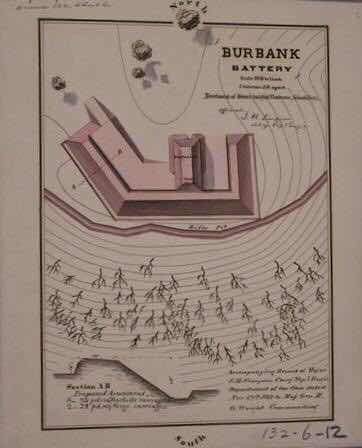
    Around this same time, some companies of the 13th Infantry were stationed at Beech Woods Battery (later renamed to Phil Kearney Battery) in Northern Kentucky, not far from the Newport Barracks. Burbank commanded these troops and served as commandant of Cincinnati in September, as the “Siege of Cincinnati” was taking place. One of the local defensive positions guarding against a threatened Confederate invasion, Burbank Battery, was named in his honor. (Ironically, most of the physical defenses of Cincinnati were not in the actual city, but, rather, among the hills of Northern Kentucky, as engineers took advantage of the terrain and the bend in the Ohio River.)


    On September 16, he was promoted again, this time to Colonel of the Second Infantry Regiment. In 1863, he led this regiment and others as a brigade commander in the Army of the Potomac. He commanded these troops at the famous battles of Chancellorsville and Gettysburg. Here is his official report  from the battle in Pennsylvania, where his forces suffered heavy losses on July 2. 

    He served in this role until early 1864, but, advancing in age as the war continued, he suffered issues with his health and eyesight. He received less stressful assignments, including responsibility for a draft rendezvous (where drafted soldiers were enrolled into the army) in Columbus, Ohio. He then rejoined the Second Infantry regiment in its headquarters at the Newport Barracks in June of 1864 and remained there until 1866, when the army transferred his command to Louisville.

    Before this transfer, he had suffered a great personal loss when his son, Captain Sullivan W. Burbank, died in June of 1864 due to wounds received at the Battle of the Wilderness a few weeks previously. According to Ronald Coddington’s book Faces of the Civil War (2004, Johns Hopkins University Press), at the start of the war Sullivan had asked his father to find him a commission in the army. Sidney succeeded in doing so, but upon learning of his son’s death, felt tremendous guilt and sorrow over his son’s fate, as virtually any father would.

    As the previously-mentioned transfer shows, he remained in the army after the war, as a military life was his destiny since birth. In 1866, he received a promotion to Brevet Brigadier General in the regular U.S. Army, effective March 13, 1865. He worked on rebuilding the Second Infantry and served on various boards and positions in these years. His work included recruiting duty and serving as President of the Army Examining Board for candidates to be appointed to the army, a title he received immediately after his transfer to Louisville. 

    From 1867 to 1869, he was Assistant Commissioner of the Freedman’s Bureau in Kentucky. The Freedman’s Bureau existed to provide assistance to former slaves as they transitioned to freedom, but it faced many challenges in its brief existence, including financial troubles and racism. 

    Burbank retired from the army in 1870 after forty years of service, and moved back to Newport, living not far from the barracks where he had served. He remained a resident of this city for over a decade, living on Front Street from 1870 until his death in 1882. 

    In an example of the way the Civil War could affect American families, census records indicate that his wife Isabella (neé Slaughter) was a native of Virginia (as were her parents), though her loyalty surely remained with her husband’s side during the war. It is unknown how or if her family relations existed during and after the war. It is possible her family members were Southern Unionists who supported the Union cause, but perhaps they favored the Confederacy, yet still remained on good terms with the Burbanks. Another possibility is that the family ties broke apart during the war and then reconciled at a later point, but some families, like that of Union General George H. Thomas, another Virginian, saw their family bonds completely destroyed by the long, bitter war.

    The Burbanks had three children, including two sons (Sullivan and Clayton) who served in the army, as well as daughter Frances, who married soldier William Maize, adding to the family’s military tradition. Clayton also was stationed in the Newport Barracks in the post-war years.

    Sidney Burbank passed away on December 7, 1882 at the age of seventy-five, due to old age and inflammation of the bowels. He left behind an estate valued at just more than $10,800. According to his obituary in the Cincinnati Enquirer, his funeral was a private service at his home, with family and a few military colleagues present. He was laid to rest in a “beautiful casket, with massive silver ornaments.” The lid included a silver plaque with Burbank’s name and birth and death dates on it. His body wore a full Brigadier-General’s uniform, and flowers decorated the casket. He was laid to rest in an unmarked grave in section fourteen of Spring Grove Cemetery in Cincinnati. 

    Sidney Burbank was a lifelong military man from a military family and led a long and honorable military life, in peacetime and in war. 

    Rest In Peace, General Burbank. 

    Sunday, May 5, 2013

    I Need Help in Identifying a Soldier


    I recently obtained this CDV because on the back it has "Newport, Kentucky" written on it and since I live near that city, it quickly got my attention and interest. (The fact that the photographer was located just across the Ohio River in Cincinnati also adds to my intrigue.)

    I need help in two areas (but I realize that my scanning and image manipulation skills are not perfect. If a better or more detailed scan will help, please let me know)

    1. What type of information does the uniform coat give? I am not a re-enactor nor an expert in period uniforms or equipment. It appears to be a frock coat perhaps, and there seems to be some striping on the sleeve. Does this indicate a rank or is it likely to have been for his branch of service (yellow for cavalry, blue for infantry, red for artillery from what I understand.)

    2. Can anyone read the name on the back and find anything for him in the Soldiers and Sailors System or any other records? I thought it might be something like "G.W. Fly or Ply" but could not find any soldiers from Kentucky to match that.

    I did find a "Gilbert Ely" in the Soldiers and Sailors System and he was in the 1st Kentucky Infantry. This seems to make sense because the first few Kentucky regiments were mustered in in Ohio as Kentucky attempted to be neutral, and Newport is located along the Ohio River, so the commute to enlist would be quick and easy for a soldier from that town. (Of course, I am not 100% sure the first letter is a "G." Most of the time I look and think it may be "F" or "T" or anything but a "G.")

    That index shows that Mr. Ely enlisted as a sergeant and mustered out as a lieutenant. That is why I am hoping that the uniform picture may somehow provide some sort of clue.

    Of course, he may not have been in Newport or even Kentucky when he enlisted. Maybe he moved and lived there only when the picture was taken. Maybe there is another explanation for that writing that does not help answer my questions, but, at the very least, this is a fascinating clue and one that I hope can help lead me to figuring out who this man was and more information about his life.

    Thanks in advance for any help, either on my questions above or suggestions on where else to look.

    Thursday, November 17, 2011

    The Helm and Maddux Case; an arrest in Newport, Ky, 1861

    This is from the Covington Journal of November 16, 1861. I have no record of what their remarks were or what ended up happening with this case, but this is the type of event that Civil War made possible, especially in a state like Kentucky, where loyalties were so divided. I am surprised, however, that they took him to court in Cincinnati, even though it was (and is) the largest nearby city. 

    The Helm and Maddux Case
    Some weeks since Messrs. Hub. Helm and Robert Maddux were arrested in Newport by a U.S. Deputy Marshal on a charge of uttering treasonable words. The prisoners were taken across the river to Cincinnati, were (sic) the case was brought before Judge Leavitt, of the U.S. circuit Court, on habeas corpus, but no decision was had at that time. On Monday last Judge Leavitt gave his decision, an abstract of which was given by the Cincinnati Times, as follows:


    The points involved were as follows: 1st. Was it a military or civil arrest? The return showed that the arrest was first made by the civil authorities, no military power having been engaged, except under civil control. 2d. At the time the habeas corpus was issued the parties had not been placed beyond the civil power. 3d. In this view, the arrest was illegal, because not made under a warrant. If the arrest had been made by the military authorities, affairs would present themselves to the Court in a different light. Consequently, the matter s not before the Court as a military arrest.


    The Court held that nothing but the most extraordinary circumstances could justify military arrests. Yet such arrests were in the province of the Chief Executive of the Government, and he did not believe that the Court should interfere with it. There, nevertheless, was a charge of serious character against these prisoners, yet the crime committed was not committed within the jurisdiction of the Court. He held it to be the duty of the Court to transfer the accused to the authorities of Kentucky, the State where the crime is stated to have been committed.


    The Court further held, that, as the accused had made use of very improper language, it should assume the power of requiring from the persons security in the sum of $2,000, for their loyalty to the Government of the United States.


    In accordance with the  decision of Judge Leavitt, Messrs. Helm and Maddux were on Wednesday last transferred to Kentucky, and placed in the custody of U.S. Deputy Marshal Allnutt, in Covington. We believe it was the intention of Mr. Allnutt to take the prisoners to Frankfort. He had, however, no sooner got them in his hands than a sergeant, backed by a file of soldiers from the Newport Barracks, presented an order for them from Col. Jones, commanding at the Cincinnati Barracks.


    Mr. Helm once submitted. Mr. Maddux said he would not be taken by the soldiers, and drawing a bowie-knife, for a time openly defied them. Finally he was cornered in the Madison House, and after some thrusts, on one side with bayonets and on the other with the bowie-knife, resulting in no serious injury, he was forcibly seized, and taken across the river to Cincinnati. The milltary (sic) power triumphed. It is proper to add that Mr. Maddux repeatedly proclaimed his willingness to go in the custody of a civil officer.

    Friday, September 23, 2011

    Departure of Home Guards

    Here is an article with some local information from the Covington Journal  September 21, 1861

    On Thursday night last a detachment of Home Guards left this city on the Kentucky Central R.R., for the purpose of guarding the bridges on that road. It was composed of the following companies: Kenton Union Guards, Capt. Farrell; Kentucky Grays, Lieut. Stacy; Capt. Condell's company; Boone Rifles, Capt. Heltimes, Marion Guards, Capt. Richardson of this city;and Capt. Artsman's company from Newport, numbering altogether about two hundred men. 

    The night was a pleasant one and a good many people were present to witness the departure of the boys, who were heartily cheered as the train moved off. 


    As the Grays were proceeding to the Depot, the ladies of the Madison House, through Maj. Clarkson, presented them with a handsome wreath.

    Wednesday, December 22, 2010

    Tuesday, December 21, 2010

    A Secret Society in Kentucky

    The Secession Ball in Charleston has been generating a lot of interest in the blogosphere, and even in the mainstream press to some extent, recently. Secession was, obviously, a topic of much discussion and debate 150 years ago as well, as South Carolina's declaration was soon followed by similar pledges from other states in the deep south. The future of  the upper south and border states was not so clear, at least until the attack on Fort Sumter and President Lincoln's call for 75,000 troops, after which the upper south states decided to leave the Union as well.

    This question still remained unsettled in the border states of Delaware, Maryland, Missouri and Kentucky, however.  Below is an article I found which discusses Kentucky's possible secession and potential reaction to such a decision. Newport is in the very northern part of the state, along the Ohio River, just across the river from Cincinnati, and just east of Covington, across the Licking River.
     
    From the Covington Journal of May 18, 1861, this letter mentions an interesting rumor that never had the chance to come to fruition. This is an example of the mixed sentiment in this area at the time, as well as the uncertainty of how the state would proceed. All three men mentioned here, including the letter-writer, were lawyers and politicians in Campbell County (which includes Newport), so they likely knew each other, though Boyd obviously took a different view of national politics than the other two did. 

    Below the letter I have included the biographical information I have been able to find about each of these men.

    Newport, Ky., May 17, 1861

    To the Editor of the Covington Journal: 

    Sir: I am informed that there is a secret society in this city, who have taken an oath, that in the event that Kentucky, by a legitimate vote of her citizens, should determine to go with her sister States of the South, they, the members of this association, are to take up arms against the State, and join their friends of the border free States, in a raid upon the loyal sons of Kentucky. G.P. Webster and Gus Artsman, are two of the prominent leaders. I have the names of others; but withhold them for the present. I have also the names of gentlemen from Covington, who have been officiating in this matter. It is proposed to extend this anti-Southern or Abolition association throughout this county, and other border counties. These men will be remembered by the people of Kentucky for their wicked and hidden designs upon their peace.


    F. A. Boyd


    F.A. (Frederick) Boyd
    Boyd, was born in Mason County Kentucky in 1815 and moved to Campbell County as a boy, along with his father. He graduated at the top of his law school class at the Cincinnati Law School in 1836, where he was highly regarded, and h became a lawyer in Newport. Health issues eventually slowed him down, and affected how much work he was able to do, but he was elected to the Kentucky Legislature in 1849, where  he served two terms. He then was chosen mayor of Newport in 1853, before becoming County Judge when his four-year term in Newport expired.  In 1868, he was a Kentucky representative at the Democratic National Convention in New York, where Horatio Seymour was nominated for President.

    Judge Boyd passed away in 1891, as the oldest member of the Campbell County Bar, and apparently had earned much respect during his life based on resolutions passed by the County Bar and its members.

    I did find it interesting that none of the articles I could find mentioned his apparent sympathy towards the South. Perhaps this was a sign of reconciliation and respect, or perhaps the coming of the war and Kentucky's insistence on remaining in the Union convinced him to keep his views to himself.

    Gustave Artsman
    Colonel Gustave "Gus" Artsman was born in Germany in 1829 and came to the United States in the mid-1840s before settling in Newport around 1854. He was elected Campbell County Circuit Court Clerk in 1856 and remained in that position until 1863. His obituary says he resigned in 1863 to become a Major in the 23rd Kentucky Volunteers during the Civil War, but I have not been able to find his name in that unit's records. I do wonder if there was another spelling (perhaps Anglicized somehow) that might show up in the records, but I have not yet found it.

    Another article mentions that he was placed in charge of the Home Guard units in the area in 1863.

    In 1872, he became Master Commissioner of the Campbell County Chancery Court, a position he held for 20 years.  His obituary says he was a Mason, dedicated to his church and a member of the "Loyal Legion" by which I believe it means the Military Order of the Loyal Legion of the United States

    He passed away in 1902. Among his pallbearers were Samuel Bigstaff and Colonel A.S. Berry, both of whom were Confederate soldiers in the Civil War.

    George P. Webster
    I have found less information about him than the others, but in 1862, the Covington Journal reported that: "George P. Webster of Campbell county, has resigned his seat in the Legislature, to accept the office of Assistant Quartermaster General."  Several other articles in the war years mention him performing his duty in this role from Covington and even moving to Cincinnati and then St. Louis after the war.

    He had also served as the Campbell County Attorney, at least in 1856, as well, so it is likely that his profession enabled him to become acquainted with Boyd and Artsman.

    Tuesday, July 21, 2009

    William Horsfall, 15 year old Medal of Honor Winner


    On May 21, 1862, William Horsfall was just 15 years old and, in his own words received a major assignment: "In the fighting before Corinth, Miss. May 21, 1862, Nelson's Brigade was engaged and my position was to the right of the First Kentucky, as an independent sharpshooter. The regiment had just made a desperate charge across the ravine. Captain Williamson was wounded in the charge and in subsequent reversing of positions, was left between the lines.

    Lt. Hocke, approaching me, said, 'Horsfall, Captain Williamson is in a serious predicament, rescue him if possible." So I placed my gun against a tree and in a stooping run, gained his side and dragged him to the stretcher bearers, who took him to the rear."

    This brave act earned a Medal of Honor for the young Kentuckian, who had been born in March of 1847. According to a local history website, http://www.rootsweb.ancestry.com/~kycampbe/horsfallcareer.htm, Horsfall had snuck away from home on the steamship Annie Laurie, which was then docked at Newport, Kentucky, across the Ohio River from Cincinnati. He remained hidden until the boat had started its journey, and then finally made his presence known.

    He eventually enlisted as a drummer boy in Company G of the 1st Kentucky Volunteer regiment, at Camp Cox, Virginia.

    According to A Compendium of the War of the Rebellion
    by Frederick H. Dyer ( http://www.civilwararchive.com/regim.htm) the 1st Kentucky Regiment had organized in Pendleton, Ohio in early 1861, as Kentucky had declared its neutrality and was not officially enrolling troops for either side yet. This regiment spent much of its early years in the region now known as West Virginia, in the District of the Kanawa. It moved though the region, including Kentucky and Tennessee, before taking part in the Battle of Shiloh in April 1862, and then at Corinth the following month, after Henry Halleck led the Union forces to that Mississippi city.

    The regiment stayed around southern Tennessee and northern Alabama for a while, then returned to Kentucky to campaign against Braxton Bragg. This operation ended with the October 1862 Battle of Perryville, after which the Southern forces left the Bluegrass state. In the next few years, these men participated in famed battles and campaigns like Stone's River, Tullahoma, Chickamauga and Chattanooga. This unit also campaigned against Confederate General and famed raider John Hunt Morgan. The 1st Kentucky Volunteer Infantry Regiment mustered out of service on June 1, 1864.

    Horsfall went on to participate in the regiments' future marches, and found himself in trouble at Stone's River, where his sized may have stopped the enemy from shooting him before he ran away and made his escape.


    He spent some time in a hospital in Nashville, before being discharged in Louisville in August 1864. He mustered into a Veteran Volunteer regiment in early 1865, just a few weeks before Robert E. Lee's surrender. He received a $400 bounty (a nice sum of money for a 18- year old (or for many older men) to have at once in those days!) and served until March of 1866. He lived for many years back in Newport and received a pension for his services.

    Horsfall's medal of honor was presented on August 17, 1895 and the citation read: "saved the life of a wounded officer lying between the lines." This information was found at

    http://www.homeofheroes.com/moh/citations_1862_cwh/horsfall_william.html

    To think of the bravery he showed by undertaking that rescue mission at the battle around Corinth is almost mind-boggling. It would have been incredible for any soldier, but it is even more remarkable that a 15 year old boy (well, young man – what he did was beyond the realms of a normal boy) was ready, willing and able to make the rescue.

    In today's day and age, it might make people sick to think of a 15 year old serving in the military in places like Iraq, but William Horsfall performed such service at such a remarkably young age during his nation's greatest crisis. His sneaking off from home is not the story of a role model, but was the first sign of the courage he would soon display on the battlefield.

    This once-young hero passed away on October 22, 1922, at the age of 75 and was buried at Evergreen Cemetery in Southgate, Kentucky