Showing posts with label Andersonville. Show all posts

Saturday, April 6, 2024

Ely Ralls: Veteran of the Mexican-American and Civil Wars


A man of uncertain origins, Ely (or Eli) Ralls was born in March of 1829, but records differ on where he was born, with Virginia, Kentucky, Ohio, and Indiana all appearing as his birthplace on various census records.


Some parts of his life, though are more certain.


In the late 1840s, as the age of "Manifest Destiny" was in perhaps its prime years, he served as a private in company L of the 2nd Kentucky Infantry during the Mexican-American War. On February 22 and 23, 1847, this unit was involved in the Battle of Buena Vista, a victory for the United States that brought fame to General Zachary Taylor, perhaps contributing to his future election as United States President.1 (His decision to join that regiment might suggest he lived in central Kentucky at the time.)

At this battle, “Jefferson Davis’1st Mississippi Rifles, the 2d Kentucky Rifles, the 2d and 3d Indiana, and the 3d Ohio volunteer regiments united in a supreme force.” (Davis, of course, was the future Confederate President.) 

“Never had the salutary effects of combined discipline and leadership of American citizen-soldiers been more convincingly demonstrated than in that desperate two-day struggle.”2 That struggle was part of the American victory in that conflict, a victory that brought a significant amount of land into the United States, an acquisition that only added to the questions about how that land - and the territory already part of the nation, should be governed.

Ely survived the war with Mexico and married Hiley Ann(a) Keethler (possibly Kirchler) in 1849.


By the time of the 1860 census, he lived in Brown County, Ohio, in a full household including his wife and their six children. He worked as a blacksmith.


After the start of the Civil War, at least partially due to the unsettled questions that the acquisition of land from Mexico had stirred up into the public's attention, Ely remained at home for more than a year and then enlisted as a private in company E of the 7th Ohio Cavalry on September 2, 1862. On September 27, he was promoted to farrier (a person working with a horse’s hooves and shoes, obviously a vital position in a cavalry unit, and a good use of his blacksmithing experience) and officially mustered in on October 26. 
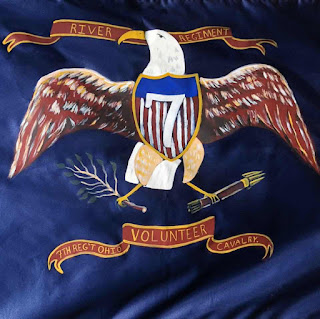


                                                                        photo from https://www.facebook.com/7thovc    


The 7th Ohio Cavalry had organized at Ripley, Ohio in October of 1862, but, “before the 7th's members were mustered into the service, a detachment of Confederate cavalrymen occupied Augusta, Kentucky, burning much of the town. Company E of the 7th crossed the Ohio River and traveled the few miles downstream to Augusta, driving the enemy from the community without suffering a single casualty.3”


 Ely was in company E and probably with the unit, ready to use his blacksmith and farrier skills if needed, but likely not in the actual combat.


View up the Ohio River along Augusta, author’s photo


In the following weeks, 25 men from that company joined a battalion from the regiment and scouted in the area, winding up in Falmouth, Kentucky, which other Union troops were already occupying.4 

In 1863, the regiment participated in the Union pursuit of Confederate General John H. Morgan and his forces in Morgan’s “Great Raid,” and was present at the Battle of Buffington Island, when many of those Rebels became Union prisoners on July 19.


The men of the 7th Ohio Cavalry moved south to the eastern half of Tennessee and joined in the Knoxville Campaign. On November 6, some of the men of the opposing armies met in a contest known as the Battle of Rogersville or the Battle of Big Creek.


During that fight, the Confederates captured several hundred Union soldiers, including Ely.5


The 1890 Veterans Schedule claims that he spent 18 months in Libby Prison, but that was probably a mistake, as no other reports mention that facility. Also, Libby Prison generally housed Union officers, and Ely was not an officer.


Other records do show that he was a “possible prisoner” at Andersonville.6 


If so, he was lucky to survive that dirty, crowded camp.


The first prisoners arrived at Camp Sumter in late February 1864. Over the course of the next few months approximately 400 prisoners arrived daily. By June 1864 over 26,000 prisoners were confined in a stockade designed to house 10,000. The largest number of prisoners held at one time was 33,000 in August 1864.

The Confederate government was unable to provide the prisoners with adequate housing, food, clothing, and medical care, Due to the terrible conditions, prisoners suffered greatly, and a high mortality rate ensued.

When the war ended, Captain Henry Wirz, the stockade commander, was arrested and charged with "murder, in violation of the laws of war." Tried and found guilty by a military tribunal, Wirz was hanged in Washington, D.C. on November 10, 1865.7

One military record on ancestry.com shows that Ely was paroled but provides no date or other details. If accurate, this could mean he did not spend any time at all in Andersonville (or any other prison) as being paroled meant the Confederates had physically released him on his world of honor not to fight again until he was officially exchanged for a Confederate soldier of similar rank.


Some soldiers did ignore their promises and immediately returned to their regiments, but the lack of details for Ely makes it impossible to know if or when he was exchanged and returned to the regiment.


After the action at Rogersville, the 7th Ohio Cavalry remained in the service and in 1864 saw action at contests like 2nd Cynthiana in Kentucky, various battles in the Atlanta Campaign, and both Franklin and Nashville in Tennessee. 


They also joined in General James H. Wilson’s Raid into Alabama and Georgia in early 1865, as the bloody war was finally nearing its end.


Whether Ely had been present for any or all of the unit’s 1864 battles is unclear, but he did muster out of the service with his company on June 30, 1865, per the regimental roster. 


 In 1870, Ely, Hiley, and their eight children resided in Brown County, Ohio, where he worked as a blacksmith. 


In 1880, he lived in Cincinnati with the family of his daughter and her husband, along with four more of his children and a woman named Ivlanan, which may have been a bungled recording of his wife’s name. He worked as a fisherman. 


He lived on the southern bank of the Ohio River in Dayton, Kentucky in 1890, and remained there in 1900 with his wife and grandson. He still listed blacksmith as his occupation but had been unemployed for all twelve months in the previous year. He was able to read and write.


Ely Ralls passed away at age 78 on November 15, 1907, in Bellevue, Kentucky and was buried in nearby Evergreen Cemetery, where hundreds of his fellow Union veterans also lie at rest.


1https://www.loc.gov/item/today-in-history/february-23/

2https://kynghistory.ky.gov/Our-History/History-of-the-Guard/Pages/The-Mexican-War.aspx

3 https://www.ohiocivilwarcentral.com/7th-regiment-ohio-volunteer-cavalry/

4 https://www.gutenberg.org/cache/epub/31584/pg31584-images.html

5 https://www.hmdb.org/m.asp?m=114918

6 https://www.nps.gov/civilwar/search-prisoners.htm#sort=score+desc&q=Ralls,+eli

7 https://www.nps.gov/ande/learn/historyculture/camp_sumter_history.htm


Sunday, March 19, 2017

Robert Good, Co. I, 4th Ky Cavalry

This, I hope, will be an interesting story to read. It certainly has been a fascinating one to research and write. I recently found an old piece of ephemera that really intrigued me, so I discussed it in a previous post. 

The form allowed the payment of a soldier's salary to his wife because he was a prisoner of war. 

The soldier for whose wife it was prepared was Corporal Robert Good of the 4th Kentucky Cavalry, and this post will tell his story that this form uncovered.

According to his file on fold3.com, Robert was either 34 or 54 years old (more on that later) when he enlisted as a private in Company I of the 4th Kentucky Cavalry on October 16, 1862 for a three-year term, mustering in on October 30. The 4th Kentucky Cavalry was organized in Louisville in late 1862. It stayed in the Western Theater, frequently in Tennessee, and saw action at Chickamauga and in the Atlanta campaign

Robert had been born in Ireland, stood 5'11" tall and had blue eyes, dark hair and a dark complexion.

Once in the army, he led a career that was far from routine, with experiences such as charges of desertion, possible court-martial, capture, hospitalization, and perhaps even imprisonment in the most infamous Civil War prison of all, Andersonville. Various documents provide insight into some of his adventures, though ther remain some holes requiring speculation and interpretation.

In his file, his story begins with forms reporting that he "deserted at Louisville before 10 Feb 1863," and "deserted, rec'd $27 bounty." Then another form, covering the period March 1 to June 30, 1863, reported he was under arrest, awaiting a general court martial. 

Another document explains the cause of and resolution to this issue, saying his "charge of desertion removed; was while sick permitted to leave camp at Louisville, Ky., on or about Dec. 25, 1862, and go to his home in Louisville, until he recovered; was sick with erysipelas and unable to travel until May 28, 1863 when he left to join his command."

Documents for late 1863 now listed him as "absent, missing in action September 21" and continued showing that through 1864. 

Other records show this was because he had been "captured near Crawfish Springs" (Chickamauga) on September 21, 1863 and taken to a Confederate prison. Exactly how his time as prisoner went is uncertain. The paperwork is confusing and some of the writing is not legible. It appears he was taken to Richmond on September 29 before moving to Danville, Virginia or Americus, Georgia (Andersonville) on December 12, 1863. The form then mentions Andersonville, but "no date given." One word on this form is, unfortunately, illegible. 


He had $5 of U.S. money taken from him. Per a discussion on CivilWarTalk.com, he carried this money on him when captured, and the prison quartermaster confiscated it and other personal possessions, keeping a record of these items, at least of the money. They likely offered to trade him Confederate dollars for his U.S. money, as Confederate dollars would be the only money prisoners could use to purchase items like food inside the prison. It also benefited the Confederacy since a Federal dollar was worth more than a Confederate one outside the prison.

I found a second form on ancestry.com that also mentioned the $5 - the microfilm from which this record was taken included "Federal Prisoners of War Confined at Andersonville, Ga, 1864-65" in its title, adding evidence that that was where he was confined. 

Contrary thinking of the location of his imprisonment may be worth the effort, however, as the National Park Service's list of Andersonville prisoners does not list his name, though those records are incomplete per the service's Andersonville website. Unfortunately, the records at Andersonville National Park, available only at the park, also fail to list him, per the response to a research request I sent. (I forwarded them the forms I found and other circumstantial evidence and they said they would look further into it.)

I also found one site showing prisoners in Danville, and his name did not appear on it either. It is hard to know what records of prisoners were kept, and, especially, which ones survived, so his absence on these lists does not necessarily mean he was not there. 

Another issue is that Andersonville did not exist at the time of his capture. Per the Civil War Trust: It was built in early 1864 after Confederate officials decided to move the large number of Federal prisoners in and around Richmond to a place of greater security and more abundant food. During the 14 months it existed, more than 45,000 Union soldiers were confined here. Of these, almost 13,000 died from disease, poor sanitation, malnutrition, overcrowding, or exposure to the elements. It did not receive prisoners until February 1864, so where was Robert from mid-December until then? Richmond seems likely, though the mention of Danville confuses things. (That description also makes his survival, if he was there, more remarkable.)

Despite this, it still may be true that he was at Andersonville. More evidence that he possibly was there is in the timing and place of his release. The prison exchange cartel between the USA and CSA had generally broken down, with occasional exceptions, but in August 1864, the two sides agreed to exchange sick and injured men, with the trade taking place on the Savannah River near Fort Pulaski starting in mid-November. Robert was paroled on either November 14 at the Savannah River or November 18 at Savannah per his paperwork (two forms have different information), so the timing and location make it seem likely that Robert was indeed part of this exchange. If not, it would be a huge coincidence for him to have been paroled at the same time and place as prisoners from Andersonville.

Craig Swain has a good discussion of this exchange here, noting that the exchanged United States prisoners had originally moved away from Andersonville as part of this process.

After his release, and having served more than a year as a prisoner, Robert was admitted to hospital division number 2 in Annapolis, Maryland on November 25, though the same form states "no later record." Some of his paperwork is again confusing and hard to read, appearing to say his name was not on any hospital rolls, but the specificity of the other forms (naming the hospital ward where he went), the muster rolls and his time in prison lead me to believe he was hospitalized, likely along with many of his fellow ex-prisoners.

A surprising note is in a report of the exchange. Thanks again to Craig for finding it. Lieutenant-Colonel John E. Mulford reported: "I have the honor to inform you that I have up to the present time received over 3,000 of our men. Their physical condition is rather better than I expected, but their personal is worse than anything I have ever seen–filth and rags. It is a great labor to cleanse and clothe them..."(Official Records, Series II, volume 7, p. 1149.) That does not quite fit in the usual picture of emaciated and near-death men leaving Andersonville though some, including Robert, were possibly at least in somewhat poor health.

Muster rolls then reported Robert as "absent, sick in hospital, rec'd 6 months pay" for January and February 1865. The mention of pay presumably refers to the money paid to his wife on the form described in the previous post.

In March, April, May and June, he was listed as "present."

Another form says "July 1865 - Correll Guard" but I have no information as to what that may be.

He mustered out with the regiment on August 21, 1865 at Macon, Georgia. 

When he mustered out, he was now a corporal who had been last paid to February 28, 1864. He owed the government money, apparently $35, though it is barely legible, for "arms, equipment, etc." He apparently had lost one saddle blanket.

On the other hand, he had received $25 in bounty money, but was still owed $75. How much had the promised bounty motivated him to enlist, or how did other factors like patriotism, a search for adventure or his political beliefs also influence his decision? Perhaps his motivation was a combination of the above or something completely different. 

 
KY Cavalry Marker at Chickamauga, courtesy waymarking.com 

As for his post-military career, the age on the document in his file is the key to what information is available. It appears to be 54 at first glance, but may be 34. It does not look like other "5s" on the same page, but is not a perfect "3" either, though it could be a "3" with the top section not completed. I posted it online and asked friends for help. Some thought it said "54" and others thought "34," so there was no consensus. I've included it here so readers can form their own opinions.


If he was really 54, I can find no further records of him, so I am going to proceed under the assumption (yeah, I know) he was 34 when he enrolled in the final quarter of 1862. This may be wrong, but I did find some information for a Robert Good who was born about 1827 and will use that to add to this story. If I come across information that confirms or refutes this Robert Good being the same as on that document, I will update this blog.

The  only census on which I can find him, that of 1880, shows a Robert Good in Louisville, age 53, giving him a birth year of 1827. It also shows his wife  "Mary," age 40. 

His headstone photo on a find-a-grave shows he was in his 58th year when he died on August 11, 1885, matching the 1827 birth date as estimated on the census, close to the 1828 based on the above form. The headstone lists his wife as "Ellen" on top, underneath his name, but the bottom of the marker shows "erected by his wife Mary." It says Ellen was in her 47th year when she passed away on August 3, 1876. The brief biography on the same page states he married Mary Walsh on December 13, 1877, so Ellen was his first wife and Mary his second, meaning the form, census and graveyard records agree with each other as the form that began my request lists his wife's name name as "Elenora," which is probably the formal name for Ellen. I have not found any record of Mary's burial.

Headstone in Saint John's Cemetery (aka German-Catholic Cemetery) Louisville, courtesy findagrave.com

He was born in Ireland, immigrated to a new country, joined the army to defend that new home and survived imprisonment - Robert Good may not have lived the longest life, or found fame and fortune, but his life certainly did not lack for change or challenges.

Rest in peace, soldier.

Thursday, September 11, 2014

Our Exchanged Prisoners: a Youth's Companion article from 1865

This Youth's Companion article and illustration come from the January 5, 1865 edition of that newspaper.


No more touching scene has occurred during the war than that which was exhibited on the deck of the dispatch boat, when the first of our exchanged prisoners in the last exchange that was made, found themselves once more under the protection of the stars and stripes. A terrible record of suffering was written upon their livid faces, gaunt, skinny limbs and tattered clothes. No words can describe the exultation of these poor sufferers a their release. With shouting and cheering, in almost an ecstasy of happiness, they greeted the old flag, singing

"Rally round the flag, boys, 
From near and from far,
Down with the traitor, 
and up with the star!"

The condition of the released prisoners is thus described by a correspondent of the Philadelphia Inquirer: One poor fellow showed me his limbs. They were not larger toward the ankle than a man's thumb. It was touching as well as amusing to the bystanders to here their remarks as they came off the boat. One man, jumping up and stamping with this feet, uttered the exclamation as though it came from his very soul, "God bless the piece of land that I'm now on." Another: "Thank God I'm in His country once more." Others would utter like exclamations of joy and gratitude, such as, "O, what a blessed hour is this!" ; "Hurrah for the Union, I'm once more in it!"  "Fourteen months in Dixie, but never a day more!" An Irishman, as he walked off, said, "Sure this is the happiest day since iver I came to Ameriky." 

The information which these men give concerning their sufferings and the cruelty practiced toward them by the rebel authorities almost staggers belief. At Camp Sumter, which is the prisoner camp where they were confined at Andersonville, thirty odd thousand were held during the summer. Very few of these had any shelter from the rain or burning sun.

Their only resort was to dig holes in the ground, and at each end excavate or scoop out the earth from under, so as to afford a partial shelter. Here two would creep for a little relief. 

Their food we need not describe. It is the same old story which we hear from every one who has ever been subject to the tender mercies of the authorities in the South. Their rations were seldom, if ever cooked. Peas and corn meal, or corn meal with an occasional bit of bacon, and in very small portions, were the only articles furnished them.

The sufferings they endured can never be imagined. As I have gone around and sat by their beds in the different wards, and heard their statements of the conditions of the poor fellows who were at Camp Sumter, and at Andersonville, and Camp Lawton, at Millen, Ga., my very heart has ached, and I have had to leave that I might hear no more.

Illustration from the National Park Service