A man of uncertain origins, Ely (or Eli) Ralls was born in March of 1829, but records differ on where he was born, with Virginia, Kentucky, Ohio, and Indiana all appearing as his birthplace on various census records.
Some parts of his life, though are more certain.
In the late 1840s, as the age of "Manifest Destiny" was in perhaps its prime years, he served as a private in company L of the 2nd Kentucky Infantry during the Mexican-American War. On February 22 and 23, 1847, this unit was involved in the Battle of Buena Vista, a victory for the United States that brought fame to General Zachary Taylor, perhaps contributing to his future election as United States President.1 (His decision to join that regiment might suggest he lived in central Kentucky at the time.)
At this battle, “Jefferson Davis’1st Mississippi Rifles, the 2d Kentucky Rifles, the 2d and 3d Indiana, and the 3d Ohio volunteer regiments united in a supreme force.” (Davis, of course, was the future Confederate President.)
“Never had the salutary effects of combined discipline and leadership of American citizen-soldiers been more convincingly demonstrated than in that desperate two-day struggle.”2 That struggle was part of the American victory in that conflict, a victory that brought a significant amount of land into the United States, an acquisition that only added to the questions about how that land - and the territory already part of the nation, should be governed.
Ely survived the war with Mexico and married Hiley Ann(a) Keethler (possibly Kirchler) in 1849.
By the time of the 1860 census, he lived in Brown County, Ohio, in a full household including his wife and their six children. He worked as a blacksmith.
After the start of the Civil War, at least partially due to the unsettled questions that the acquisition of land from Mexico had stirred up into the public's attention, Ely remained at home for more than a year and then enlisted as a private in company E of the 7th Ohio Cavalry on September 2, 1862. On September 27, he was promoted to farrier (a person working with a horse’s hooves and shoes, obviously a vital position in a cavalry unit, and a good use of his blacksmithing experience) and officially mustered in on October 26.
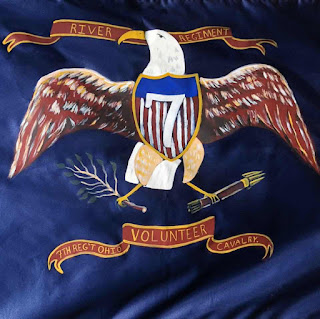
photo from https://www.facebook.com/7thovc
The 7th Ohio Cavalry had organized at Ripley, Ohio in October of 1862, but, “before the 7th's members were mustered into the service, a detachment of Confederate cavalrymen occupied Augusta, Kentucky, burning much of the town. Company E of the 7th crossed the Ohio River and traveled the few miles downstream to Augusta, driving the enemy from the community without suffering a single casualty.3”
Ely was in company E and probably with the unit, ready to use his blacksmith and farrier skills if needed, but likely not in the actual combat.

The men of the 7th Ohio Cavalry moved south to the eastern half of Tennessee and joined in the Knoxville Campaign. On November 6, some of the men of the opposing armies met in a contest known as the Battle of Rogersville or the Battle of Big Creek.
During that fight, the Confederates captured several hundred Union soldiers, including Ely.5
The 1890 Veterans Schedule claims that he spent 18 months in Libby Prison, but that was probably a mistake, as no other reports mention that facility. Also, Libby Prison generally housed Union officers, and Ely was not an officer.
Other records do show that he was a “possible prisoner” at Andersonville.6
If so, he was lucky to survive that dirty, crowded camp.
The first prisoners arrived at Camp Sumter in late February 1864. Over the course of the next few months approximately 400 prisoners arrived daily. By June 1864 over 26,000 prisoners were confined in a stockade designed to house 10,000. The largest number of prisoners held at one time was 33,000 in August 1864.
The Confederate government was unable to provide the prisoners with adequate housing, food, clothing, and medical care, Due to the terrible conditions, prisoners suffered greatly, and a high mortality rate ensued.
When the war ended, Captain Henry Wirz, the stockade commander, was arrested and charged with "murder, in violation of the laws of war." Tried and found guilty by a military tribunal, Wirz was hanged in Washington, D.C. on November 10, 1865.7
One military record on ancestry.com shows that Ely was paroled but provides no date or other details. If accurate, this could mean he did not spend any time at all in Andersonville (or any other prison) as being paroled meant the Confederates had physically released him on his world of honor not to fight again until he was officially exchanged for a Confederate soldier of similar rank.
Some soldiers did ignore their promises and immediately returned to their regiments, but the lack of details for Ely makes it impossible to know if or when he was exchanged and returned to the regiment.
After the action at Rogersville, the 7th Ohio Cavalry remained in the service and in 1864 saw action at contests like 2nd Cynthiana in Kentucky, various battles in the Atlanta Campaign, and both Franklin and Nashville in Tennessee.
They also joined in General James H. Wilson’s Raid into Alabama and Georgia in early 1865, as the bloody war was finally nearing its end.
Whether Ely had been present for any or all of the unit’s 1864 battles is unclear, but he did muster out of the service with his company on June 30, 1865, per the regimental roster.
In 1870, Ely, Hiley, and their eight children resided in Brown County, Ohio, where he worked as a blacksmith.
In 1880, he lived in Cincinnati with the family of his daughter and her husband, along with four more of his children and a woman named Ivlanan, which may have been a bungled recording of his wife’s name. He worked as a fisherman.
He lived on the southern bank of the Ohio River in Dayton, Kentucky in 1890, and remained there in 1900 with his wife and grandson. He still listed blacksmith as his occupation but had been unemployed for all twelve months in the previous year. He was able to read and write.
Ely Ralls passed away at age 78 on November 15, 1907, in Bellevue, Kentucky and was buried in nearby Evergreen Cemetery, where hundreds of his fellow Union veterans also lie at rest.
1https://www.loc.gov/item/today-in-history/february-23/
2https://kynghistory.ky.gov/Our-History/History-of-the-Guard/Pages/The-Mexican-War.aspx
3 https://www.ohiocivilwarcentral.com/7th-regiment-ohio-volunteer-cavalry/
4 https://www.gutenberg.org/cache/epub/31584/pg31584-images.html
5 https://www.hmdb.org/m.asp?m=114918
6 https://www.nps.gov/civilwar/search-prisoners.htm#sort=score+desc&q=Ralls,+eli
7 https://www.nps.gov/ande/learn/historyculture/camp_sumter_history.htm


