Showing posts with label Civil War. Show all posts

Saturday, April 6, 2024

Ely Ralls: Veteran of the Mexican-American and Civil Wars


A man of uncertain origins, Ely (or Eli) Ralls was born in March of 1829, but records differ on where he was born, with Virginia, Kentucky, Ohio, and Indiana all appearing as his birthplace on various census records.


Some parts of his life, though are more certain.


In the late 1840s, as the age of "Manifest Destiny" was in perhaps its prime years, he served as a private in company L of the 2nd Kentucky Infantry during the Mexican-American War. On February 22 and 23, 1847, this unit was involved in the Battle of Buena Vista, a victory for the United States that brought fame to General Zachary Taylor, perhaps contributing to his future election as United States President.1 (His decision to join that regiment might suggest he lived in central Kentucky at the time.)

At this battle, “Jefferson Davis’1st Mississippi Rifles, the 2d Kentucky Rifles, the 2d and 3d Indiana, and the 3d Ohio volunteer regiments united in a supreme force.” (Davis, of course, was the future Confederate President.) 

“Never had the salutary effects of combined discipline and leadership of American citizen-soldiers been more convincingly demonstrated than in that desperate two-day struggle.2 That struggle was part of the American victory in that conflict, a victory that brought a significant amount of land into the United States, an acquisition that only added to the questions about how that land - and the territory already part of the nation, should be governed.

Ely survived the war with Mexico and married Hiley Ann(a) Keethler (possibly Kirchler) in 1849.


By the time of the 1860 census, he lived in Brown County, Ohio, in a full household including his wife and their six children. He worked as a blacksmith.


After the start of the Civil War, at least partially due to the unsettled questions that the acquisition of land from Mexico had stirred up into the public's attention, Ely remained at home for more than a year and then enlisted as a private in company E of the 7th Ohio Cavalry on September 2, 1862. On September 27, he was promoted to farrier (a person working with a horse’s hooves and shoes, obviously a vital position in a cavalry unit, and a good use of his blacksmithing experience) and officially mustered in on October 26. 
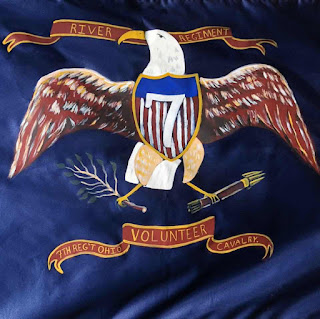


                                                                        photo from https://www.facebook.com/7thovc    


The 7th Ohio Cavalry had organized at Ripley, Ohio in October of 1862, but, “before the 7th's members were mustered into the service, a detachment of Confederate cavalrymen occupied Augusta, Kentucky, burning much of the town. Company E of the 7th crossed the Ohio River and traveled the few miles downstream to Augusta, driving the enemy from the community without suffering a single casualty.3”


 Ely was in company E and probably with the unit, ready to use his blacksmith and farrier skills if needed, but likely not in the actual combat.


View up the Ohio River along Augusta, author’s photo


In the following weeks, 25 men from that company joined a battalion from the regiment and scouted in the area, winding up in Falmouth, Kentucky, which other Union troops were already occupying.4 

In 1863, the regiment participated in the Union pursuit of Confederate General John H. Morgan and his forces in Morgan’s “Great Raid,” and was present at the Battle of Buffington Island, when many of those Rebels became Union prisoners on July 19.


The men of the 7th Ohio Cavalry moved south to the eastern half of Tennessee and joined in the Knoxville Campaign. On November 6, some of the men of the opposing armies met in a contest known as the Battle of Rogersville or the Battle of Big Creek.


During that fight, the Confederates captured several hundred Union soldiers, including Ely.5


The 1890 Veterans Schedule claims that he spent 18 months in Libby Prison, but that was probably a mistake, as no other reports mention that facility. Also, Libby Prison generally housed Union officers, and Ely was not an officer.


Other records do show that he was a “possible prisoner” at Andersonville.6 


If so, he was lucky to survive that dirty, crowded camp.


The first prisoners arrived at Camp Sumter in late February 1864. Over the course of the next few months approximately 400 prisoners arrived daily. By June 1864 over 26,000 prisoners were confined in a stockade designed to house 10,000. The largest number of prisoners held at one time was 33,000 in August 1864.

The Confederate government was unable to provide the prisoners with adequate housing, food, clothing, and medical care, Due to the terrible conditions, prisoners suffered greatly, and a high mortality rate ensued.

When the war ended, Captain Henry Wirz, the stockade commander, was arrested and charged with "murder, in violation of the laws of war." Tried and found guilty by a military tribunal, Wirz was hanged in Washington, D.C. on November 10, 1865.7

One military record on ancestry.com shows that Ely was paroled but provides no date or other details. If accurate, this could mean he did not spend any time at all in Andersonville (or any other prison) as being paroled meant the Confederates had physically released him on his world of honor not to fight again until he was officially exchanged for a Confederate soldier of similar rank.


Some soldiers did ignore their promises and immediately returned to their regiments, but the lack of details for Ely makes it impossible to know if or when he was exchanged and returned to the regiment.


After the action at Rogersville, the 7th Ohio Cavalry remained in the service and in 1864 saw action at contests like 2nd Cynthiana in Kentucky, various battles in the Atlanta Campaign, and both Franklin and Nashville in Tennessee. 


They also joined in General James H. Wilson’s Raid into Alabama and Georgia in early 1865, as the bloody war was finally nearing its end.


Whether Ely had been present for any or all of the unit’s 1864 battles is unclear, but he did muster out of the service with his company on June 30, 1865, per the regimental roster. 


 In 1870, Ely, Hiley, and their eight children resided in Brown County, Ohio, where he worked as a blacksmith. 


In 1880, he lived in Cincinnati with the family of his daughter and her husband, along with four more of his children and a woman named Ivlanan, which may have been a bungled recording of his wife’s name. He worked as a fisherman. 


He lived on the southern bank of the Ohio River in Dayton, Kentucky in 1890, and remained there in 1900 with his wife and grandson. He still listed blacksmith as his occupation but had been unemployed for all twelve months in the previous year. He was able to read and write.


Ely Ralls passed away at age 78 on November 15, 1907, in Bellevue, Kentucky and was buried in nearby Evergreen Cemetery, where hundreds of his fellow Union veterans also lie at rest.


1https://www.loc.gov/item/today-in-history/february-23/

2https://kynghistory.ky.gov/Our-History/History-of-the-Guard/Pages/The-Mexican-War.aspx

3 https://www.ohiocivilwarcentral.com/7th-regiment-ohio-volunteer-cavalry/

4 https://www.gutenberg.org/cache/epub/31584/pg31584-images.html

5 https://www.hmdb.org/m.asp?m=114918

6 https://www.nps.gov/civilwar/search-prisoners.htm#sort=score+desc&q=Ralls,+eli

7 https://www.nps.gov/ande/learn/historyculture/camp_sumter_history.htm


Saturday, December 10, 2011

Let's Talk About it: Making Sense of the Civil War


I have been fortunate enough to participate in the Let's Talk About It: Making Sense of the Civil War  series at the Boone County Public Library. It was one of only 65 libraries in the country (2 in Kentucky) to receive a grant to participate in this program offered by the National Endowment for the Humanities and the American Library Association.

We have had two sessions so far, with three more scheduled on the first Wednesday of every month. I hope winter weather will not be bad on those days as I would hate to miss any of the sessions.

The first session featured a theme of "Imagining War" and involved reading the novel March by Geraldine Brooks, as well as a brief reading from Louisa May Alcott.

For this past week, the topic morphed to "Choosing Sides" with several readings from America's War: Talking about the Civil War and Emancipation on their 150th Annversaries by University of Richmond President Edward Ayers.

I really found this month's readings to be quite fascinating. I previously mentioned Frederick Douglass' What to the Slaves is the 4th of July speech. It is very powerful and provides a terrific perspective of how Douglass interpreted American history as an African-American and former slave. The phrase "guilt trip" may be one possible way to describe it, as Douglass tried to make white Northerners see the separation of understanding of the country's history between his race and theirs.

I also found Henry David Thoreau's A Pleas for Captain John Brown to be quite fascinating. This was another new essay to me and Thoreau's unequivocal support for Brown impressed me. He did not hesitate to support Brown, though many Northerners, including the new Republican Party and it's supposed anti-slavery ideals, quickly criticized Brown's methods. (Thoreau had appeared in March in the previous session.) The question of Brown being either a hero or villain, martyr or terrorist still stirs debate more than 150 years later, but Thoreau strongly voiced his opinion even during the time when he knew Brown would soon be hanged.

Among the other readings were Abraham Lincoln's First Inaugural Address, Alexander Stephens' Cornerstone Address, pieces of a speech by Robert Montague supporting Virginia's secession and a speech by his colleague Stuart Chapman opposing secession. The last two did an excellent job of showing both sides of the argument. Both men supported slavery, but disagreed on how best to protect that institution.

The final three readings featured an excerpt from Elizabeth Brown Pryor's excellent Reading the Man, discussing Robert E. Lee's process of deciding to join the Confederacy, The Private History of a Campaign that Failed by Mark Twain and excerpts from the diary of a young Louisiana woman, Sarah Morgan, available as Sarah Morgan: The Civil War Diary of a Southern Woman. Re-reading the section on Lee and Pryor's additional thoughts she put together for this book provided a great view on how Lee approached his decision.

All of these readings were very valuable. At the meeting, the participants (about 35-40, same as the first meeting) broke into three discussion groups. The group in which I was involved talked mostly about Lee's decision and various aspects of it, but did touch on each of the readings, with several interesting points made and questions asked.

I am really enjoying this series and look forward to the next one in early January. Once this is through in March, though, I'm not sure what I will do. Hopefully I can find something at least similar to this in terms of discussion and participation and who knows, I may even make some friends and contacts in these sessions. I have enjoyed the people I have met so far.

If any readers have the chance to participate in this, please consider it strongly. It is fun and gives you the chance to hear other people's perspectives as well as questions that you may not think up on your own.


Thursday, September 1, 2011

Urgent Demand for Peace: An editorial on Civil War

The Covington Journal of August 31, 1861 offers this editorial, which offers some familiar themes, such as nobody gaining any benefit from the war, no reconciliation being possible after a civil war, and the threats to various liberties during the war.

 Urgent Demand for Peace
The war ought to be stopped.

Because we are brethren and if we cannot live together in peace an amicable separation ought to be agreed upon. "And Abraham said to Lot, let there be no strife, I pray thee, between me and thee, and between my herds, men and herdsmen for we be brethren. Is not the whole land before thee?"

Because the longer the war is prosecuted the less likely it is to settle the difficulties out of which it sprung. We shall have to negotiate sooner or later, and the sooner the better.


Because of the spirit of lawlessness and ferocity the war is creating, and the unutterable horrors by which its prosecution is attended. The Duke of Wellington, near the close of his eventful life, said "Circumstances  have placed me in countries where the war was internal - between opposite parties in the same nation - and rather than a country I loved should be visited with the calamities I have seen, with the unutterable horrors of civil war, I would run any risk, I would make any sacrifice, I would freely lay down my life. There is nothing which destroys property and prosperity and demoralizes character to the extent which civil war does. By it the hand of man is raised against his neighbor, against his brother, against his father, the servant betrays his master, and the master ruins his servant." 

Because it will ruin the business of the people, exhaust their resources and load the country with a heavy and lasting national debt. "The healthful channels of enterprise and profit will be choked up; the capital of the country will be horded or absorbed by the government for warlike uses; consumers and idlers will be multiplied; producers will be diminished, property will depreciate in value; the hard-earned credit and wealth of years will vanish away; there will be general bankruptcy, and all classes - especially the poorer - will suffer." 


Because we can have no assurances of benefits compensating for the thousands of human lives destroyed and the millions of money expended; the suppression of the freedom of speech and of the press; the suspension of the writ of habeus corpus; the seizure and confiscation of private property by military force; the substitution of the military for the civil authority; the arrest of women, the confinement of men in dungeons without specific charges, where the access of friends and legal counsel is denied; the destruction of property by mobs, and the utter annihilation of the last vestige of constitutional liberty.

Tuesday, April 20, 2010

Book Review: Lincoln's Labels, by Jim Schmidt


Lincoln's Labels: America's Best-Known Brands and the Civil War
Author: James M. Schmidt
Edinborough Press
2009 

The "Dolly Parton Buildings," as locally known, may be known more officially as the Proctor and Gamble corporate headquarters, but, either way, form two of the more recognizable and instantly identifiable buildings of Cincinnati's skyline.


I share this image because in his book Lincoln's Labels: America's Best-Known Brands and the Civil War, Jim Schmidt shows how P&G, along with several other companies still well-known today, survived, thrived, struggled and adapted during the long and bloody Civil War of 1861 to 1865.

Before I start the actual review, however, I wish to point out a couple of tidbits from the book that interest me not because of anything that most people would find significant, but, rather, due to a few "connections" I found between this book and my own life. Perhaps readers of the blog may not care about such trivia, but I found this stuff fascinating and it did add to my enjoyment of this fine book.

First of all, I live in Northern Kentucky and work in downtown Cincinnati, and P&G is one of the big names in local industry. Plus, as I look at my washer and dryer, I notice a container of Tide detergent  sitting on the floor, so clearly P&G has a presence inside my abode.

Additionally, other companies profiled in the book include Tiffany's and Brooks Brothers. Well, in the office building in which I work, sit a couple of storefronts I see every day - Tiffany's and Brooks Brothers. Neither has any history in Cincinnati, nor really any significance to me, but as I walk past these stores each day, I now do look at them a bit differently after reading the stories of their existence in the midst of war.


Gail Borden, inventor of a famed milk product, lived briefly in Covington, KY during his youth. That city is only a few minutes from where I live.

Additionally, I learned that two of the founders of American Express were named Wells and Fargo, who combined to form their own company shortly later. I work for an annuity company and American Express (now Ameriprise) and Wells & Fargo are both very familiar names. I told several people at work about this factoid and it did attract quite a bit of interest. ("Where did you see that" was a popular question.)

Now, enough of my own self-serving observations, and on to my thoughts about this book.

One cliche in Civil War writing is that with so much written about the war, how can anybody find something new to write about?

Well, as Schmidt, author of a "medical department" column in the Civil War News and publisher of blogs about Civil War Medicine  andNotre Dame in the Civil War (as he works on a book about the same subject), shows, a hard-working researcher can find new information and perspectives about the Civil War even almost 150 years after it began.

Though I suppose this book could be considered more "business history" than Civil War history, it is interesting to the Civil War student because it shows how these companies affected the war and or the soldiers that fought it, and demonstrates how the war affected several companies that are still well-known today, even if their missions have changed.

Non-history students often ask why what happened in the past matters today, but this book gives several examples of answers to such a query. Would P&G have grown into the international company it now is, if it had not benefited from attention it got during the war, even if that informal advertising came in the forms of soap boxes used for seats and benches in Civil War camps? How many people today have drank Borden's Condensed Milk, a product that also gained fame during the war? Dr. Edward R. Squibb made medical advances in the antebellum years, but was able to expand his influence and production during the war. How many people have benefited from his work, as it lives on through Bristol-Myers Squibb?

Besides these examples of why history is important, the book is simply informative and enjoyable. It is well-written, very readable and understandable. It is not a chore to get through this book - in fact it is a very quick read, both because of the style of writing and due to how enjoyable the subject becomes thanks to the author. I have never read much corporate history, and I doubt I ever will, but the author's ability to tie the history of these companies to the Civil War certainly caught my interest and attention. Two seemingly disparate subjects - corporate history and war history - bond together seamlessly in this narrative.

One small complaint I found with the book was that it's too short, with only 164 pages over seven chapters. Of course, this is as much a compliment as a complaint, as I simply wished to read more stories of other similar companies and their survival stories. I did not want it to end, which is one of the best compliments I can pay any book.

At the end of the book, Schmidt includes a very nice bibliographical essay about the sources he used, showing how thorough his research was and how many potential sources of material exist for such a book.

In hindsight, there was one other small, perhaps barely relevant, thing I did not particularly like about the book - the sad ending of the final chapter. It is appropriate and powerful, a very fascinating piece to include in that chapter about express companies, but it did make me a bit sad to have such an enjoyable book end on such a note.Still, it's hard to consider this to be much of a complaint.

All-in-all, Lincoln's Labels is a well-written, deeply-researched book that is very enjoyable, informative and readable. It explores a new area of study about the Civil War and does so with a topic that is still very relevant in today's world, through the exploration of the histories of several companies that remain in business today. It is certainly a book that Civil War students or historians will want to find a place for on their shelves.

(As always, my review is done on my own time and will, with no compensation involved, and any opinions expressed here are solely my own.)

Sunday, February 28, 2010

Book Review: Andersonvilles of the North, by James M. Gillispie


Andersonvilles of the North: The Myths and Realities of Northern Treatment of Civil War Confederate Prisoners
Author: James M Gillispie
copyright 2009
University of North Texas Press

Andersonvilles of the North: The Myths and Realities of Northern Treatment of Civil War Confederate Prisoners was written by Dr. James M. Gillispie to show that the Union prisons' "difficult living conditions do not by themselves constitute proof of systematic negligence and cruelty and the the most reliable evidence available seriously undermines the widely held idea that Union officials conspired to make their prisons as horrible and deadly as possible." (page5).

Gillispie discusses the origins of the beliefs that Union officials had participated in such a conspiracy and that they showed little or no care for the welfare of the prisoners. He explores postwar writings, by Northerners held in Southern prisons and Southerners held in Northern prisons, to show the spread of such charges by both sides against their enemy. He makes the argument that these accounts are unreliable, due to the motivations the writers had, such as making themselves look brave, despite missing battles, by showing what terrible conditions they had to face in prisons, as well as some of the Lost Cause mythology, in which Southern writers tried to paint their wartime enemies as cruel, sadistic, non-Christian monsters. Both sides used what modern readers might recognize as "propaganda" to make their side look better and the enemy appear more cruel.  The two chapters covering this discussion are quite interesting and shows why he chose to rely more upon the War of the Rebellion: Official Records of the Union and Confederate Armies,  The Medical and Surgical History of the War of the Rebellion  and various diaries and letters written during the war, when these actions were being taken, instead of postwar memoirs and books.

Gillispie then shows how modern writers cover the issue of prisoners of war, especially in Northern prisons, and how many of them continue using the same themes that post-war southern writers used, especially the thought that the North was a land of plenty but did not share its resources with its captives in an acceptable or generous fashion. He shows that many such writings still have some of the "Lost Cause" type of reasoning behind them, but that some writers have started to manage avoiding that, and started to look at more war-time evidence instead of post-war propaganda.

Chapter 4 looks at actual Union official policies regarding the treatment of captives and concludes "Ultimately the more objective wartiome evidence from Northern and Southern sources indicates that Union policies towards Confederate prisoners cannot be defined as vindictive or inhumane." (page 104)

The next four chapters - the heart of the book - discuss nine major Federal prisons, the treatment Confederates received at each and the actions of inspectors and Union officials at each. The nine prisons studied are (in alphabetical order, not the order discussed in the book): Alton, Camp Chase, Camp Douglas, Cam Morton, Elmira, Fort Delaware, Johnson's Island, Rock Island and Point Lookout.

Gillispie relies on inspector reports and communication from Union officials, especially Commissary-General of Prisoners, Colonel William Hoffman, to show that Northern officials did often recognize problems withe the camps and often tried to rectify them. Inspection reports by Union surgeons and officials may sound like biased sources, when they say prisoners had enough food or clothing, and that is a legitimate point, but these reports did provide many criticisms of the conditions of these camps, indicating that the actual inspectors took their duties seriously and performed them in good conscience.

Gillispie, despite  his intent to show that the Confederate prisoners were not intentionally mistreated by their captors, does not paint a  pretty picture of the camps, showing how even the best faced challenges of weather, crowded conditions, and, especially, sanitation, even when the Union tried to rectify such situations. There were situations, such as barracks at Camp Morton or Foster's Pond at Elmira, that Gillispies criticizes the Union leaders for not having them fixed more quickly and efficiently. His is not a book that tries to portray these prisons as being comfortable by modern standards, or Union officials as flawless in their performance.

The final chapter of the book is entitled "The Omnipresent Specter of Disease" and shows the challenges these soldiers faced, even within their own camps, much less in prisons. It is a good reminder of the shape medical science in this country was in at the time of the war, with knowledge of the causes of diseases and how they spread not yet understood. Even the best, most conscientious, doctors and officials simply did not have the knowledge that so many modern readers would find to be basic, in today's world. This is a subject that should be taken into consideration when discussing the subject of conditions of prisons. Disease simply could not be easily avoided during this era.

(One theme throughout the chapters covering the specific prisons was which diseases were most deadly at each prison, what medical science at the time knew about them, their causes and cures, and how surgeons, doctors and officials at each prison tried to combat these illnesses, usually smallpox, diarrhea/dysentery (as classified at the time), and pneumonia.)

Gillispie concludes his book by claiming "In the end, Northern officials appear to have done the best they could at the time for Confederate prisoners of war. Tragically, that was often not enough." (page 238)

I enjoyed this book and found it to be very readable and informative. Gillispie provides a lot of evidence to back up his statements and claims, and makes this a subject certainly worth further reflection. I do wish that he had addressed  accusations that Union officials shot or physically tortured prisoners (such as by hanging them by their thumbs), but given his decision to rely on war-time evidence and not post-war claims and propaganda, such accusations may not have held enough credibility to be worthy of discussion.

For anybody interested in Civil War prisons or prisoners, this book, and the evidence it contains, is certainly one to be read and considered.

(As usual, this review is my opinion only, and done without any form of compensation, other than personal enjoyment.)

Monday, October 12, 2009

Book Review: 1776 by David McCullough

1776
Author: David McCullough
Copyright 2005
Simon & Schuster
(First Simon & Schuster paperback edition 2006)

Book Summary


So I swerved off the Civil War pathway briefly to read this entertaining and enjoyable book on another period of American history, but for a long while, I did not realize the subject had changed.

Discussions and mentions of topics like "rebels," differences of attitudes between Virginians and Southerners (see p. 43 for one example), bold plans by the underdog force trying to form a new country (pp. 50-1), difficulties finding money to pay troops (p. 54), and the motivations of troops to fight in such a war (also page 54) all sounded themes extremely familiar to me through my Civil War readings.

Perhaps all these topics could be found in any war, or especially in rebellion or Civil War where one group or region is trying to sever ties with a "mother country" but all those topics and more all caught my attention and perhaps even led me to a better understanding of the Civil War.

At several times in the narrative, the author mentions George Washington's dislike and distrust of Yankees and New Englanders, such as on page 41 when McCullough quotes Washington as calling Yankees "dirty and nasty" and goes on to say Washington "had only contempt for 'these people'" claiming the problem was a "kind of stupidity in the lower class of these people, which believe me prevails but too generally among the officers."

In the past, I have often read of the Southerners' attitudes towards the Northerners during the "Second American Revolution" but did not realize such similar attitudes existed so long before that conflict. Seeing such expressions from Washington and the descriptions of his mistrust of the people from this different region makes me understand a bit better how and why such an attitude existed by the 1850s and 60s. It was not something new that had developed over time and during the various battles over slavery, but, rather, a feeling that existed before the colonies became a nation. This eye-opening reading really fascinated me and gave me a new perspective on some of these attitudes.

Beyond these and other similarities to the Civil War (rag-tag bunch of rebels with rags for clothes, few shoes, hard marching and much building of fortifications, for further, but not all,  examples), this book simply was enjoyable and informative. Not only did it describe the events surrounding what became known as the Continental Army during 1776, including the Siege of Boston and the battles of Brooklyn and New York, but the author did a fine job of focusing on the humanistic aspects of many of the men involved, such as Washington, his assistant Joseph Reed, General Nathaniel Green, British General William Howe and others.

Instead of simply praising Washington for his greatness and the triumphs he eventually achieved, McCullough shows Washington's self-doubts, his questioning of the commitment of his Yankee soldiers, his occasional bouts of indecisiveness and points out mistakes Washington made. He does the same for the British generals as well, but also shows how experience could be a good teacher, especially for Washington and Greene. Even men who did not make the rank of general are represented in similar fashions, especially in regards to the challenges they faced and emotions they felt.

McCullough showed great candor in referring to the day that American General Charles Lee was captured as an "exceedingly lucky" break (p. 264) for the rebel troops, despite the British hopes that the imprisonment of their former comrade and the man they regarded as the colonists' premier military man would bring the war to an end.

Another similarity to the Civil War is the occasional mention of hopes for a decisive battle or short war, on both sides; like the later war, however, both would be disappointed in the failure of that wish to come true.

One small change I may have liked in this book would have been a short prologue, with some information on what happened to some of the characters of this story in later years, men such as Howe, Greene and Henry Knox, but that's a small quibble and, perhaps, simply a subject for which I need to find other reading. The ability of McCullough to make the reader feel greatly informed yet hungry for more is impressive, I must admit.

I truly enjoyed this narrative, and found it to be very readable and pleasurable. Unlike many historical writings, it does not have footnotes cluttering up the pages, and while that may not be ideal, the lack of such distractions added to the enjoyment of this book, much like the feel from reading Shelby Foote's three-volume The Civil War: A Narrative. McCullough did include source notes at the end of the book, as well as a long bibliography.

After reading McCullough's fine work, the "four-score and seven years" that separated this fascinating and important year from the era of a famous speech in a small Pennsylvania town do not seem to be so far apart in terms of attitude and similarity of the type of fight ongoing. Perhaps this will also help me to gain a better appreciation of the Civil War era claims of both sides of "upholding the Revolution" that seem so frequent at times, especially in the presence of sectional tension so much sooner than I realized and in the similarity of the actual fighting.

Although I do have a "Civil War Obsession," I am glad I stepped back in time and read this fascinating narrative of another remarkable time on this continent. The military struggle of 1776 was harsh, tough, and unpredictable, but makes for a compelling and enjoyable story when told by an author of the skill of David McCullough.

What a fascinating and enjoyable read!

Monday, October 5, 2009

Mount Vesuvius, Krakatoa, Mt. St. Helens, and the 1850s in the United States


What are four famous volcanoes?
Well, not really, but I have come to believe that the arrival of Civil War in the United States was the culmination of a long series of events, not just one election or one speech or any one single grandiose occurrence. It was a long, slow process that, in hindsight, gives the modern reader plenty of evidence of what was to come, and may even make the war seem inevitable given the many controversies, disputes and grandstanding that took place in the ante-bellum era. When trying to get a feel for this era and how a long and bloody Civil War resulted from it, the best metaphor that has come to my attention is that of a volcano, with years of pressure building underneath the surface, not really seen or understood by those living on top of it despite occasional venting that might now appear to have been foreshadowing of future events.
This thought has been in my mind for a while and I did express in publicly once, in a message board post on Civilwartalk.com, which started some very good and interesting discussion. Most of the below message is from that post, with some tweaks I've made, including some thoughts gathered in feedback to my original claims and questions.
Perhaps the argument could be made that this time frame should be extended back to 1848 to include the Wilmot Provisio and the trouble it stirred, or to earlier events like the Mexican War, the acquisition of Texas, or even to the Gag Order or Nullification Crises, in the early 1830s. A strong argument could claim that such troubles were within this country from its birth, or even beforehand. I, however, chose to focus on the 1850s as the pattern of major public arguments taking place every couple of years really caught my attention with the start of this new decade. I do actually see the annexation of Texas, the Mexican War and the Wilmot Proviso as part of that pattern as I read more about them and perhaps that's a topic for further exploration in the future, but for now I look into the turbulent 1850s. This decade may not be nearly as famous as the "Roaring 20s" or the 1960s of Vietnam and Civil Rights struggles, but, I contend, certainly belongs at the top of any list of decades which influenced this nation.


As the roar of cannon-fire sounded through Charleston Harbor early on April 12, 1861, and balls and bullets thudded into the earth or the masonry walls of Fort Sumter, the United States of America had descended not only into war, but into a type of war long regarded as the most serious, violent and harmful of all – Civil War. Where it would lead in the next few years in terms of death, bloodshed, lost limbs, split families, orphaned children, widowed wives and political and social change is a story that remains popular many years and decades after the men who fought in that war have passed away from this life. It will likely remain an object of study and curiosity for as long as the United States lives on, but the story of how that war came about, how and why that volcano exploded when it did is a fascinating tale itself.
The 1850s witnessed tensions between North and South grow like never before, more quickly, more constantly, with a series of events that served as both evidence of the pressure building underneath the American political groundwork and as additional pressure and stress.
In 1850, the very start of the decade, debate over the Compromise of 1850 stirred passions, but ended with several measures to try to sooth feelings, including major concessions such as the admission of California as a free state, the banning of the slave trade in Washington DC and a tough fugitive slave law. Neither North nor South found this totally satisfactory, but it provided enough for both sides, at least temporarily.
The possibility of compromise, upon which the nation's foundation had been lying for much of the 19th century, soon diminished early in this decade, however, with the deaths of the "Great Triumvirate" of John C. Calhoun, Henry Clay and Daniel Webster, all between 1850 and late 1852. Three great, influential men – from regions southern, border and northern – were now gone, along with their long and well-known work. The succeeding generation would find it impossible to replace such leadership and influence.
In 1852, the publication of Uncle Tom's Cabin created a firestorm about the issue of slavery and the treatment of slaves, as well as how the north and south perceived the institution and how it was to be publicly portrayed. Steam was starting to creep out from underground as the earth and politicians tried desperately to contain it.

1854 witnessed the capture of Anthony Burns in Boston and his return to Virginia. This may not have been the biggest event on a national basis, but it certainly did create an uproar in Massachusetts and the surrounding region, and did nothing to diffuse the tempers of the most radical of abolitionists.
A major political shift occurred during the middle part of this decade when the Whig party, the nationally organized opponents of the Democratic party, began to fall apart, as the slavery issue divided Northern and Southern wings of this party and the Know-Nothing party, with its nativist and anti-Catholic sentiments, managed to build support of its own, much of it coming from the Whig party.
Adding to the political strain was the Kansas/Nebraska Act of 1854. With its concept of popular sovereignty being applied to the slavery question, its repeal of the Missouri Compromise, and its making possible the expansion of slavery into federal territories, it may have been symbolic of the first magma creeping onto the surface of the political world, showing how serious the situation truly was and was becoming. Perhaps it could be argued that this act and its after-effects in Kansas were the actual first eruption of civil war. That may be an exaggeration, but it is beyond dispute that this act enflamed the situation even more than it had been, especially in the North and among former Whigs, and even some Democrats. This was now a political crisis in the eyes of many.
One of the effects of this political act was to get a fairly unknown Illinois lawyer named Abraham Lincoln back into politics on an active basis, first still as part of his beloved Whig party, then, when that party eventually died, as part of a new group that called itself the Republican party.

Preston Brooks attacked Charles Sumner in Congress in 1856, hitting him with his cane and beating him severely, due to a speech Sumner had made that was taken as an insult to Brooks' uncle and an attack on slavery as well as family honor. Freedom of speech was under attack by the slave power, or so it seemed to many Northerners (though the Southerners who sent Brooks new canes and re-elected him to Congress may not have agreed.)

"Bleeding Kansas" and the Lecompton Constitution controversy both were taking place during the middle of the decade as well, adding bloodshed and violence to all the political talk and grandstanding. It was no longer just an issue of talk and bravado.
These issues also added to the trouble within the Democratic party as Douglas split with President Buchanan over the issue of Kansas and its admission as a free or slave state, another sign of things to come.

1857 brought the Dred Scott decision, which said no government had any right to keep slavery out of the territories, meaning slave-owners could take their "property" with them to the lands to the west and northwest. This ruling outraged many people, including the Republicans, but also negated Stephen Douglas' theory of popular sovereignty, adding to the fissure within the Democratic Party, which resulted in the splitting of the party at its Charleston convention in 1860.
That year also saw the publishing of "The Impending Crisis of the South" by Rowan Helper, which claimed slavery was bad for the South from an economic viewpoint (not the same moral view that many/most abolitionists supported), an argument that offended many of Helper's fellow Southerners. Then, the 1859 House of Representatives had trouble selecting a Speaker of the House as the Democrats refused to vote for anyone who had endorsed Helper's book, as many Republicans had done. This was one of the events that may not have created an explosion of ash and dust, but which certainly added to the stress and strain on the political system, beyond the view of many citizens.
Finally, and perhaps most dramatically, John Brown and his few minions attacked Harper's Ferry in 1859, attempting to convince local slaves to rise up against their master. This scheme was a huge failure and Brown was quickly captured, tried and hanged, but he served as an important symbol to many people on both sides - a martyr to some in the North, dying for what he believed in, and a threat to many in the south, a sign of slave uprisings and how the North might encourage them.

One year later, the Democratic party split into Northern and Southern halves, a Constitutional Union party formed to compete for the nation's highest office and the new Republican Party, which had lost its first Presidential election in 1856, nominated that unknown prairie lawyer Abraham Lincoln as its second Presidential candidate.
Lincoln's victory in November preceded South Carolina's December declaration of secession. After a few more weeks of ineffectual leadership by outgoing President James Buchanan, the United States inaugurated its new leader, who, then had to decide how to react to Fort Sumter after only a few weeks in office.

The Civil War – long, bloody, violent, perhaps revolutionary – had finally erupted, spewing ash, dust, magma and lava throughout the land, leaving nobody perfectly clean over the next four years of incredible pain, suffering and violence.

Friday, July 31, 2009

Preventing war after Lincoln's election

Another fairly large topic that probably could take hundreds of pages of writing and discussion and hours of research, but my opinion is that once Lincoln was elected, the only way war would be averted would have been for either side - north or south - to have completely sacrificed their basic principles and beliefs, be they state's rights, the government's right to control slavery in the territories, or if states had the rights to seceed. From all I've read and heard, I just cannot see where any compromise was possible without one side totally giving up their basic philiosphies.

Slavery either could be stopped from going into the territories by the federal government or it could not. No "sometimes it can, sometimes in can't" idea would work.

Likewise, states either could seceed at their own desire, or they could not. Again, no "sometimes they can, sometimes they can't" idea would be feasible.

My belief is that once Lincoln was officially elected as President, South Carolina was determined to seceed (or attempt to seceed, if you prefer) and that only a true sacrifice of the principles on which the Republican party had campaigned could change that. Even then President James Buchanan was not weak enough to give up Fort Sumter or to say that secession was legal. He did not attempt to stop it, but at the very least maintained the status quo until Lincoln officially took office. In other words, Buchanan's leadership was bad, but "it could have been worse."

Tuesday, July 7, 2009

Feeling recharged as a volunteer

Days like today make volunteering at the James A. Ramage Civil War Museum feel even more worthwhile than normal. We had one tour of history teachers, with about 30 in attendance, and then a group of home-schooled children (about 30 more, with a few chaperones) also came it for our educational program.

Both groups did give us money, but that is besides the point. The opportunity to show off our musuem and to contribute to the education of children is so wonderful. Spreading the word about the Civil War in the Cincinnati area and how our museum focuses on that time period is the reason for our existence, and when so many people are at the museum, it seems more alive, energetic and refreshing. It's definitely a positive feeling to have so much energy around the building as we had today. Some days our normal hours can be a little bit slow, but days like today sure help to show how our museum can help the region understand its past.

It was a great day for the museum, and a nice reminder of why I volunteer and how I can help make a difference. Thanks to the other volunteers and board members who were able to help today. What a great day it truly was!

Tuesday, June 30, 2009

Was the Civil War a Good Thing?

Having completed the two essays in Why the Civil War Came that deal with what they called the failure of the American political system, I have to ask myself "was the Civil War a good thing?"

It seems to me that you can only say the political system failed if you assume that the coming of the war was something negative and something not to be desired. My first reaction upon coming to that conclusion was that the coming of the Civil War was not a bad thing and therefore maybe the political system did end up working out. After all, perhaps the most disenfranchised people in the country, African-Americans (I guess you could argue women were more disenfranchised, but that's for another discussion) had helped overcome their almost total lack of any civil, social or political rights, especially in the South, but even in the North, and had contributed to the downfall of American slavery. That's certainly a good thing and if such a group could rise up and achieve something so remarkable, isn't that a sign that the political system was working?

And, let's face it. The Civil War ended slavery, the most accursed institution in American history. That certainly is a positive and anything that accomplishes something as monumental and lasting as the removal of human slavery must have some redeeming qualities, must it not?

It also preseved the Union, keeping alive a country based on democratic principles and which at least tried to offer freedom and liberty to its citizens (despite the struggle to define what "citizenship" truly meant.) Keeping such a form of government alive, and this nation together, was certainly another postive outcome of the war.

But, the price of that newfound freedom was over 600,000 dead men, leaving behind millions of grieving relatives – mothers, fathers, sisters, brothers, sons, daughters, cousins, aunts, uncles, nieces, nephews, grandpas, grandmas – and friends. Such suffering, sadness and agony is not good. The thousands of bodies never identified or never sent home to loved ones are another sign of tragedy.

What about the numerous men who lost arms or legs or suffered other indescribable injuries or illnesses (imagine those who actually survived prison camps and field hospitals)?

On top of the human suffering, how about the animals that got killed in combat? What about the property damage to homes, barns, farms and other structures? How many forests or cornfields were crushed by the armies and their equipage? Millions, likely billions, of dollars of damage took place east, west, south, north throughout the land (though the southeast did seem to take more than its share.) How is that a good thing?

As much as I enjoy studying the Civil War, collecting books and artifacts about it and hope to visit more hallowed ground in the future, I just cannot in good conscience say it was a good thing. Maybe some good can come out of a tragedy and the ending of slavery amidst such terrible carnage may be the ultimate example of such, but that does not make 4 years of suffering, pain, loss, grieving and mourning into something good.

And if I can ever convince myself that the coming of the war was bad (something inside me now keeps wanting to insist it was a good thing, despite my attempts to use logic to show that this war, like others, was, at the very least a negative occurrence, or, perhaps, some personification of pure evil -or at least a sign of the evil that humans can do to fellow people, even fellow countrymen). Why cannot I convince myself that this was all a tragedy? Is my enjoyment of this era so much that I am actually glad it happened so that I have something I enjoy so much? I truly hope that is not the case, yet something in the pit of my stomach is trying to lead me to say that the Civil War was a good thing. Why?

I suppose that is something I will have to keep on pondering as I continue on this voyage of exploring why I enjoy the Civil War so much and what about it fascinates me so. This may not be something I can resolve – if it was so terrible why do I enjoy studying it so much? Why don't I move on to something not so negative? I've always loved sports, and despite the unpleasant happenings that show up on the sports page, at least over half a million people don't lose their lives in those fields of competition. Why has the passion I had for reading the sports page or listing to sports talk when I was younger been replaced by this new hobby? I still like baseball, football and basketball, but my passion, or, perhaps, my obsession, is the Civil War. I don't mean to complain about it, for I truly enjoy reading and studying about the battles and personalities of the war, but I do wonder exactly why I have so much enthusiasm fo something so terrible that brought so much pain to so many for so long.