Showing posts with label letter. Show all posts

Sunday, July 27, 2025

An Exciting New Personal Project: Letters from a Civil War Ancestor

As I continue my exploration of local Civil War soldiers and their stories, I’m adding another project, one that combines the Civil War with another interest I’ve had for quite a while - genealogy.

I have made a few posts over the years about family members in the war and even have a separate page with some of these names and information on it, but this new undertaking involves a perspective I never expected to find. 

A few months ago, I wrote about Richard Stamper, a distant relative of mine from so long ago. He was a private in company D of the 7th Kentucky Infantry and died on January 8, 1863, from wounds received at the Battle of Chickasaw Bayou late in December of 1862. He was the first member of my family that I knew had served and perished in the war, so this was a sad but fascinating discovery.  

The same cousin who informed me of his story later obtained the pension records of Richard's father Joel. These records include letters home from Richard to Joel as well as a couple from Edward P. Turner, Richard's brother-in-law and a member of the same company. My guess is that the letters were in the same file since they were sent to Joel Stamper back in Owsley County in eastern Kentucky. Joel was also Edward's father-in-law, as Edward had married his daughter (Richard's sister) Delitha, aka Lida.
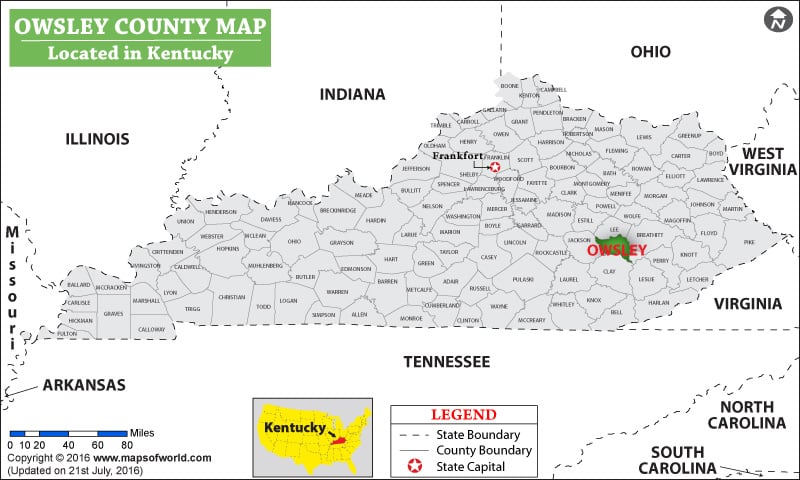
Location of Owsley County

Like Richard, Edward also died during the war, passing away due to typhoid fever on April 9,1862, at Cumberland Ford, Ky.

As I did not know of any ancestors who had died during the Civil War, so did I also not have any letters or other similar writings from any of my many family members of the past, Civil War veterans or not - no letter collections, diaries, or anything like that. That this one case involves both makes it a treasure of sorts, at least to me.

Some of the letters have standard dates, headings, and greetings, as well as signatures or notations from the sender. Others, however, do not, and this causes some confusion as some letters were longer than one page. I am working on these, trying to figure out which pages belong with which others, at least as accurately as I can. It seems that some pages are simply gone, not part of this file, including the one I thought may have been the most interesting. I'm still hoping to match up some of these pages to others, but that seems unlikely.  I may need to publish some pages as "unknown date and place” or “incomplete,” as it appears that much of this collection is a mishmash of pages from various letters. Oh well. This is still fascinating.

Most that have headings are from southeast Kentucky or northeast Tennessee in late 1861 through mid-1862. I believe all were from that region and time. It’s not exactly the midst of the most famous campaigns of the war, but the Union did gain some success in this area during and just after the timeframe of these letters.

These letters generally ask how family at home is doing and state how the soldiers wish to see friendly faces again. Actual military talk is uncommon, but there are a few brief discussions on such topics.

That’s kind of where I am starting on this, along with trying to read the writing and understand the wording. The authors used phonetic spelling at times, but it is not always clear what the writer meant. Sometimes, though, the meaning is perfectly clear, and I think I can hear relatives I’ve known talking with the accent some of these unique spellings represent. Much of my maternal family - both sides - come from Breathitt County and the surrounding area, such as Owsley County, where farming was the most common way to make a living, one which I believe most of my ancestors there likely held, so I suspect Richard and Edward are fair, or at least reasonable, representatives of my direct ancestors of the time in terms of how they spoke and the language they used. It may be a door into my past, the kind that does not show up on enlistment forms, census records, obituaries or any such common genealogical documents. This is different. It's special.

I must say it’s hard for me to read these “few lines” - a common phrase in these letters - without trying to vocalize them in my head, especially the word “hant.” 

I find it really cool that a couple of these letters are on patriotic letterhead. They do not change the message in the letters but certainly are a nice detail. I wonder if Richard got stationery from sutlers near camp or if he received it from home. 

One example of the stationery.

There is truly a level of personal interest in this work that goes beyond my other research and writing. I am anxious to dig more into it and to share these writings and the stories they tell. I’m undecided if I will correct the spellings or just post them as written. I think making the corrections will make them easier to understand, so I’m leaning that direction, but the authenticity of how they spelled out their thoughts is something I appreciate as well. I’m sure I’ll figure it out eventually, perhaps not consistently from post-to-post, or even sentence-to-sentence, so this might be a challenge. I also don’t know how soon I’ll finish it. I want to enjoy this and not rush through it. I'm not really sure how quickly or slowly this will go. 

Sunday, January 14, 2024

A Letter from Camp Pope in New Haven, Ky.

A long letter appeared in the December 22, 1861 Cincinnati Daily Enquirer, printed with permission by the unnamed person to whom it was addressed, a rare piece of wartime correspondence from a solider who had been in Campbell County.

This soldier, William Halpin, had been raising a company for the 50th Ohio Infantry, but withdrew it from that unit and moved the men to Camp Webster in Jamestown, Campbell County, where he was “desirous of procuring a few more recruits” per the Cincinnati Daily Enquirer of October 20, 1861, which stated that additional enlistees would be “sure of a month’s pay in advance, and clothing as soon as their names” were officially on the  company rolls. These men, and others recruited there, eventually became part of the 15th Kentucky Infantry Regiment, which officially formed in New Haven, Kentucky, from where Halpin wrote this missive about the trip from Campbell County to this camp and a few other observations he made. He became captain of Company K of that regiment, eventually being promoted to major and then lieutenant colonel.


After the war, Halpin continued to fight, working for Irish Independence. This link - and others easily found with a basic internet search - provides more details of his adventures and troubles after his fighting in the American Civil War.

A few words were illegible in the scanned image of the newspaper, and in one section, it appeared the paper folded over on itself, making a couple of lines impossible to read. I have noted those areas, but the vast majority of the document was readable.


Camp Ham. Pope

Nelson County, KY. December 17, 1861


It is nearly time that I should write you a line, saying where I am and how located. I presume you want a history of “our” marching, pipe claying, and illegible” and such other incidents of military life as occucrred to us since we left the sunny side of Cincinnati. Here follows the story as briefly as I can state it. We left “Camp Webster” on a wet and very inauspicious day, got on board of a boat, whose name I fortunately forget, for between you and me and the gate post, I have no particular desire to recollect it; although she bore us bravely along the turbid waters of the Ohio, until somewhere “among the wee illegible-small? hours” when the pugnacious thing thought it proper to run into the starboard side of the mail-boat Telegraph. There was consternation for a moment or so among the passengers, and hearts that would not quail before the best manned battery of Southern Jeff. throbbed fast and loud at the prospect of a watery grave. Fortunately, there was no damage done, and we went on our way rejoicing that our time had not yet come. 

We reached the wharf at Louisville and found our old stern-wheel moored alongside the boat that contained the Sixth Ohio Regiment. I won’t tell you the trouble I had during the night to prevent the bombardment, not of a Southern citadel, but of a small corner of the ship’s cabin, where Paddy’s eye-water was dealt out to thirsty travelers at a dime a jigger. The boys had a dime of their first month’s pay left, an as they were going to be “kilt” the next day, considered the best way to rid themselves of such unnecessary incumbrances was to exchange it for as much strychnine as would drown “dull care.” Entreaty and remonstrance wee alike unavailing; they were “on the ocean wave,” with death below, above and before them, and they would have their way. Guards were placed around the sanctuary to prevent the impetuous men of Mars from indulging in the baneful cap; but morning came, and the illegible of the venerable deity who presided over the flowing nectar told more plainly than words could say that he reaped a silver harvest during the silent hours, which honest men devote to the wooing of Somnus. 

From the wharf we marched through the city to the Louisville and Nashville Railroad depot, where a substantial breakfast was prepared for us by the citizens, which we enjoyed with a keen relish. It was on this occasion that my camp knife, which friend Merns presented before I left the Queen City, was first brought into requisition. A few hour’s ride brought us to Camp Hamp. People, about 45 miles south of Louisville, in the midst of a drenching rain. Our quarters were any thing but inviting, and this, coupled with the fact that Colonel Artsman was to have no place in the regiment, disconcerted the men, and they instantly formed illegible to march back to Jamestown. They (page folded, so a couple lines and several words not legible) quarters with the illegible … next day; but as soon as they illegible (got to meet?) with Colonel Pope and his field officers, they changed their notions, and are since contented and happy. It would be impossible to be otherwise, for a finer set of officers than the field and company commanders it would be very difficult to meet.  

Colonel Pope is a wealthy citizen of Louisville, a graduate of West Point, and a fine military commander. He could live in ease and affluence, but when his country called for aid from her sons, he generously abandoned the endearments of private life, left wealth and hoe and family, and, like a true patriot, buckled on his sword to defend the glorious star-spangled banner. He is a true type of a generous, whole souled Kentucky gentleman, in whose presence the humblest man or boy I the regiment feels at home. The company officers are of the same stamp, and the men who compose the Fifteenth Kentucky are as fine and orderly a set of fellows as I ever saw in any camp. There is a fine company of Irishmen, commanded by Captain Spalding, of Louisville, who, the day of our arrival, learning that most of our company venerated the shamrock, invited us to supper, and, like generous Gauls as they are, actually cooked for us their own rations. If ever John Bull shows his teeth to Brother Jonathan, these brave and generous fellows, will not be the last to enter the army that will cross the Atlantic to wipe out the last traces of British rule in the old camp island of their fathers. 

It would surprise any of the old acquaintances to see the improvement in the Camp Webster men. The healthy location of the camp and the exercises they have daily, contribute materially to this result; but chiefly, the absence of the ardent, which can not be had hereabouts, for “love or money.” I would not change the life of a soldier for any I have yet experienced. The fun around the camp fire, the merry joke, the blithesome laugh and patriotic song of the light-hearted soldier, win one in sensibly to love the camp, with all its toils and privations. 

I regret to relate that our usual joy has been lately turned into grief by the demise of a brother in arms. On Saturday, the 4th inst., the grim old King of Terrors whetted his scythe, entered our camp and claimed Patrick Goffing (he meant Patrick Gaffney, who actually died on December 14 after becoming sick while on guard duty at Camp Webster a couple weeks earlier) as his own. Poor Goffing wrecked his constitution in the cellars and garrots of Cincinnati; he caught a cold at Camp Webster, that fastened on his lungs, and finally cut the ligature that bound his shattered frame to earth. He had been in hospital since we came here and knowing that his end was near, prepared himself for his long journey. He received all the rites of the Catholic Church and died in the bosom of her who had closed the eyes of his fathers for fourteen centuries. His remains were borne to the Catholic cemetery at New Haven, on Sunday afternoon, by his comrades, and buried with the honors of war. 

Never was I more impressed with the beauties of the Catholic ritual, and the solemnity of the ceremonies used in thee burial of the dead. In the fashionable thoroughfares of large cities, and even in the pillared aisles of the grand Cathedrals, where artificial music greets the ear, and the painted belle in gorgeous plumage attracts the eye, one is apt to forge tat the ceremonies of religion were meant for heaven, or think they were more than a fleeting earthly show; but here, in the midst of the primitive forest, to use the white robed minister of God follow to the tomb the poorest of the children of the Church, with the same care and solicitude as if he were a sceptered monarch, is a sight to impress the heart with the liveliest feelings of gratitude to God for providing a religion that ministers alike to all His children, and cares for the humblest as well as the most exalted, from the cradle to the grave.To see the aged and venerable successor of the apostle, bent with age, yet filled with fervor, march from the church to the graveyard, with uncovered head, reciting the beautiful psalmody proper for the occasion, was a sight so full of grandeur as to strike the beholder with astonishment, and draw from the lips of unbelievers an acknowledgement that the creed that taught such earnest simplicity was indeed of divine origin. Words can not express the satisfaction it was to poor Goffing to know that while his grave should be made by stranger hands, far away from his home and kindred, that a requiem would be sung by the appointed mister of the Most High.

We expect to move soon to Elizabethtown, where we are to join three Ohio regiments, including the Tenth. I learned tonight that Colonel Lytle will be our Brigadier General, and the boys are wild with joy over the news. On Saturday last General Nelson’s brigade passed here and encamped about seven miles further south. There is no doubt of an early forward movement, but in what direction I am unable to say. The Thirty fourth and Thirty Sixth Indiana were encamped alongside of us until Saturday last, when they moved off to see old Buckner. The Sixth Ohio and Colonel Stanley Matthew’s regiments are with General Nelson. We are provided with all the equipments except wagons, and as soon as they are furnished, off we go. Until then, farewell. I am at a great loss for the Enquirer – can’t you send me an occasional copy?

Yours truly, 

W.G.H.

--

The 15th Kentucky did end up in brigade under Colonel Lytle, including during the hard fighting around the Bottom House at Perryville.

Sunday, March 5, 2023

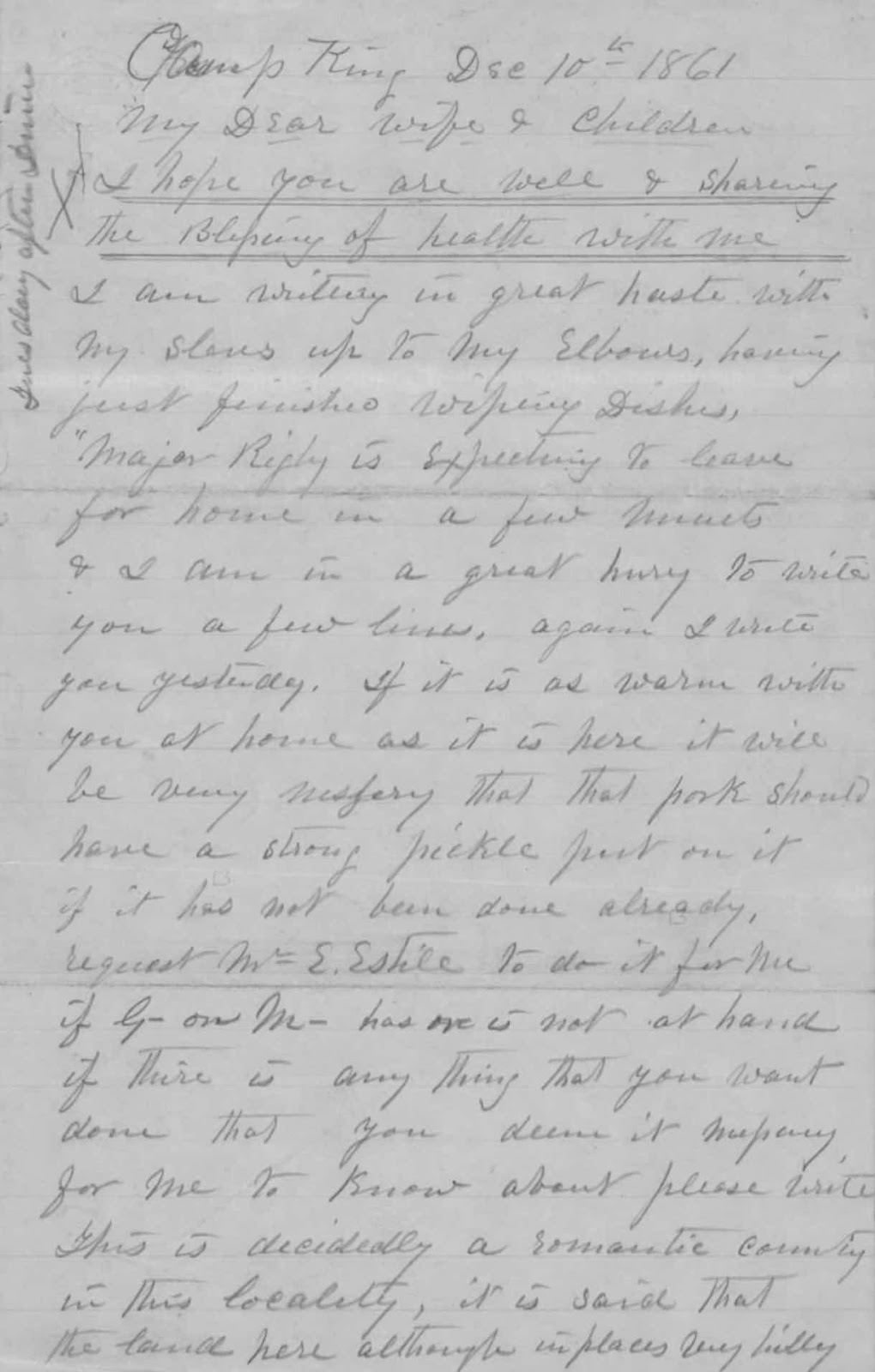
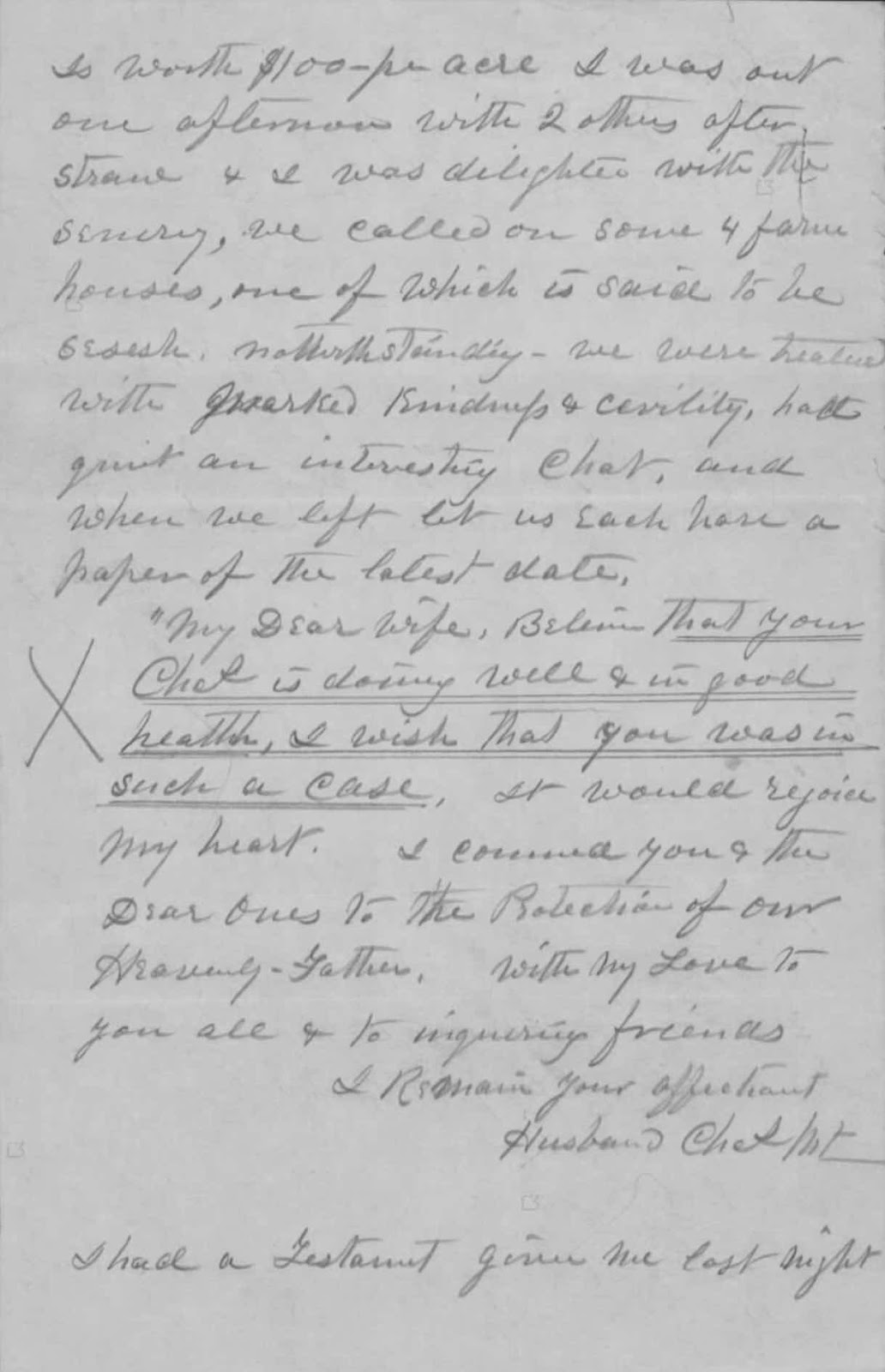
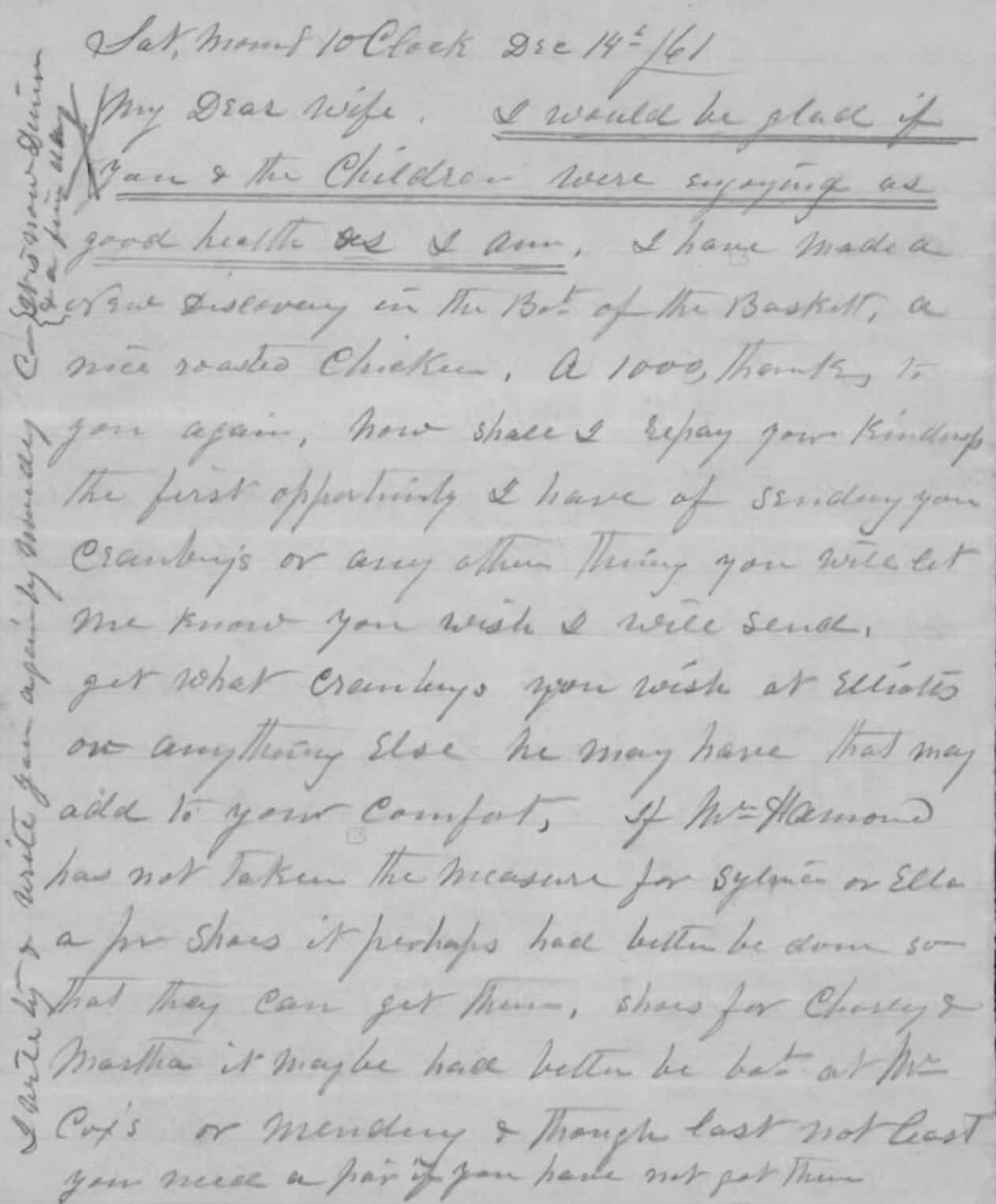
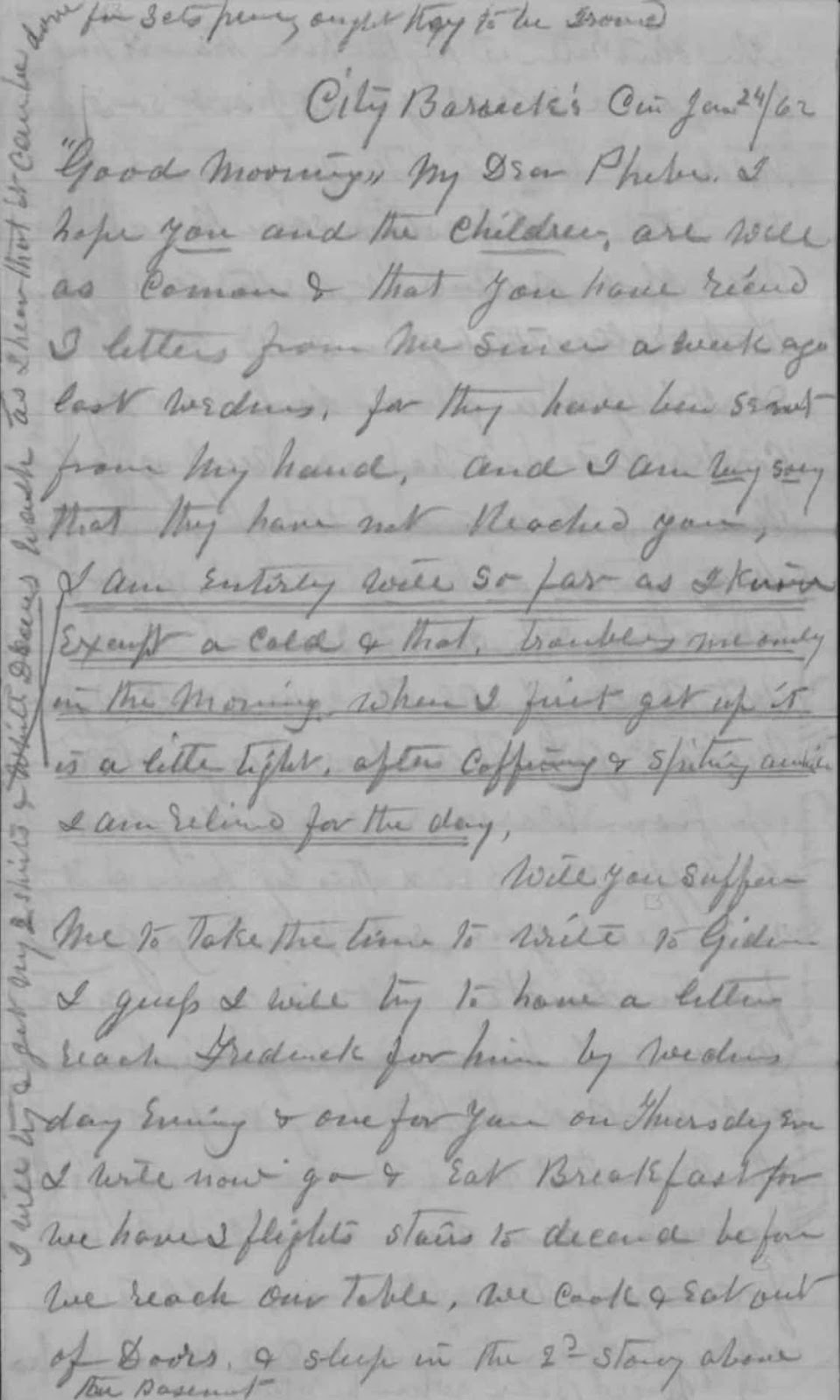
Charles Mount, 20th Ohio, Letters Home

I recently posted about a soldier in the 20th Ohio named Charles Mount

Four of his letters home survived the war and are in his widow’s pension file on Fold3.

Here are my attempts to transcribe them, though some words are unclear. I tried to add modern spelling, spacing, and punctuation to help make them easier to read. 

On the final letter, he wrote the start of it on the bottom half of the page, then the last half from bottom to top of the top half. It was a mess, and he also had a habit of writing in the margins, both on the sides and then back at the very top. I tried to put everything in a sensible order but could not find another closing that fit, so those lines seem to dangle, but at least they were generally legible and sensible.

Emphasis (underlining) is in the originals. I used italics for illegible words.  

—Letter 1


Camp King Dec. 10, 1861, Tuesday afternoon

My Dear Wife & Children

I hope you are well & sharing the blessing of health with me. I am writing in great haste with my sleeves up to my elbows, having just finished wiping dishes. Major Rigby is expecting to leave for home in a few minutes & I am in a great hurry to write you a few lines again. I wrote you yesterday. If it is as warm with you at home as it is here it will be very necessary that that pork should have a strong pickle put on it. If it has not been done already, request Mr. E. Estill to do it for me if G or Mr. – has one is not at hand. 

If there is anything that you want done that you deem it necessary for me to know about, please write. This is decidedly a romantic county in this locality. It is said that the land here, although in places very hilly, is worth $100 per acre. I was out one afternoon with 2 others after straw & I was delighted with the scenery. We called on some 4 farmhouses, one of which is said to be sesesh, notwithstanding we were treated with marked kindness & civility, had quite an interesting chat and when we left let us each have a paper of the latest date. 

My dear wife, believe that your Chas. is doing well & in good health. I wish that you was in such a case. It would rejoice my heart. 

I commend you & the dear ones to the protection of our Heavenly Father. 

With my love to you all & to inquiring friends, I remain your affectionate husband, Chas. Mt. 

I had a testament given me last night.


— Letter 2


Sat. Morning 10 o’clock, Dec. 14, 61

 My dear wife I would be glad if you & the children as good health as I am.

I made a great discovery in the bottom of the basket, a nice roasted chicken. A 1,000 thanks to you again. How shall I repay your kindness? The first opportunity I have of sending you cranberries or any other thing you will let me know you wish, I will send.

Get what cranberries you wish at Elliott’s or anything else he may have that may add to your comfort.

If Mr. Harmon has not taken the measure Sylvia or Ella a pair of shoes, it perhaps had better be done so that they can get them.

Shoes for Charley & Martha it may be had better be bought at Mr. Cox’ or illegible & though last not least you need a pair if you have not got them, you will please get. If you need money let me know, or there is a few accounts which if not paid in soon Gideon will look to these things. I hope you will not be backwards about writing to me in time, that you may be cared for in time. 

Those cakes which were put in my satchel, I have them except one. You will think it strange perhaps that I loved them so well at home & get here, have cared so little for them. Their turn will come by & by perhaps.

I would say that when Lieut. Rogers got in camp, it was night & had no supper & the men that came with him had no supper. I done what I could for their comfort & took W.R. into our tent & opened the basket of good things which you sent. He partook of the biscuit, butter & cakes & divided most of the apples to the boys that there happened to be in. I had not discovered the chicken there.

Mr. Dunedin(???)  gave us a pail full of apples as we passed his house. I have a few yet. We can get them here in camp 2 large ones for 5 cents, or small ones for 1 cent apiece.

I remain your affectionate husband, Chas.


— Letter 3


City Barracks – Cincinnati – January 24, 62

Good morning my dear Phebe. I hope you and the children are well as Corman & that you have rec’d 3 letters from me since a week ago last Wednesday, for they have been sent from my hand, and I am very sorry that they have not reached you. I am entirely well so far as I know except a cold & that, after coughing & spitting a while I am relieved for the day.

Will you suffer me to take the time to write to Gideon. I guess I will try to have a letter each for Frederick for him by Wednesday evening & one for you on Thursday evening. 

I write now go & eat breakfast for we have flights of stairs to descend before we reach our table. We cook & eat out-of-doors & sleep in the 2nd story above the basement.

I will try & get my 2 shirts & white gloves washed as I hear that it can be done for 3 cents illegible to be illegible.

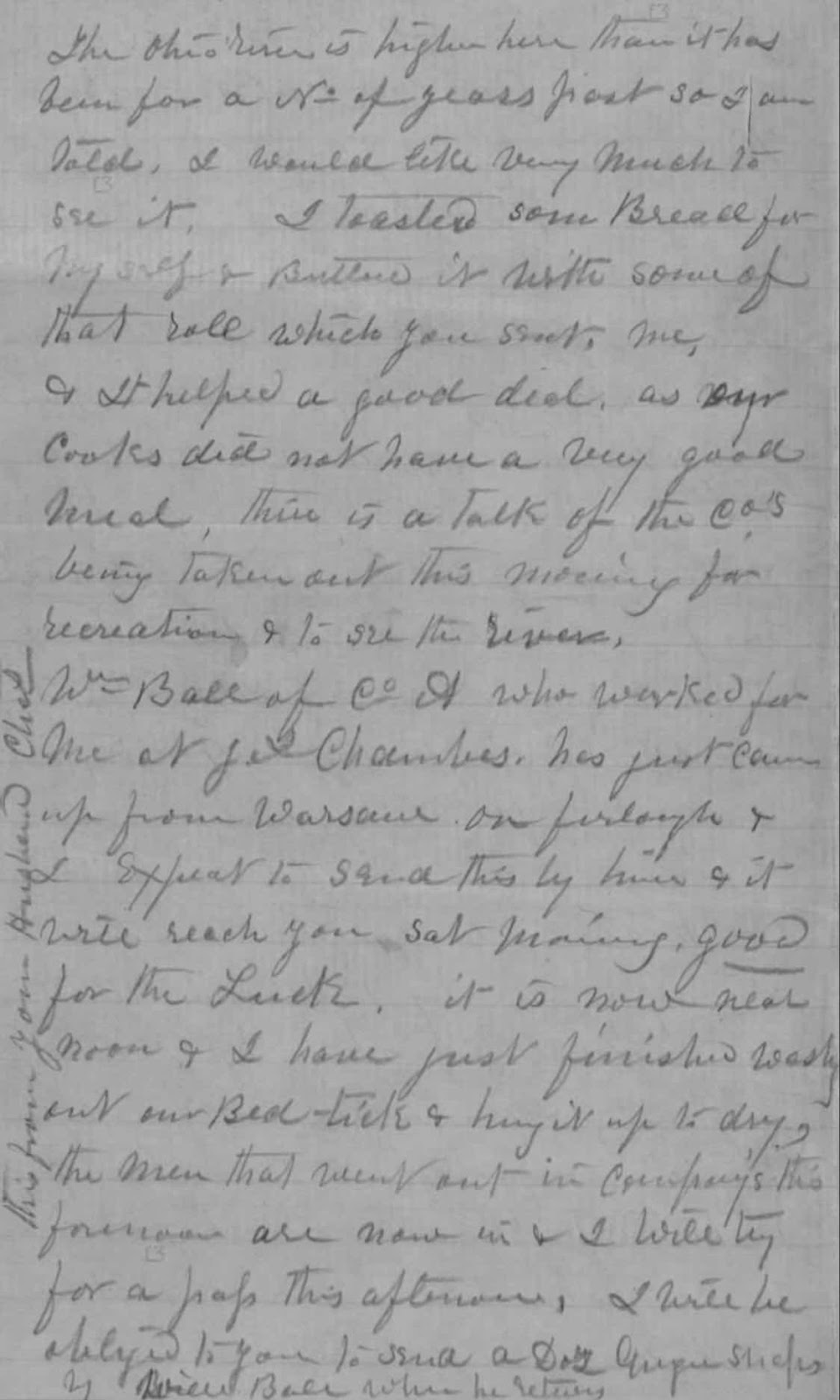
The Ohio River is higher than it has been for a number of years past, so I am told. I would like very much to see it.

I toasted some bread for myself & buttered it with some of that roll which you sent me & it helped a good deal as our cooks did not have a very good meal. 

There is a talk of the company being taken out this morning for recreation & to see the rivers.

Wm. Ball of Co. A who worked for me at Jms. Chambers has just come up from Warsaw on furlough & I expect to send this by him & it will reach you Saturday morning. Good for the luck.

It is now near noon & I have just finished washing our new bed tick & hung it up to dry. 

The men that went out in Company’s this forenoon are now in & I will try for a nap this afternoon.

I will be obliged to you to send a dozen illegible sticks by Will Baer when he returns. 

This from your husband Chas. 


— Letter 4 (it begins in middle of the first page)


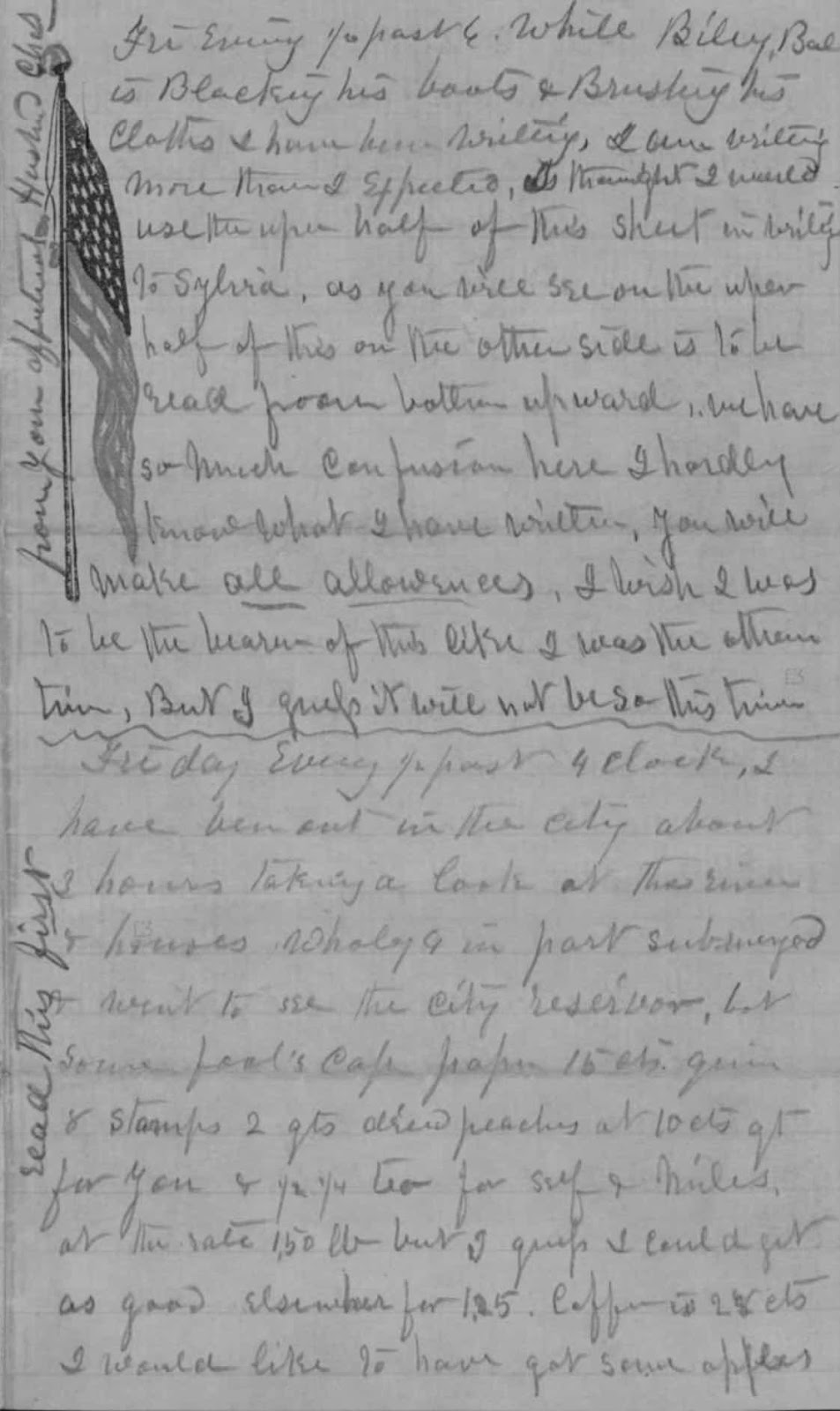
Friday evening ½ past 4 o’clock

I have been out in the city about 3 hours taking a look at the river wholly & in part submerged.

Went to see the city reservoir, bought some foolscap paper 15 cents, illegible 8 stamps, 2 quarts dried peaches, at 10 cents a quart for you & ½ ¼ tea for self & Miles at the rate 1.50 lb., but I guess I could get as good elsewhere for 1.25. 

Coffee is 2 cents.

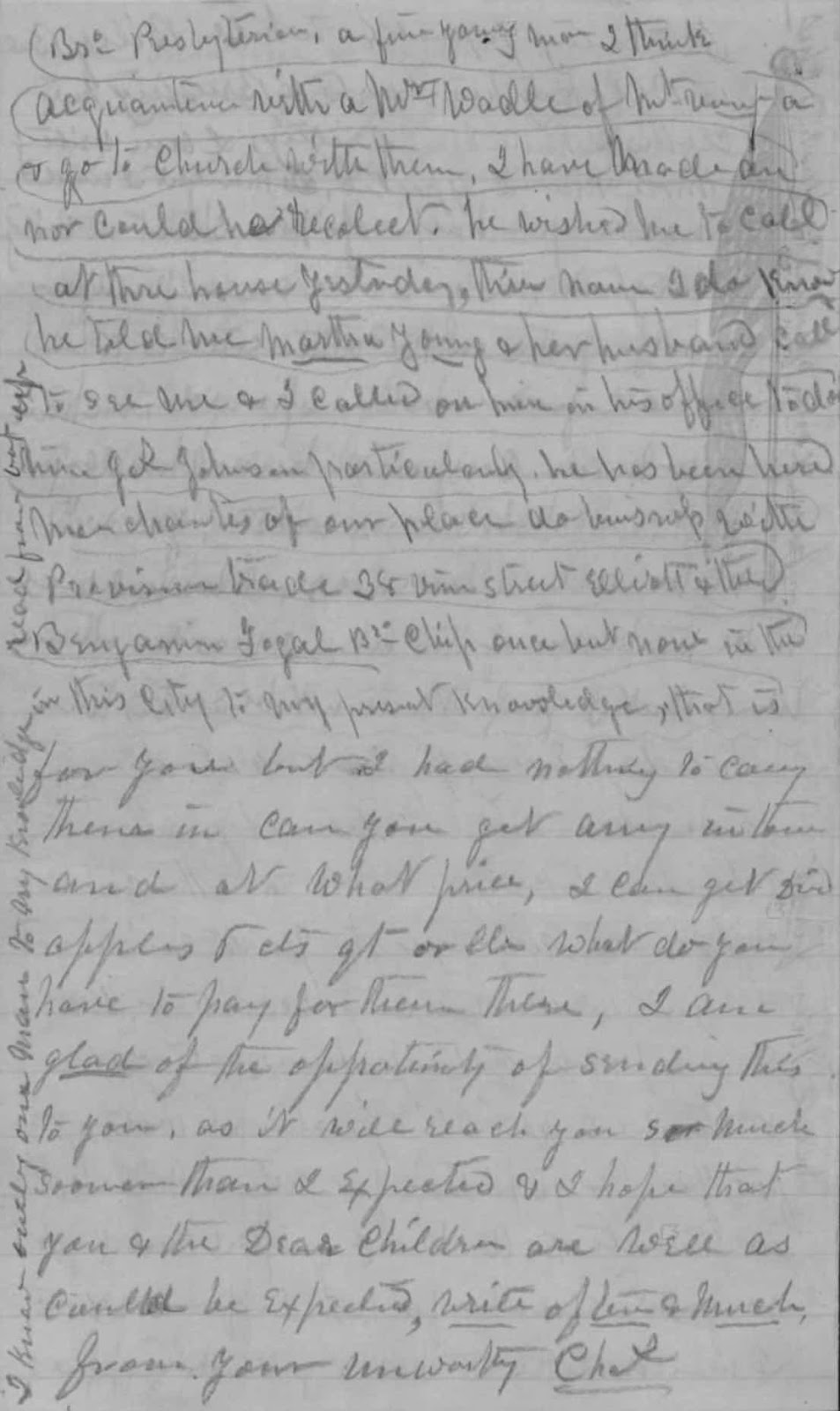
I would like to have got some apples  (move to middle of last page) for you, but I had nothing to carry them in. Can you get any in town & at what price? I can get fine apples 5 cents t or lb. What do you have to pay for them there?

I am glad of the opportunity of sending this to you as it will reach you so much sooner than I expected & I hope that you and the dear children are well as could be expected. 

Write often & much.

From your unworthy, Chas.

Top of first page: Friday evening ½ past 6.

While Billy Ball is blacking his boots & brushing his clothes I have been writing. I am writing more than I expected. I thought I would use the upper half of this sheet in writing to Sylvia, as you will see on the upper half of this on the other side is to be read from the bottom upward. 

We have so much confusion here I hardly know what I have written. 

You will make all allowances.  

I wish I was to be the bearer of this like I was the other time, but I guess it will not be so this time. 

From your affectionate husband, Chas. 

(Last section starts in left margin on final page, then moves to the middle of page and goes upward.)

I know exactly one man to my knowledge in this city to my present knowledge, that is Benjamin Fogal, illegible once but now in the provisions trade 39 Vine Street. Elliott & the merchants of our place do business with him J. Johnson particularly. 

He has been here to see me & I called on him in his office today. He told me Martha Young & her husband called at their house yesterday. Illegible – perhaps his? name I do (not) know nor could he recollect. He wished me to call & go to church with them. 

I have made an acquaintance with Wm. Waddle of Mt. Vernon, an illegible Presbyterian, a fine young man, I think.


Monday, December 6, 2010

Through hell on a hard-trotting horse, with a porcupine saddle

I found this letter by accident in the September 16, 1862 edition of the Cincinnati Daily Commercial. It's rather remarkable how the writer is so extremely harsh of General Nelson at first, but then seems to support him - or at least one of his actions -by the letter's conclusion.

I liked the creative punishment he suggested in the third paragraph - that's quite an image it paints - and I may keep those words in the back of my mind to ponder when someone annoys me.


Huntsville, IND., Sept 9, 1862.

Ed. Journal: In your daily of yesterday I see an extract from a special correspondent of the Cincinnati Times, concerning the villainous barbarity of some of the citizens of Richmond, KY., shooting at our soldiers as they were retreating through that place. In addition to the testimony given by that correspondent, my own son saw it, and many others from this town and vicinity. We can procure avalanches of testimony verifying the truth of that statement; men whose word will not be doubted in any community where they are known.

With regard to Nelson killing at least two of our brave volunteers and wounding a third,
is (sic) also true. J. Bly, an honest and reputable citizen of this place, saw him kill one, and the wounded volunteer is a resident of this county. I can send a list of witnesses corroborating these statements that our worthy Secretary of State will recognize their names and standing at sight and I know that he will certify to their being men of truth and veracity.

As to General Nelson, my wish is that he may be trotted through hell on a hard trotting horse, a porcupine saddle, without water, money or friends, and that our Indiana boys will again be permitted to revisit Richmond, Ky., and that they may rain fire and brimstone on it like Sodom and Gomorrah.

The boys can make the fire, and old Randolph county will find the brimstone, until it is consumed, and never to be remembered amongst men again, especially when we think of our brave troops first passing through the town before Gen. Smith and his men. The same people had cheered them, and pretended to be Union men; but as soon as the misfortunes of the day were apparent, they waved secession flags in our boys' faces, and shouted for Jeff. Davis at the top of their voices, and shooting was started. You may consider me harsh, but I am a father, and had a son who was thus treated by these Janus faced** devils, and you may know that my feelings cannot be easily reconciled towards (illegible - fold in the original paper)

There is great lamentation in some quarters over the "brutality" of General Nelson to soldiers who were straggling. A number of individuals are virtuously indignant on the subject. General Nelson took the short method with those who were running from their comrades who stood in the line of battle. It was high time to do something to discountenance the cowardly habit of falling out of the lines on various false pretenses. Those who were basely sneaking out of the fight should have been energetically admonished of the impropriety of their course.


Photo courtesy of animal.discovery.com  

**Publisher note - I had not heard the phrase "Janus faced" before, but it means something along the lines of "two-faced" named in reference to the Roman god Janus. Thanks to www.dictionary.com for providing this information.

Sunday, October 24, 2010

Died at Sea

Here's another article from the January 15, 1863 edition of the Youth's Companion from a column entitled "Scraps for Youth." It gives a description of death on a Union transport ship, and also focuses on the spiritual and religious aspect of that event, in line with the goals of this paper to deal with subjects like "piety" and "morality."

More articles from various editions of this paper will follow in the future.


Died at Sea
Many a noble, self-sacrificing young man in our armies has died during the unholy war brought upon us by the slaveholders of the South, because of exposure in sickness and the want of proper attention and medications, such as would have been received from loving hearts and hands at home. A writer in the Presbyterian, whose letter is dated on board one of our transports, sailed*** with soldiers on their way to some Southern port, shows how such a sad thing it is to die under such circumstances. The last words of this young man we hope will be remembered by our readers. 


"The weather became intensely cold, the men were necessarily much exposed, and no small measure of sickness has been the result. It is a sad thing to be sick, even when surrounded by the comforts of a home and the delicate attentions of loved ones; but to be sick on board a man-of-war, amid its necessary noise and confusion, and with only such attentions as the male nurses and sturdy shipmates can render, is still sadder. We have already lost one bright and interesting young man, and I fear that some others will not survive.  The one who died on Friday was a youth of eighteen, belonging to Boston. His disease was diptheria. He seemed to apprehend death from the commencement, although he survived several days. The chaplain visited and prayed with him often, and directed him to the crucified Savior. At the first interview he exclaimed, 'Oh! sir pray that I may be a true Christian before I die!' He was very earnest, and there is some hope that before the silver cord was cut he had obtained his heart's desire. His grandfather had been written for, and arrived from Boston an hour or two before he died. That grandfather had lately made his last will and testament, bequeathing twenty thousand dollars to this sailor boy! But he needs no earthly inheritance; and if our hopes for him are well founded, a richer legacy is already his."

*** - A small part of the page is ripped and only "led" is remaining from that word."Sailed" is my best guess, at what was originally meant.

Saturday, October 16, 2010

Abe grows a beard

Yesterday was the 150th anniversary of the letter from Grace Bedell to Abraham Lincoln in which she suggested he grow a beard. Her suggestion was not the only one in a similar vein that he received, but it certainly is the most famous.

Here is a link to a story in the Observer of Dunkirk, NY about the letter.  It includes the text of her letter, which I have printed below.

NY
Westfield Chatauque Co

Oct. 15, 1860

Hon A B Lincoln

Dear Sir
My father has just home from the fair and brought home your picture and Mr. Hamlin's. I am a little girl only eleven years old, but want you should be President of the United States very much so I hope you wont think me very bold to write to, such a great man as you are. Have you any little girls about as large as I am if so give them my love and tell her to write to me if you cannot answer this letter. I have got 4 brothers and part of them will vote for you any way, and if you will let your whiskers grow I will try and get the rest of them to vote for you you would look a great deal better for your face is so thin. All the ladies like whiskers and they would tease their husbands to vote for you and then you would be President. My father is a going to vote for you and if I was a man I would vote for you to but I will try and get every one to vote for you that I can I think that rail fence around your picture makes it look very pretty I have got a little baby sister she is nine weeks old and is just as cunning as can be. When you direct your letter direct to Grace Bedell Westfield Chatauque County New York

I must not write any more answer this letter right off Good bye

Grace Bedell


Thursday, March 11, 2010

New acquisition for the Ramage Museum

The  James A Ramage Civil War Museum has been fortunate enough to acquire recently a letter written on November 20, 1862 by  Cincinnati resident Betsy Sheelman. It is in remarkably good shape, along with envelope in which it was sent.

It is 4 pages long, on one sheet of paper that folds out into 4 sides. The handwriting is beautiful, much better than mine, but is faded just enough to make it slightly difficult to read.

While it discusses everyday normal topics such as "what is butter worth there" (written to her family in New York) and the birth of a friend's daughter, but what makes it so fascinating to the museum is the paragraph where she describes how "We had a big scare this time the rebles (sic) was over in Kentucky only a bout five miles from here." It's not a long section or discussion, but it still is a great first-person overview of the September 1862 threat that many know as the "Siege of Cincinnati." To have such a wonderful document in the museum's possession is just wonderful - it's the perfect type of item for us and the story we tell.

The letter also mentions a Sunday church service at which a military chaplain from the 2nd Ohio regiment gave "as good  sermon as I about ever heard."

The letter writer did not always use punctuation or capital letters like modern writers are used to, but is still fairly easy to read and comprehend.

We already have a spot on our wall reserved for it, once we get it professionally framed. We're still discussing exactly how to frame it - show as much of the original as possible, show a scanned version to protect the original, or show the original front page and section on the local "scare," or other options as we may think of them, but we hope to have it on the wall for public display soon. We will have a full transcription available in the museum (I'll probably start working on it this weekend), but it is so cool and such a wonderful relic, that it is hard to wait to get it on display.

I'll try to post a scanned image of part of the letter once I get one.