Showing posts with label Ohio River. Show all posts

Saturday, June 11, 2022

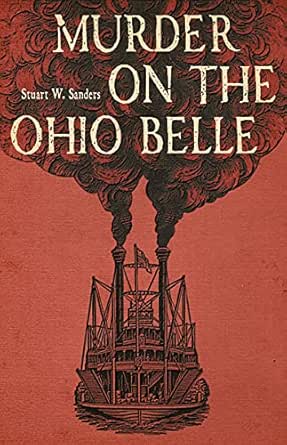
Book Review: Murder on the Ohio Belle

Amazon.com: Murder on the Ohio Belle eBook : Sanders, Stuart W.: Kindle  Store
 
Stuart W. Sanders 
Copyright 2020
University Press of Kentucky

Murder on the Ohio Belle is not a Civil War book, but covers the war era including the generation of people who brought on and fought the war, thus making it a worthwhile read for those focused on the fighting years. Mid-nineteenth century culture is the main theme of this work, as seen through the experiences of one steamboat, its crew and passengers.
 
As its title implies, Murder tells the story about a killing (actually two) that took place on the steamboat Ohio Belle, but it goes well beyond that, serving as sort of a biography of mid-nineteenth century steamboat and American culture, or at least many aspects thereof.

This book starts with a strong introduction. Many works use such a start to explain the author’s goals for the book, but few are as straight-forward and effective as the this one.

The hope of this book is to “help us better understand nineteenth century riverine culture.” (page 2) It explores the relationship northern owned boats and their crews had with slavery and slave culture along the Ohio River.The phrase “fluid border” between free states and slave states was literally true, since the waters of the Ohio formed much of that border. The author shows that these boats profited from, and thus supported, slavery with the business they conducted in the south.

Sanders further pledges to explore“how Americans contended with violence” (page 3) such as murder, lynching, and warfare, and argues “the history of the Ohio Belle also presents a portrait of how western antebellum society embraced retribution.” (page 4)

This work considers a variety of period cultural issues, such as “interpersonal violence, slavery, honor culture, and retribution.” (page 4)

The introduction comes to a definitive conclusion: “A single event…can illuminate a more important, broader narrative about our past.” The plan is to show readers “important themes from the nineteenth century that are still relevant today” (page 5), such as vigilantes, injustices, and others.

“History, including the tale of a murder on a steamboat, still matters” is an apt final sentence to this introduction.

The book lives up to the promises and goals listed in its beginning. It does so mostly in a chronological fashion, but does jump ahead and back at appropriate times to tell the story fully. 

This is not a long book. It has an introduction, eight chapters and a conclusion which combine to take up 111 pages, including the acknowledgements, but does also feature 30 pages of notes, some of which include information beyond the citations. This length, and the writing style of the author, make it a quick and easy read, so anyone worried about finding enough time to read an entire book should still consider this one.

Besides the telling of the story of the actual murders, and how it parallels mid-nineteenth century American behavior, this book also details the career of John Sebastian, the captain of the Ohio Belle, and how he dealt with those issues on his boat.

Another interesting aspect of this work is the story of Margaret Garner. Many people have heard or read  of her escape from slavery in Boone County, Kentucky, across the Ohio River to Cincinnati, where she killed her young daughter instead of letting slave catchers capture her. This book details more of her story after that incident, as she was sent downriver aboard a steamboat.This part of her story is not as famous as her attempted escape, but does include more heartbreak. Her tale was an unexpected but valuable addition to the study of the region's culture at the time. Few stories illustrate the nature of slave-state Kentucky’s proximity to the free state of Ohio as clearly as hers does.

Violence, revenge, honor, and the definition of a “gentleman” (and expectations of such a man’s behavior and interactions with others) are concepts that appear throughout the book, and are familiar to Civil War students. The use of alcohol, mixed with gambling and traits like pride, honor, and the tradition of carrying concealed weapons was a common contributor to problems, including occasional mob violence. This behavior on “the Ohio Belle, and other vessels was simply a reflection of behavior on land during this period.” (pages 58-9) This book provides examples of this, including in the river city of Louisville.

Class distinctions – particularly between wealthy planters and “lower” economic classes, but also between races – were ever present in how people behaved on land and water.

Of course, the defining event during the steamboat era of the mid-nineteenth century was the Civil War, and chapter seven dives into it, how it affected the Ohio Belle  (captured by the Confederacy) and John Sebastian (he lost his left arm during the conflict.) It was the ultimate example of violence during the era, but these years also continued to demonstrate the dangerous desire and search for vengeance, much like during peace time.
 
Overall, this is a fine book for anybody who enjoys history, but it also covers topics that should interest those focused on the Civil War, river history or social/cultural history in mid-1800s America. This book is a pleasure to read. I happily recommend it.

Tuesday, May 14, 2013

Now reading: Uncle Tom's Cabin

I read this famous novel in college, 20+ years ago (yikes!) and finally picked it up again recently. My reading is going rather slowly, I admit, mostly at lunch while at work and on the bus to and from work, but, wow! What a disgusting story, even at the start. I know "disgusting" is not a great word but as I started reading it, that was the first thought that came to mind.

I knew what the story was about and why it was so controversial, but I guess I had forgotten the specifics. On one hand, I can understand why I would forget such details due to time mainly, but I'm kind of sad that I had not remembered more of it. I guess reading it in college, with many other such assignments and a less mature than now (hopefully :) ) mind probably provides a reasonable explanation, but I do wish I had remembered more about this story.

It is very good reading, even when I struggle through the dialects in which Mrs. Stowe wrote many of the conversations and I am happy to have started reading it again. It is a powerful story of slavery and many of the different types of characters involved in it. That it is based in Kentucky and obviously concerns the northern Kentucky and Cincinnati areas does make it a bit more personal to me, especially as I ride a bus across the Taylor-Southgate Bridge that spans the Ohio River, one of the major boundaries between potential freedom and slavery in the mid 1800s and in this story.

I hope I can convince myself to read it more frequently and focus on this story, but I also want to think about what I'm reading and not just glance over words on a page. I know it is a novel and is fiction, but slavery was a real part of this country, this state, this region and even my family.

Families were split up, people were hurt and millions of African-Americans were treated like cattle or pieces of furniture or other such property. This story is re-opening my eyes to one period view of that institution and its affects on so many people no matter how young, old or innocent. I imagine I'll have at least one or two more entries about this book as I get deeper into it and ponder the issues it raises and the stories it tells.

courtesy http://www.harrietbeecherstowecenter.org

Wednesday, July 25, 2012

Crossing the Ohio River

I'm not really sure how to approach this idea that popped into my head today, but it seems like a good idea or question to mention here and maybe help me think about it or about how to approach it. This will probably be kind of a stream-of-consciousness post as I figure out what to say or how to explore it.

I live in northern Kentucky and work in Cincinnati, so I cross the Ohio River every day, along with thousands (or tens of thousands) of others, some going north like me, but many heading south. It's not a big deal; I've even walked home from work many times, a distance of about 2.5 miles.

150+ years ago, however, even that short distance was much longer than it seemed, at least for many African-Americans. The Ohio River was an unofficial border between the slave state of Kentucky and the free state of Ohio (as well as Indiana and Illinois - check out a map - Kentucky has a long northern border along the Ohio.)

If a slave tried to run away, oftentimes reaching the Ohio River, with stations on the Underground Railroad along its banks, north and south, was a major goal and milestone. It did not guarantee safety - Cincinnati was not the most progressive city regarding racial relations (some people even today say Cincinnati is like part of Kentucky, while others claim Northern Kentucky is more like Cincinnati than the rest of the state) and if escaping slaves could cross the river, so could slave catchers.

Nonetheless, it was an important boundary between North and South, free and slave, and it made cities like Cincinnati and Louisville into important trading ports. The border along the Ohio River was a key reason Abraham Lincoln considered keeping Kentucky in the Union to be so important. If the Confederates could set up defenses along the lower banks of the river, they could devastate Union trade in the west, prevent Union forces from penetrating the Deep South in the West (think Vicksburg, Shiloh, Corinth, Nashville among the key southern cities in this theater) and perhaps have a launching pad for attacking the Illinois, Indiana, Ohio or other Northern states with more than an occasional John Hunt Morgan raid.

Despite this, I cross this river twice a day and until today never really thought about it in a historical context. Does it make sense for me to try to picture escaping slaves (like Margaret Garner for one famous, though unsuccessful, example) while I'm in an air-conditioned (in the summer, heated in the winter) bus? Should it help me appreciate my good fortune or to understand better the differences between now and the past? How many African Americans would have absolutely loved to have safe, reliable transportation from my beloved Kentucky into Ohio or another northern state?

To me, the Ohio River is just a piece of everyday life, nothing really special or noteworthy, except for an occasional flood. Historically, however, this was a key border, a major crossing point, a place of hope for people to try to reach freedom, to escape bondage, to try to have some control over their lives. It is not a famous battlefield of dozens or hundreds of acres, with monuments and gift shops and tourists taking pictures. It is simply a wonder of Nature that human mapmakers once used as a separation point of what we call states, and which continues to flow southwards, just as it did 150 years ago. It has no mind or desires or other human emotions, but steadfastly flows until it reaches the mighty Mississippi. Yet this river, one of many throughout the country, even as constituted in 1865 and before, was very important, as a border into potential freedom and as a goal, to countless people who wanted to better their lives.

I often wonder what it would be like to live near a really famous battlefield like Gettysburg or Antietam or Shiloh. My appreciation for Perryville grows as I understand it more, but even that is a couple of hours away.

Yet here is an important place, just a few minutes from my home, that absolutely played a role in 19th century America and in the slavery controversy that at least contributed (though I believe caused) the bloody Civil War.

This is a perspective I had not considered before. I'm sure I'll think about it more often now, as I routinely cross this border so frequently and easily.


The above is a picture I took in April 2009 from downtown Cincinnati, with a brief view of the river separating the states.

Friday, May 20, 2011

More controversy at Cincinnati

Here is another story of what happened to a shipment that tried to pass by Cincinnati on the Ohio River, a major trade route of the time. It is from the Covington Journal of May 18, 1861, reprinted from the Maysville Express.

We learn that a shipment of bacon made by a firm in this city, to Louisville, was arrested at Cincinnati and sent back to the consignors here. Such conduct is a most unjust, illegal and illiberal interference with our commerce between our own ports and citizens.  The Ohio River belongs exclusively and rightfully to Kentucky - and the transit of our products along it should be free and undisturbed.

--

Here is a link to a previous entry about a similar incident, along with some reaction to that first achievement

Sunday, May 15, 2011

Slightly off-topic: 1848 views of Cincinnati

I realize this is not a pure "Civil War" post, but I think this is a neat story, and it may be the only photographs to show what the riverfront area of this city - an important trade stop on the Ohio River and around the 6th largest city in the country at time - looked like. Surely it had changed somewhat by the time 1861 rolled around, but perhaps not terribly much

Cincinnati Enquirer story


One of the views of Cincinnati courtesy of the article linked above