Showing posts with label women. Show all posts

Tuesday, December 10, 2019

The Would-Be Soldier

During the Civil War, some women disguised themselves as soldiers (male, of course) in order to fight in the war. This was not an overly common occurrence, but it did happen, probably more frequently than most people realized then or do today. This subject, however, has garnered more attention and study in recent years. For instance, the American Battlefields Trust has published a story on Female Soldiers in the Civil War, and here is a Smithsonian story on the topic. This nice article also discusses this situation, and a quick online search will turn up many similar accounts.

 I came across such an instance described in the January 10, 1862 Cincinnati Enquirer, and immediately knew it was a must share as I did not recall seeing a similar account in a local source. That it happened in Kentucky certainly heightened my interest, and then I realized it mentioned a unit that I’ve read about at Perryville, the 15th Kentucky Infantry, further capturing my attention.

Camp Temple, mentioned in the article, was Camp Joseph B. Temple, in New Haven, Nelson County, Kentucky, the same city in which the 15th Kentucky organized and mustered into service.
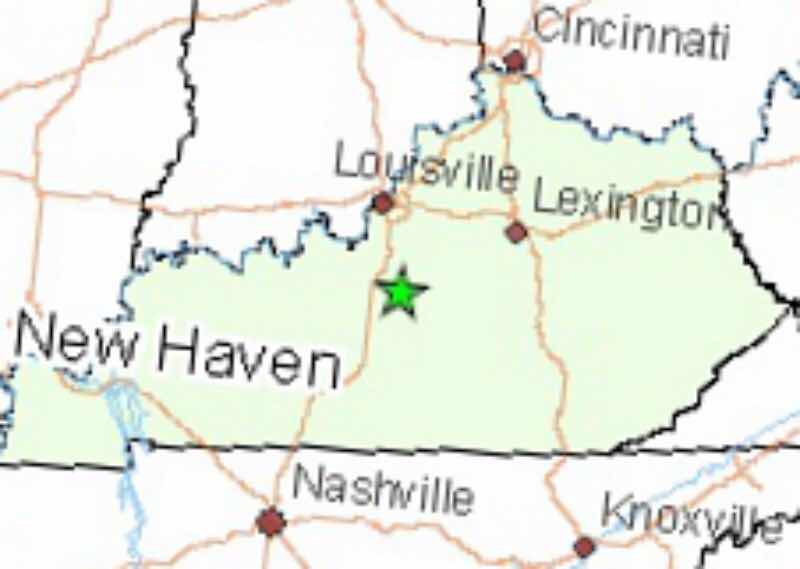

Location of New Haven, from bestplaces.net

This unsigned letter was written from Camp Ham. Pope, also near New Haven, on January 6, 1862.

An incident not common in modern times, though frequent in the Amazonian and the days of chivalry, occurred at Camp Temple, adjoining us, yesterday. Some five weeks ago, a fine, healthy-looking and dashing young man joined Colonel Boone’s regiment (the 28th Kentucky Infantry.) He was duly mustered into service and performed the arduous duties of a soldier since, standing his regular guard and doing picket duty in his turn; but by some unlucky accident it was discovered yesterday that the man had changed his sex and turned out to be a woman. She was compelled, much against her will, to doff  the habiliments of Mars and substitute hat and hoops in their place. She was sent to Louisville under escort, with a view to be sent to Indiana, where it is said she hails from. She is a young widow, with captivating eyes and air and charms of romance. It is said she formerly enlisted and served sometime in a cavalry regiment, where she had a lover, and adopted the method of re-enlisting to reach him before or on the battlefield. I regret that I have not her name to send to you for the benefit of the novel writers, who could make a charming romance out of the affair. So fascinating was the would-be soldier, when forced out of unmentionables, that she quite captivated the heart of a gay Lieutenant, belonging to the Fifteenth Regiment. (This probably refers to the 15th Kentucky Infantry, which was organized at New Haven in the time frame the article describes.) He was formerly a rollicking disciple of Crispin* but now the light and life of the camp. He happened to be at the depot when she was departing, and, hearing the circumstance, immediately yielded himself up, a willing votary of the shrine of the heroine. Had she turned her face in any other direction than that of Louisville, the Fifteenth would now be minus one Lieutenant; but, inasmuch as there was another claimant for his affections there, with half a dozen responsibilities, he concluded that “discretion was the better part of valor.” 

The correspondent did briefly mention the female soldier’s physical appearance and “charms of romance,” while portraying her as chasing after a man, but also praised her work as a soldier instead of only commenting on traditional female traits, a fair and respectful description of this person. Of course, the lack of a name or other identification is a frustrating hole in the story, as is the ignorance of what the “unlucky accident” that revealed her secret was, but is still is a small, fascinating piece of the Civil War.


*The meaning of “a disciple of Crispin” is unclear. Crispin and Crispinian are patron saints of “cobblers, currents, tanners, and leather workers” per Wikipedia, and a St. Crispin’s Day Speech appears in Shakespeare’s play Henry V, but but neither of those appears to make sense in the context in which this article uses it. If anybody sees something I’ve overlooked, leave a comment or email me. 

Sunday, August 12, 2018

Book Review: Mrs. Lincoln by Catherine Clinton


By Catherine Clinton
  (c) 2009
Harper

Before reading this book, one I have wanted to read for quite a while, I expected to feel much pity for Mary Lincoln after reading it, like I did after watching the movie Lincoln, and while I do feel some of the sentiment, I am in a quandary, as I also feel a different, unsympathetic feeling, perhaps as harsh as derision, or at least frustration, towards her.  This book describes a complicated, confusing, sad, tragic, ambitious, successful woman and life. She was strong, yet weak, intelligent, yet naïve, independent, yet self-identified with her husband and his career.  I realize that some of those descriptions are redundant or contrasting, but I find that an appropriate way to describe the subject of this book.  She was simply human, but not a simple hunan, and this book does a terrific job of exploring the many competing facets of her life.

These various aspects of Mary Lincoln form a main topic of this book, which serves as a biography of both the former Mary Todd and of her marriage. Though her life certainly takes priority, telling the story of Mary Lincoln simply requires a discussion of her husband and marriage. It is inescapable, even after the assassination, as Clinton notes: Her identity was wholly bound up with remaining Mrs. Lincoln (page 287).

That line is an accurate summary of Mary’s post-1865 life, but this book starts much earlier, thoroughly discussing her early life, including the tragic loss of her mother, the coming of her step-mother and the ever increasing size of her nuclear family, with so many siblings and half-siblings.

I must admit that when I think of the tragedies in Mary’s life, the loss of her mother often escapes my mind, but this book illustrates how great a loss this was for her, as well as the difficulty of having a step-mother and so many half-siblings. The tension in this large family is evident in this book and the author shows that this situation hurt Mary, the first major loss of her life, but certainly not the last. 

Mary grew up in a well-to-do Southern household, a lifestyle that influenced her expectations of life going forward. To paraphrase a popular saying, you can take the girl out of the South, but you can’t take the South out of the girl. This was largely true of Mary, who constantly expected the same type of life and socializing she witnessed in her youth. She did, to her credit, grow to disapprove of slavery, an institution with which she grew up, but otherwise saw herself as a Southern belle, with the expectations of being treated as such. Clinton describes this dominant part of Mary’s personality throughout the book. 

One word used more than once in this work was “entitled,” a fair description of Mary’s attitude. She liked being the center of attention and expected to receive attention, respect, and even admiration due to her position of First Lady and, later, in a term she coined, “First Widow.”  She did make some attempts to help herself, one time resulting in the embarrassing “Old Clothes” scandal, but also expected gratitude from the government and from people who she believed benefited greatly from her husband’s Presidency. This is another theme explored throughout the book, but especially in the discussion of the post-1865 years.

Page 329 offered up another memorable line describing Mary’s attitude, this time in reference to the assassination of James Garfield: when she discovered there was a movement afoot to offer government funds to provide for Gardield’s widow and five fatherless children, Mary, not uncharacteristically, thought of herself (my emphasis added.). She had adored her husband and children and spent much time and energy visiting wounded troops in the hospitals, but  could often be much less unselfish.

Clinton discusses many aspects and incidents of Mary’s life including her love of youngest son Tad and the devastation his death caused her. Of course, her commitment to an insane asylum by eldest son Robert receives much attention, including discussion of the unfairness of the trial and the grudge Mary understandably held against Robert for years. Her behavior during these years, especially concerning issues of money is examined and the author points out possible legitimate mental health issues Mary may have suffered, while also giving examples of times when Mary’s faculties were working very well. The complexity of the questions of her mental health apply to the complexity of her whole life as well. 

This is a riveting book about a complex woman who led a fascinating, sad, complicated life. To keep this review to a reasonable length, I will not attempt to mention all the specific incidents it covers, but the author does an outstanding job of presenting evidence and then analyzing it. An especially noteworthy example of this is the description of Mary’s temper, jealousy, and behavior towards Julia Grant and other women during a late war trip to Virginia. 

At the end of the work, Clinton adds a few paragraphs about Mary’s reputation both in her time and in the modern era, including how scholars and writers have treated her. This was a wonderfully unexpected and interesting section and I wish it had been expanded to include more details, such as some found in the end notes. 

Biographies frequently develop into near hagiographical works for their subjects, as authors who spend so much time and effort studying people can start to like them and let this positive feeling seep into their work.  That did not happen in this book - Clinton certainly offers praise for Mary at times and defends her behavior more than once, but also provides frequent criticism and points out bad decisions Mary made and flaws she possessed. It is a balanced examination of Mary Lincoln, and the author deserves much credit for that fairness, perhaps the strength of this book. 

The book does include helpful end notes and a few photographs as well. I wish the pictures had been of higher quality (maybe that’s a function of the type of paper used in the book)  but that is picking nits. The text is well-written and makes for an easy, quick read. This is a fine book, a virtual must-have for any Lincoln scholar or those interested in women’s history, and a “should-have” for general Civil War libraries. I am happy to recommend it strongly.

Thursday, June 30, 2016

Some Thoughts on Free State of Jones


I am in no way, shape or form a movie buff, but as a student of the Civil War, I wanted to see Free Story of Jones when I heard about it and, surprisingly, have already seen it, only a few days after its release. I did not even see Lincoln until a couple of months after it came out, so this was different.

I enjoyed this movie. It was entertaining and seemed reasonably believable, not like a fairy tale or total fabrication. I will discuss it here a bit, with the disclaimer that I do not watch a lot of movies and am not an experienced reviewer of them, even ones based on historical occurrences. I won't discuss acting, cinematography or anything like that. 

This may end up as more of a "discussion" than an actual review, as I try to explain the thoughts I had during and after seeing it. I do not intend to give any sort of "spoilers" in this discussion but I make no promises, so anybody who does not want to read about parts of the storyline may want to read this post later. I imagine I will get into some specific scenes for which I had some thoughts or ideas.

I also admit that I have not read the book on which the movie is based, nor studied the situation in Mississippi much, so I cannot opine on how accurate the details of the movie are. I will just do my best to describe the thoughts and reactions that the movie provoked in my mind.

The intensity of the movie surprised me. The intensity (the best word I an think to use) began with the excellent (and surprising) opening scenes. Whoever decided to open the movie like that made a very good call . Not all of the movie was at that same level, but much of it was, which I thought made the whole movie better. 

I like that the movie has both action scenes and more "talking" scenes instead of all of just one of those. Another movie I watched the same day was almost all action and fighting. It was a decent film (seeing it in 3D helped) but all of the action kind of blended together. That really did not happen in Free State. 

The portrayal of Newton Knight as a soldier and how he became disillusioned with the Confederacy seemed reasonable. The reality of battle, his nephew's death, the tax-in-kind on common citizens and the 20 Negro rule all were part of the script. The common line "rich man's war, poor man's fight" also was spoken as part of his developing dislike towards the cause for which he had enlisted.

His escape from the Confederates who were trying to catch him seemed a bit too good to be true to me. Even when the dog caught him and delayed  him, the rest of the party did not catch up to him or see exactly where he went, even as he limped forward.

Once he was in the swamp with a few escaped slaves and an increasing number of deserters, the remaining Confederates came across as silly, almost stupid, repeatedly going down what appeared to be the same road in the woods only to be ambushed by Knight's men multiple times without seeming to try a different route or strategy. Did it really happen like that?

When the story needed to show the increase in the number of Confederate deserters, it simply flashed "July 1863, Vicksburg is surrendered. Desertion increases" on the screen. I guess that was a good way to tell of increased desertion in a timely manner, but thought the movie could have at least indicated that Vicksburg was also in Mississippi, like the rest of the story. Any non-Civil War students may not have realized that and I do think that would have helped at least a bit.

Also at this time, two images of the damage caused by war flashed on the screen. I did not recognize one of them, but the other was the famous image of the Dunker Church at Antietam. My first instinct was to ask why use an image from such a far battlefield, but this really does not matter. That level of detail was probably insignificant; I suppose the picture used was good enough to make its point.

A couple other items I wish to mention include the "hanging" scene. I thought it was very good overall, especially the lead-up showing the emotions involved - the fear and sadness were very clear - but thought it could have been more powerful or intense had they shown the bodies dropping and jolting to a stop. That may have, however, been a bit too much for the intended audience, so I cannot complain much about it.

The role women played in this movie was noteworthy too. The moment I especially noticed it was when the women were sitting and shucking the corn while the men were picking it and carrying the baskets of corn to be shucked. There was an unmistakeable separation of gender roles in that scene, but in earlier and later scenes the movie showed women running the household while men were gone, directing slaves to help refugees and even carrying arms to defend their homes. A later scene even showed women firing guns at Confederates who were trying to capture Newton and his men. This movie did portray mostly traditional roles for men and women (men in the army, women at home) but still gave the women some strength and determination. They were not helpless victims at all.

I thought the same showed for the African-Americans who joined Knight's group, though I thought they disappeared for a while. When Knight went into the swamps, he was with a small group of escaped slaves but as the movie showed the increasing amount of army deserters joining Knight, the ex-slaves did not seem to be as present for a while, before re-emerging as strong characters towards the end of the film. I thought the various scenes showing some parts of African-American life as slaves and immediately after the war added a lot of meaning to the movie. The characters "Rachel" and "Moses" were especially important ones.

This added meaning especially showed up in the Reconstruction scenes. Having a section on Reconstruction was a great, perhaps brilliant, idea, providing valuable perspective on some of the difficulties African-Americans faced during this time and the legacy of the war. This is a lesson many (most?) American can use. 

I did find the Reconstruction section, as valuable as it was, to be a bit disjointed. There were frequent captions on the screen to provide information on what was happening or on what the movie could not show. It seemed to me that the movie writers had a lot to say in this part of the film, but did not have enough time, so they had to pick and chose some storylines to include while omitting others. The final product turned out well, but perhaps could have been smoother, though that may be easier said than done. Even a long movie like this has limits.

The voting scene, including the showing of the actual vote count, with only two Repiublican votes being counted, was very effective.

One nit I do wish to pick here was that the Reconstruction piece of the film began with a quick showing of a portrait of Abraham Lincoln to represent his passing. I felt that an image of the actual assassination would have been more powerful in showing the change of leadership.

In addition to the war and Reconstruction storylines, the  various court scenes about the challenge to Knight's descendant's attempted marriage were powerful as well, showing how the legacies of the war and reconstruction (and the importance of race and racial roles) were still around Mississippi in the 1940s, so many years later. This was tied in to the movie's depiction of the relationship between Knight and Rachel, giving these scenes a connection to the rest of the story.

One thing that I noted and thought was interesting about the entire film is that the words "Confederacy" and its derivatives ("Confederate," etc.) were barely mentioned. I only remember seeing it in a couple of the captions and am not sure if any characters uttered such words. If so, it was not frequent. I wonder if this was intentional and if it actually means much or was just a natural part of the story's flow. 

Overall, I really enjoyed this movie, despite the few small quibbles I mentioned. It is a long movie, but tells several different stories about the war, Recinstruction, race relations and family ties. There is quite a bit of intense action throughout it, as well as a mix of more peaceful scenes of thought and discussion. It features several characters who earn the viewers' sympathies, as well as a few "villains" who are less likable. I certainly believe that anyone interested in the Civil War should find time to go see it and that even those not particularly interested in history should as well. I may even go see it again, which is not something I often do for movies. (I'm not sure I have ever watched the same movie twice in a theater.) It is a good, enjoyable film with plenty of action, stories and characters to catch the viewers' interest and tells a story of the Civil War era perhaps unlike any other in popular media. 


Thursday, October 16, 2014

Female Bushwhackers

Here is another story I found in an old book, this time Frank Moore's The Civil War in Song and Story 1860-1865, which I have used in the past. This tale comes from page 423 and offers a few interesting, even brash,  comments on some of the southern women the author had encountered.

Female Bushwhackers 

The women of the South are the goads that prick the men to action. I should have said first that there are female as well as male bushwhackers. When a woman takes one of these creatures to her home or heart, as the case may be, she becomes a partner to his guilt, according to the common law. She thus recognizes his vocation, and applauds him in his robberies. She is the receiver, and the receiver is as bad as the thief. All the country is infested by these guerrillas and bushwhackers; they have certain haunts, where they make their headquarters and store away their plunder. These haunts are invariably presided over by that creature (God help her, after all) of modern growth and the off-spring of the miseries of war - the "war widow." They are, without exception, bitter and inveterate secesh. Usually, indeed in all cases, ignorant and wholly uneducated, they are entirely controlled by passion. Being in destitute circumstances, and lonely, they gladly become the accomplices of this herd of robbers prowling about. I am not to be understood as saying that all the women of the South who unfortunately have lost their husbands in this war, are of this class known as "war widows." Far be it from me. I have found many such women as intelligent, refined and pure as any I have ever known. But everybody knows, or is supposed to know, what the real "war widow" is, and it is of her I write. She makes a good home bushwhacker; aids and abets freely and voluntarily in all the depredations of her  accomplice. She feeds and clothes him, secretes him when hunted down, encourages him in his bad work,  and does all she can (and women are all-powerful for good or evil) to make him a reckless and depraved outlaw. There is a certain sort of superstitious poetry of innocence stitched to woman's being, which has been handed down to us since the time Adam beheld the beautiful image of Eve in the clear, crystal water. While I would regret to despoil woman any of the romance of her nature, I must say that, as far as regards women  bushwhackers, there is nothing in their natures except poetical depravity - a license in licentious liberty, which mars and blackens her nature. As liars, they cannot be excelled in the universe. Actually, they would lie anything or anybody out of existence. And they do it with such brazen impudence - such a shameless air of innocence. Their little hearts are awfully corrupt. While out with scouting parties,  I have repeatedly asked for various kinds of information from these frail creatures, and, looking into my face as innocent as an unwooed maiden, they have told lie upon lie, yes, mountains of them. Their moral perception of right and wrong is very blunt, while their perceptive faculties are quite acute in judging of the relative value of a ring, a blanket, a watch, or other article brought them by their bushwhacking lords." - "Dr. Adonis, in the Louisville Journal"

Tuesday, March 27, 2012

Julia Cutler's Civil War Journal Blog

Thanks you to Peggy Dempsey who saw my recent entries about the riots at Pike's Opera House in Cincinnati and forwarded me a link to her blog, containing the daily writings of an eastern Ohio woman during the Civil War. It looks quite fascinating and I look forward to following it. It will be interesting to see what kind of events this lady found noteworthy and the kind of opinions she formed.

From what I've read of the entries so far, she seems to have kept up on current military events and commented on them. Hopefully I find time soon to read more of the back-entries, while also watching for future ones as well. I have added it to my blogroll.

Julia Cutler's Civil War Journal

Thursday, February 9, 2012

Covington Journal articles on abolition and race

These come from the February 8, 1862 edition of the paper

Abolition Cowardice
The Chicago Times says "If abolitionism was not the embodiment of the meanest cowardice, it would not seek to introduce the black element into the war while the white population  of the loyal States is twenty-one millions against seven millions in the disloyal States. If we cannot whip out the rebels with these odds in our favor, we had better abandon the contest and plead guilty to the rebel taunt that we are an inferior people."


The Poor Negro
The Boston Herald exposes the fact that a notorious Abolition firm in that city, the members of which have sighed and groaned and cast up their eyes of the sufferings of the poor negro, until they have obtained a rich contract for supplying the army with drawers, are paying women sixpence a pair for making them. By hard word and over hours, the women thus employed can finish two pair a day. Twelve cents for a day and half a nights work! Oh, the poor, overtasked, suffering negro!

untitled article
A short-haired, thick lipped negro from Chicago was  hustled out of Kenosha in double quick time on Friday afternoon, for attempting to marry a white woman who came with him for the delectable purpose. The "roughs" got wind of the affair, and after (word missing, perhaps catching?) the darkey, escorted him to the depot, and gave him some good advice for regulating his conduct in such cases hereafter. 


As the train moved off bearing this colored Caesar minus his fortunes, we mused on the uncertainty of human affairs in general, and the absolute inconsistency of Abolitionists in particular. This poor fellow had heard of the social equality doctrines of Wisconsin Abolitionists, and was "stabbed in the house of his friends." After all, "blood will tell."  [Kinosha (Wis) Sentinel]