about the American Civil War
Monday, August 15, 2011
Battery Hooper Days 2011
You have probably already seen the "event" information set up on the sidebar, but I wanted to add a few words about this event, which will be bigger and better here in its 7th incarnation this year.
We will still have our Civil War encampment, with several groups of reenactors being represented, including a cavalry group. There should be over 2 dozen such performers here, with various tents and equipment, including rifles, uniforms and other items soldiers routinely carried.
Stan Wernz will again put on his wonderful impersonation of Abraham Lincoln, and this here we have a Harriet Beecher Stowe impersonator for the first time. We look forward to seeing her.
Pat Fan will be back on Saturday as Harriet Tubman and Generals Lew Wallace and Horatio Wright will be on hand as well. Their presentations are always fantastic.
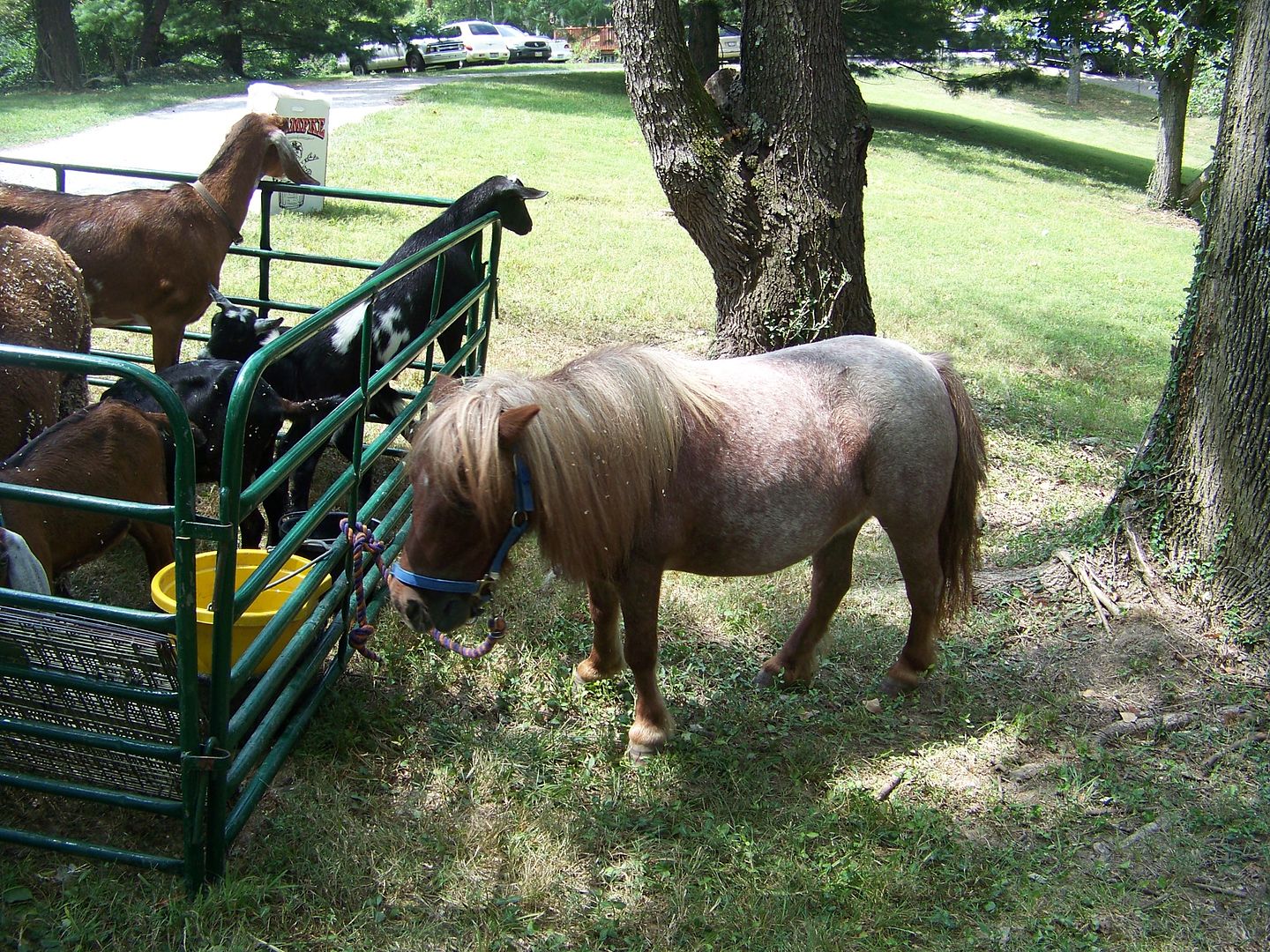
We will have the petting zoo back, as well as our face-painting station, two events that children always love (though I suspect some of the adults like the animals in the petting zoo as much as the kids do)
Admission is free, but we will of course be accepting donations. We will have our gift shop (with several new items) and used book sale open, for anyone looking for a momento or something new to read.
Museum memberships will be for sale too. This is our biggest single fund-raising tool, as the museum is now entering the world of financial self-sufficiency. Memberships - for one year- are just $20 for individuals and $35 for families. Members will receive member cards, discounts to our gift shop and book sale and other benefits throughout the year.
Sunday, August 14, 2011
Fall Hike at Perryville November 5, 2011
Fall History Hike at Perryville Battlefield State Historic Site
1825 Battlefield Road
Perryville, KY 40468-0296
859-332-8631
Perryville, KY 40468-0296
859-332-8631
November 5th. Hike starts at 11:00 a.m. Museum opens at 10:00 a.m. The museum charges a small fee to visit their exceptional displays. Participants are encouraged to visit the museum before the hike to familiarize themselves with the high level details of the Perryville campaign and battle. There is also a well stocked gift ship in the museum, with many titles covering the Perryville campaign and other western battles. There are modern restrooms below the museum.
Please meet by 10:50 in front of the museum. The hike will start promptly at 11:00 a.m. and will go on rain or shine.
The hike will consist of four to five miles of walking and discussing the battle. Please wear sturdy shoes, bring plenty of water, and have something to snack on. If it is a sunny day, wear sunscreen and/or a hat as the battlefield does not offer much in the way of shade. The terrain is rolling with a few short climbs. The hike will last three to four hours.
For those interested there are several locations in the general area for post hike meals and libations. The Old Owl Tavern (part of the Beaumont Inn complex) in Harrodsburg offers tasty meals and beverages. In Danville there are many choices, some of the hike leader’s favorites are The Hub Coffee House ‘n’ Café, Bluegrass Pizza and Pub, and 303 W, all in downtown Danville. If craft beers are more to your liking, the Beer Engine in Danville offers their own and other tasty microbrews on draught.
Hike Leader Info – Darryl Smith serves as a board of trustees member for the Buckeye Trail Association, is a regimental color bearer in the Civil War Trust (civilwar.org), and is a member of the Friends of Perryville Battlefield (perryvillebattlefield.org). He is an avid hiker and backpacker who also has a passion for American military history. Perryville Battlefield is one of his favorite Civil War sites, due to the near pristine nature of the park, looking much like it did during that hot day in October, 1862. Please contact him at 513-321-1539 or ohioatperryville@yahoo.com if you need more information. You can also follow his Perryville blog at www.ohioatperryville.blogspot.com.
.
Harrodsburg
The Old Owl Tavern
638 Beaumont Drive
Danville
303 W
303 West Main Street
Bluegrass Pizza and Pub
235 West Main, #100
The Hub Coffee House ‘n’ Café
236 West Main Street
Beer Engine
107 Larrimore Lane
107 Larrimore Lane
Saturday, August 13, 2011
Book Review: The Supply for Tomorrow Must Not Fail
The Supply for Tomorrow Must Not Fail: The Civil War of Captain Simon Perkins Jr., a Union Quartermaster
Lenette S. Taylor
copyright 2004
The Kent State University Press
Quartermasters in the Civil War armies held a position much like that of a baseball umpire or basketball referee, in which they were likely to be noticed only when something went wrong. It was a tough, convoluted, mostly thankless, yet extremely important job that both armies desperately needed to have performed competently.
Lenette S. Taylor does a terrific job of showing just how complicated and confusing the role of quartermaster could be. Using papers belonging to Captain Simon Perkins Jr., which have miraculously survived the decades since Perkins left the Union army, as well as many other sources she was able to locate, Taylor tells the story of this positions through the war adventures of this one specific officer.
Taking advantage of the rare remaining quartermaster paperwork, Taylor describes the many responsibilities Perkins shouldered throughout his stint of just over 2 years as a quartermaster. He was in charge of forage for animals, of transportation arrangements, of finding rooms and housing for officers and workers. He occasionally was in control of local depots, or of forming new supply stations and starting new ones at new locations. Building new buildings, cooperating with railroad authorities, dealing with changing river levels and Confederate threats - all of these were among the responsibilities he assumed, sometimes even when a particular task may not have technically been in his official job description. He simply did what had to be done to help the army.
Movements were frequent. He did work in and around Nashville for a while, but also had to work at other stations such as near Shiloh, or Tullahoma, or Gallipolis, Ohio. He almost always had people under his employ, sometimes dozens at a time, and he needed to hire, control and pay them.
Dealing with money and accounts was a key duty of almost all his positions. For much of the time, the government had not allocated funds to pay army expenses, so he had to offer vouchers in return for goods or services. This often created hardships for the recipients of these vouchers, who did not know when they would get paid. This was a constant issue Perkins had to confront.
Though the story of Perkins himself is quite interesting, starting with his family political connections, including his uncle David Tod, Governor or Ohio, and Perkins post-war economic successes in Pennsylvania, Taylor's book is most fascinating for the many details of a quartermaster's job, the frequent changes, sometimes with conflicting orders from various generals, trying to supply large armies which were frequently traveling miles away. There are too many such obstacles and responsibilities for me to try to name them all (or even most) in this review, but The Supply Must Not Fail does a terrific job of illustrating the various roles a quartermaster played and how the army, including generals, depended on these men, despite the fact that most armies did not have enough men filling these roles.
One interesting aspect is that quartermasters remained at the rank of captain. Only a select few were ever promoted (to Lieutenant Colonel) no matter how much work they did or how effectively they did it. It was not a job for glory or glamor, and was not one that just anybody could do.
This book is a very informative and eye-opening account about the quartermaster's unsung role in the Civil War. Simon Perkins Jr. was a hard-working, effective officer and his story shows how many challenges a man in his position had to face every day of his employment. The army needed equipment and supplies in order to move and to function and men like Perkins put in the effort to allow that to happen, despite knowing they had little chance of promotion or recognition.
Wednesday, August 10, 2011
Stop him! Stop him!
I know ads for runaway slaves were not uncommon 150 years ago, but I have not stumbled across many in the Covington Journal, so I thought I would share this one from August 10, 1861
Ranaway from the subscriber on Saturday morning, the 4th inst., a negro man named
He is about thirty years of age, of light copper color, about six feet high, weighs about one hundred and seventy pounds, of rather sullen countenance; but when spoken to becomes pleasant; rather a stooped walk, or round shouldered. His clothing I need not describe, as he will of course change it.
I purchased said man of Mr. John Lyle, near Lexington, some eight years since. He has a wife at Mr. A. Blackwell's in Clarke county, Ky. He was raised in the county of Woodford, between Versailles and the Kentucky river, where he was apprehended some seven or eight years ago and lodged in the county jail.
I will give $150 reward if taken out of the State; $100 if taken in any county bordering the Ohio river; or $25 if taken anywhere else, and in all cases to be delivered in jail in this State so I get him.
W. C. Young
Jessamine County, August 7th, 1861
Covington Journal copy three times and charge this office. -[Lex. Observer]
Ranaway from the subscriber on Saturday morning, the 4th inst., a negro man named
S A M
He is about thirty years of age, of light copper color, about six feet high, weighs about one hundred and seventy pounds, of rather sullen countenance; but when spoken to becomes pleasant; rather a stooped walk, or round shouldered. His clothing I need not describe, as he will of course change it.
I purchased said man of Mr. John Lyle, near Lexington, some eight years since. He has a wife at Mr. A. Blackwell's in Clarke county, Ky. He was raised in the county of Woodford, between Versailles and the Kentucky river, where he was apprehended some seven or eight years ago and lodged in the county jail.
I will give $150 reward if taken out of the State; $100 if taken in any county bordering the Ohio river; or $25 if taken anywhere else, and in all cases to be delivered in jail in this State so I get him.
W. C. Young
Jessamine County, August 7th, 1861
Covington Journal copy three times and charge this office. -[Lex. Observer]
Monday, August 8, 2011
Ferocious Kentuckians
From the Covington Journal of August 10, 1861, comes this piece.
A correspondent of the New York Tribune draws a very captivating picture of the Kentuckians in Johnston's division:
Among the troops was one regiment of over 1,000 Kentuckians, armed with rifles and bowie-knives. They refused to take but one round of cartridges to go into the contemplated fight with Gen. Patterson's column, intending to lie hid on the ground in the artificial thickets until our troops should approach, and then make at them with their bowie-knives. This might have made some desperate fighting; but our bayonets would probably have been an overmatch for their knives.
The men of the Kentucky regiment are described as a savage and desperate set, who exhibited their ferocious disposition on the slightest pretext, and kept everyone in terror of them; they considered it a pleasant diversion to chop a man up with an Arkansas tooth-pick. The wife of one them (sic) is the vivaudiere of the regiment; she is a thorough soldier and acts as a lieutenant of a company, which she drills herself. She is said to be very handsome and a perfect Amazon. Her dress is very gay and conspicuous. Her ruffian comrades take great pride in their fierce and dashing heroine; and she is as anxious to split a Yankee with her bowie-knife as the bloodiest-minded wretch among them.
A correspondent of the New York Tribune draws a very captivating picture of the Kentuckians in Johnston's division:
Among the troops was one regiment of over 1,000 Kentuckians, armed with rifles and bowie-knives. They refused to take but one round of cartridges to go into the contemplated fight with Gen. Patterson's column, intending to lie hid on the ground in the artificial thickets until our troops should approach, and then make at them with their bowie-knives. This might have made some desperate fighting; but our bayonets would probably have been an overmatch for their knives.
The men of the Kentucky regiment are described as a savage and desperate set, who exhibited their ferocious disposition on the slightest pretext, and kept everyone in terror of them; they considered it a pleasant diversion to chop a man up with an Arkansas tooth-pick. The wife of one them (sic) is the vivaudiere of the regiment; she is a thorough soldier and acts as a lieutenant of a company, which she drills herself. She is said to be very handsome and a perfect Amazon. Her dress is very gay and conspicuous. Her ruffian comrades take great pride in their fierce and dashing heroine; and she is as anxious to split a Yankee with her bowie-knife as the bloodiest-minded wretch among them.
Friday, August 5, 2011
Brief gunboat and Cincinnati story
Here is a brief article from the August 10, 1861 Covington Journal that makes some comments about a few Union gunboats. The mention of the sites of construction of these ships caught my eye, as this may refer to ships like the gunboat Cincinnati, mentioned in my previous post
The three gunboats Lexington, A.O. Tyler and Conestoga, fully armed and manned, leave New Albany to-day for Cairo. There is no doubt but that they will get out of the Lower Ohio. The two former have each six guns on board, and the latter four guns.
We understand that none of our Cincinnati ship builders obtained the contracts for building the thirteen gunboats for the Government. They are to be built at Pittsburg, St. Louis, and other points.
Thirty-five cars loaded with guns and ammunition arrived from Pittsburg on Sunday, via the Cincinnati, Hamilton and Dayton Railroad. The ordnance was all re-shipped over the Ohio and Mississippi Road to Cairo.
(From the Cincinnati Enquirer, 6th)
The three gunboats Lexington, A.O. Tyler and Conestoga, fully armed and manned, leave New Albany to-day for Cairo. There is no doubt but that they will get out of the Lower Ohio. The two former have each six guns on board, and the latter four guns.
We understand that none of our Cincinnati ship builders obtained the contracts for building the thirteen gunboats for the Government. They are to be built at Pittsburg, St. Louis, and other points.
Thirty-five cars loaded with guns and ammunition arrived from Pittsburg on Sunday, via the Cincinnati, Hamilton and Dayton Railroad. The ordnance was all re-shipped over the Ohio and Mississippi Road to Cairo.
(From the Cincinnati Enquirer, 6th)
Thursday, August 4, 2011
Gunboat Cincinnati
Flipping through a book I had acquired a few months ago, I saw a page that seemed much more brownish than all the others. Looking to find it again, to see if it was what I suspected, I finally did come across it and discover that it was, indeed, an old newspaper clipping. Not having any idea what the clipping would be about, I picked it up, pleased to see it was in good shape, not brittle at all, and found that it actually had to do with not only the Civil War, but also a local aspect of it, at least in name.
Here is a link to a couple of photographs of this boat, at the Cincinnati Hamilton County Public Library. The notes for them are simply a brief recap of this article that I added to their page.
This link gives a bit more information about this class of ships and does discuss this very ship as well.
The clipping is undated, but is apparently from sometime in 1957 or early 1958, and is from the Cincinnati Enquirer. I transcribe it below.
'Gunboat Cincinnati'
One of Several Civil War Ironclads Named for River Towns, It Took Part in Many Deadly Skirmishes
By Jimmie Blount, Enquirer Writer
Probably no person, place or thing - Union or Confederate - absorbed as much punishment per square inch during the Civil War as the gawky gunboat bearing the name Cincinnati.
Part of the Western Flotilla which reopened the Mississippi River to military and civil traffic, the ironclad sank twice and survived at least two fires, numerous battles with bayou mud and foliage and hundreds of piercing "minnie balls" and sundry shot.
Approximately 40 crewmen died and 20 other suffered major wounds during its many engagements
One of the dead the Cincinnati's first commander who swallowed a confederate shot
***
One of seven craft built by Capt. James E. Eads, some of her parts and equipment came from Pittsburgh and Cincinnati as well as St. Louis where it was assembled.
Launched late in 1861, the 175 by 51 1/2-foot ironclad was one of the most formidable ships in the U.S. Navy with its three eight-inch guns, six 32-pounders, four 42-pound army rifles and one 12-pound howitzer.
Called "Pook Turtles," the Cincinnati-type boats were designed by Samuel M. Pook and had a definite resemblance to the slow-moving water creatures.
Despite 2 1/2 inches of iron plating on her steep sides, the Cincinnati could manage nine males an hour and drew only six feet of water.
***
The Eads ironclads began service with the capture of Fort Henry, a Confederate stronghold on the Tennessee River. It was the Cincinnati, leading the attack, which fired the first shot and received the rebel surrender in the February 6, 1862, triumph.
When the two-hour battle ended, the Cincinnati had absorbed 32 shots, mostly in the chimney and after-cabin. Two guns were disabled and a shell, bouncing around in the iron enclosure, claimed one life.
She retired for repairs until March 17 when the Cincinnati took part in the three-week siege of Island No. 10 on the Mississippi.
The Cincinnati led that six-gunboat attack which netted 5000 prisoners and vast stores of supplies.
***
Fort Pillow was the next Mississippi obstacle. The Cincinnati began the May 10 morning attack by towing a mortarboat within two miles of Pillow. But before she could retire,smaller and faster Confederate vessels moved in for the kill.
Her crew threw oil into the boilers in an attempt to gain speed. Even the mortars failed to stop the rams. The nearest ironclad was eight miles up river.
In succession the rebel rams General Bragg, General Price and General Butler cracked into the unprotected underwater sections.
Although Cincinnati guns raked the rams, they left a 12- foot hole in her hull, cracked the port beam and destroyed the steering gear. One of the rebel marines fired a shot into the pilothouse, striking Commander R. N. Stembel in the mouth. (blog note: see the link for more info on Commander Stembel. The following sentence in this article was incorrect.)
He died before the Cincinnati settled to the shallow bottom.
***
After the surrender of Fort Pillow the Cincinnati was raised and repaired and dispatched to General Ulysses S. Grant who was battering the river fortress at Vicksburg.
The Cincinnati began its "second life" January 8, 863, against Port of Arkansas (or Fort Hindman), a 500-0-man outpost 40 miles up the Arkansas River from the Mississippi. It had been harassing the Vicksburg operation.
Cincinnati led two other gunboats into the shallow water under the fort where they poured shells into the high citadel. The rebels' 13 heavy guns were useless; they were aimed at midstream.
With General William Tecumseh Sherman leading the land forces, the fortress surrendered after a brief siege.
***
But Vicksburg still was in Confederate hands in May. Its capture would mean cutting the Confederacy into two parts.
May 27, 1863, Grant sent the Cincinnati down the river against the batteries of Fort Hill, appropriately termed "Fort Hell" by the troops opposing it. These guns had stymied Sherman's offensive.
It was a fatal assignment. Colonel Andrew Jackson Jr., commanding the guns, concentrated on the boat's aft, the only part not protected by iron plating.
His guns streamed shells into the vessel, hitting the magazine, ripping through her bottom and killing the seaman at the wheel.
A shot flattened the flag pole, but Commander George M. Bache exposed himself to fire and attached the banner to the stump before turning away from the batteries.
***
Credit for the eventual sinking went to an 18-pound rifle, "Whistling Dick" a product of Richmond's Tredgar (sic) Ironworks which got its name from the sound of its missiles.
Cincinnati hit bottom only 25 yards from shore in three fathoms of water. Twenty crewmen died in the artillery exchange. Another 15 drowned when she went under.
The Confederates set fire to above-water sections, but not before Sherman's men striped(sic) her of her guns on a dark night during a "low" river. The Cincinnati's guns played a big part in the silencing of "Fort Hell." The second time they were manned by Sherman's artillerymen.
***
With the fall of Vicksburg (July 4, 1863) Cincinnati was raised and sent to Algiers, La., for repair and rearmament.
When the "third" Cincinnati, still commanded by Bache, a nephew of Western Flotilla Commander David Porter, returned in December, she was assigned patrol duty on the Mississippi, around Natchez.
The ghost of Fort Pillow and Vicksburg concluded combat service in the defeat of Fort Morgan in Mobile Bay, one of the final encounters of the war.
But the end didn't come until March 26, 1866, for one of the bloodies and most stubborn craft in U.S. naval history. This time it wasn't rebel artillery, but an auctioneer who sold her for private use.
Here is a link to a couple of photographs of this boat, at the Cincinnati Hamilton County Public Library. The notes for them are simply a brief recap of this article that I added to their page.
This link gives a bit more information about this class of ships and does discuss this very ship as well.
The clipping is undated, but is apparently from sometime in 1957 or early 1958, and is from the Cincinnati Enquirer. I transcribe it below.
'Gunboat Cincinnati'
One of Several Civil War Ironclads Named for River Towns, It Took Part in Many Deadly Skirmishes
By Jimmie Blount, Enquirer Writer
Probably no person, place or thing - Union or Confederate - absorbed as much punishment per square inch during the Civil War as the gawky gunboat bearing the name Cincinnati.
Part of the Western Flotilla which reopened the Mississippi River to military and civil traffic, the ironclad sank twice and survived at least two fires, numerous battles with bayou mud and foliage and hundreds of piercing "minnie balls" and sundry shot.
Approximately 40 crewmen died and 20 other suffered major wounds during its many engagements
One of the dead the Cincinnati's first commander who swallowed a confederate shot
***
One of seven craft built by Capt. James E. Eads, some of her parts and equipment came from Pittsburgh and Cincinnati as well as St. Louis where it was assembled.
Launched late in 1861, the 175 by 51 1/2-foot ironclad was one of the most formidable ships in the U.S. Navy with its three eight-inch guns, six 32-pounders, four 42-pound army rifles and one 12-pound howitzer.
Called "Pook Turtles," the Cincinnati-type boats were designed by Samuel M. Pook and had a definite resemblance to the slow-moving water creatures.
Despite 2 1/2 inches of iron plating on her steep sides, the Cincinnati could manage nine males an hour and drew only six feet of water.
***
The Eads ironclads began service with the capture of Fort Henry, a Confederate stronghold on the Tennessee River. It was the Cincinnati, leading the attack, which fired the first shot and received the rebel surrender in the February 6, 1862, triumph.
When the two-hour battle ended, the Cincinnati had absorbed 32 shots, mostly in the chimney and after-cabin. Two guns were disabled and a shell, bouncing around in the iron enclosure, claimed one life.
She retired for repairs until March 17 when the Cincinnati took part in the three-week siege of Island No. 10 on the Mississippi.
The Cincinnati led that six-gunboat attack which netted 5000 prisoners and vast stores of supplies.
***
Fort Pillow was the next Mississippi obstacle. The Cincinnati began the May 10 morning attack by towing a mortarboat within two miles of Pillow. But before she could retire,smaller and faster Confederate vessels moved in for the kill.
Her crew threw oil into the boilers in an attempt to gain speed. Even the mortars failed to stop the rams. The nearest ironclad was eight miles up river.
In succession the rebel rams General Bragg, General Price and General Butler cracked into the unprotected underwater sections.
Although Cincinnati guns raked the rams, they left a 12- foot hole in her hull, cracked the port beam and destroyed the steering gear. One of the rebel marines fired a shot into the pilothouse, striking Commander R. N. Stembel in the mouth. (blog note: see the link for more info on Commander Stembel. The following sentence in this article was incorrect.)
He died before the Cincinnati settled to the shallow bottom.
***
After the surrender of Fort Pillow the Cincinnati was raised and repaired and dispatched to General Ulysses S. Grant who was battering the river fortress at Vicksburg.
The Cincinnati began its "second life" January 8, 863, against Port of Arkansas (or Fort Hindman), a 500-0-man outpost 40 miles up the Arkansas River from the Mississippi. It had been harassing the Vicksburg operation.
Cincinnati led two other gunboats into the shallow water under the fort where they poured shells into the high citadel. The rebels' 13 heavy guns were useless; they were aimed at midstream.
With General William Tecumseh Sherman leading the land forces, the fortress surrendered after a brief siege.
***
But Vicksburg still was in Confederate hands in May. Its capture would mean cutting the Confederacy into two parts.
May 27, 1863, Grant sent the Cincinnati down the river against the batteries of Fort Hill, appropriately termed "Fort Hell" by the troops opposing it. These guns had stymied Sherman's offensive.
It was a fatal assignment. Colonel Andrew Jackson Jr., commanding the guns, concentrated on the boat's aft, the only part not protected by iron plating.
His guns streamed shells into the vessel, hitting the magazine, ripping through her bottom and killing the seaman at the wheel.
A shot flattened the flag pole, but Commander George M. Bache exposed himself to fire and attached the banner to the stump before turning away from the batteries.
***
Credit for the eventual sinking went to an 18-pound rifle, "Whistling Dick" a product of Richmond's Tredgar (sic) Ironworks which got its name from the sound of its missiles.
Cincinnati hit bottom only 25 yards from shore in three fathoms of water. Twenty crewmen died in the artillery exchange. Another 15 drowned when she went under.
The Confederates set fire to above-water sections, but not before Sherman's men striped(sic) her of her guns on a dark night during a "low" river. The Cincinnati's guns played a big part in the silencing of "Fort Hell." The second time they were manned by Sherman's artillerymen.
***
With the fall of Vicksburg (July 4, 1863) Cincinnati was raised and sent to Algiers, La., for repair and rearmament.
When the "third" Cincinnati, still commanded by Bache, a nephew of Western Flotilla Commander David Porter, returned in December, she was assigned patrol duty on the Mississippi, around Natchez.
The ghost of Fort Pillow and Vicksburg concluded combat service in the defeat of Fort Morgan in Mobile Bay, one of the final encounters of the war.
But the end didn't come until March 26, 1866, for one of the bloodies and most stubborn craft in U.S. naval history. This time it wasn't rebel artillery, but an auctioneer who sold her for private use.
Monday, August 1, 2011
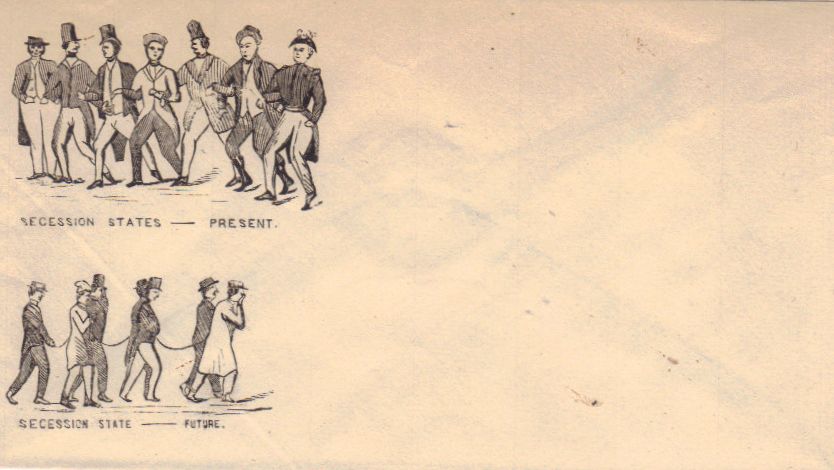
Patriotic Cover: Secession States Now and in the Future
Here is another patriotic cover I recently came across. Unfortunately, it does not have any printer's name, location or date on it, but it is obviously from early in the war, perhaps even 150 years ago this summer
This link should provide a larger view of this cover.
I do have a couple more of these I will be sharing soon and they have more detail in them, so there will be some more interpreting to do on them. I find items like this to be quite fascinating to review.
Subscribe to:
Posts (Atom)