Showing posts with label preservation. Show all posts

Tuesday, April 23, 2019

Positive Preservation News from Perryville

I was surprised and happy to see this news on Facebook yesterday. I shared it there, but wanted to create a quick post to discuss it a bit  more. I really appreciate all the preservation the American Battlefield Trust has done at Perryville over the years and adding even more land to the park is a terrific accomplishment. The park itself is a Kentucky state treasure and I love that it is being preserved and even enlarged. This was a major battle. It does not get the attention of the great Eastern Theater fights like Gettysburg or even some of the Western battles like Shiloh, but keeping Kentucky in the Union and sending the Confederate army back south was an important outcome. No major Confederate army ever penetrated so far north in the Western theater again (excluding raids, of course.) It was a  hard, brutal fight and Sam Watkins' thoughts about it in Company Aytch are good reminders of that, but the land itself - the hills, valleys and fields - are monuments to the toughness of the men who fought on that hot day. Nothing is better than standing on the actual battlefield and now that will be more possible with the addition of more preserved acreage. Huzzah!

This news  just makes me want to go back to Perryville this year. Perhaps May would be a good month if I find a nice enough day (as I notice how close to May we already are.) It should not be too hot yet but still should be warm enough to make it pleasant. I still have  not seen the most recently preserved land (the high tide of the Confederacy in the West) so I would like to see that and also get a better idea of where this land is, though I realize it will be a while before it is open to the public. I probably won't hike as much as I have in the past, but a quick trip to the museum plus some looking at a few spots would make for a fun outing.

From battlefields.org
The ABT will hold their annual conference in Lexington this year. I was really hoping to go, but just cannot make it work. Still, I am glad to have them in this state and see them still preserving land here. Kentucky was in a geographically fascinating place during the war and this state's war history (and post-war "secession") is equally fascinating. It pleases me to have a respected national group continuing to bring attention to Perryville specifically and Kentucky more generally.

Here are 2 of the many pictures I took there a few years ago, reminding me of the park's beauty and cleanliness.  I wonder if I should read Ken Noe's book about the battle again. It has been a few years since I did so.


Thursday, February 18, 2016

Help Save More Land at Perryville!

It is days like this (or, well, everyday, really) when I wish I had won the Powerball jackpot (but I'm not too greedy - even just 1/2 or 1/3 of it would work. Of course, my odds would have been better had I actually purchased a ticket.)
Anyway.....
The Civil War Trust (CWT) announced a new campaign to save 70 more acres at Perryville. This land is the "Western High Water Mark" for the Confederacy. It is also known as the "Goat Farm" for those familiar with the current park. It is a very important piece to preserve for eternity, due to the tough fighting that occurred there, and would continue the outstanding work the CWT and the state of Kentucky have done in preserving so much of the battleground.
Please consider making a donation if you can. Even smaller amounts add up and help this cause.
The Battle of Perryville was already raging when Colonel John Starkweather’s Union brigade pushed its way toward the front. Moving to the Army’s imperiled left flank, Starkweather threw a portion of his brigade into a cornfield, posting his remaining troops behind a stone wall on the last unoccupied piece of ground in that sector of the battlefield. The Yankee colonel knew this ground had to be held "at all hazards."
The Confederate onslaught struck with a fury. General George Maney’s brigade drove the Federals out of the cornfield, only to be met by withering volleys from the Starkweather's reserve. With the Confederate advance now checked, his men leapt from behind the wall and launched a ferocious counterattack, putting Maney’s troops on their heels and bringing the battle to a close on this portion of the field.
Few battlefields are as pristine as Perryville, where rolling fields of Kentucky bluegrass look much like they did in 1862. This is due in large measure to the work you and our members have done to protect this important battlefield, where we have already saved 957 acres. The Civil War Trust now has the opportunity to save an additional 70 acres at Perryville—the very ground where Starkweather's and Maney’s brigades clashed. In addition to being historically significant in its own right, this ground is one of the last pieces of the Perryville battlefield yet to be preserved. Help complete the work we have begun, and save Perryville.
----

From the Civil War Trust's site, the yellow section is the desired property.

Sunday, August 9, 2015

Camp Nelson Preservation News

This article provides some good preservation news this weekend.

Camp Nelson  was a Union supply depot during the Civil War and became the third largest recruiting depot for African-American soldiers for the Union army.  Only Louisiana provided more African-American soldiers to the Union army than Kentucky.

It also served as a refugee camp for African-Americans, many of whom were the family members of the soldiers.

I also find it interesting to see the mention of the idea of making it a national park, similar to the recent suggestion about Perryville.

I have been to Camp Nelson National Cemetery,but not to Camp Nelson itself. I will have to change that. (I also need to visit the Richmond Battlefield, not terribly far from Camp Nelson. Perhaps a day trip to visit both would be a good idea.)

Sunday, February 3, 2013

Proposed Bill to Preserve Mill Springs Battlefield

This link is the press release with more details about how Kentucky Representative Hal Rogers is proposing to try to preserve this battlefield in eastern Kentucky.

Here is the Civil War Trust's information on this battle of January 19, 1862, where Confederate General Felix K. Zollicoffer was killed.


Tuesday, December 4, 2012

Preservation Success at Perryville

I found this article on facebook and shared it there and thought it was worth posting here. It's great that more land is being preserved and hopefully that continues.

I'm already trying to think of my 2013 trip or trips to the site, perhaps around Memorial Day Weekend, with side trips to Bardstown, Hodgenville or other local places of historical interest.

Perryville Preservation

Union re-enactors at Perryville's 150th, October 6 & 7 2012

Wednesday, June 27, 2012

Book Review: The Battle of New Market Heights


by James S. Price
The History Press
copyright  2011

One of the many blogs I follow and enjoy is Jimmy Price's The Sable Arm blog. His research and writing are very informative and valuable to Civil War scholarship. I really enjoy his writing on that blog and ever since he announced he would have this book published I have been anxious to read to buy and read it. I finally achieved that goal recently and admit that I am happy to have done so.

Throughout the text, he shows some of the challenges African-American soldiers faced in the Union Army, and how controversial general Benjamin "Beast" Butler became one of their biggest supporters. Butler gave them opportunity to show their mettle and he was quick to recognize their bravery and reward it by personally financing the Army of the James Medal. Even though the War Department never formally recognized this award, it was still a great honor to the men who earned it.

This book further describes how the units that ended up fighting in this battle were formed and discusses some of their early experiences as they became soldiers in the United States Army.This is very nice background information about this new source of manpower for the Federal forces.

As for the fight itself, Price describes the days leading to the battle, the many obstacles the soldiers faced on the actual battlefield, and how poor decision making by several of their leaders made their chore even more difficult. Among these obstacles were various entanglements of trees and branches, such as chevaux-de-frise. Additionally, the Confederates became motivated and even angry when they realized that the troops attacking them were African-American. The Union troops fought bravely and took many casualties, but they eventually managed to overcame these challenges and achieve success on the field.

This is a very well-written and enjoyable work. The narrative is very readable, and I especially enjoyed the many pictures and maps (by noted cartographer Steven Stanley) spread throughout it. These illustrations greatly add to the understanding of the text and the story it tells.

I do wish the author had spent more time refuting some of the arguments about this action not being as important as reputed. It is great that he showed that point of view, but I would have liked some more comments and views differing with that perspective and arguing for the importance of this battle and the justification for the awarding of the 14 Medals of Honor. I do not know why, but this section of the book left me wanting for more, though this admittedly is a small criticism of a book that I truly enjoyed. 

The final section on the book, concerning attempts to preserve the land that made up the battlefield, is especially fascinating, exploring the many frustrations and few successes that preservationists have experienced through the years and decades. We hear many stories these days of preservation triumphs, but the land around New Market Heights and Chaffin's Farm is not, unfortunately, one of those great stories.

The Battle of New Market Heights is a very fine book, telling the tale of an important battle in the Union campaign to defeat Robert E. Lee's troops. African-American soldiers made valuable contributions to the Union war cause and Price's book tells the tale of one of the lesser-known fights in which their valor came to the forefront. It is a very good book for any Civil War student or enthusiast to have and I gladly recommend it.

Friday, May 11, 2012

Good news for Perryville

I don't know how I missed this, but thanks to the very good Civil War Librarian blog for bringing this to my attention.

This link to the Advocate -Messenger of Danville reports that another 140 acres have been preserved, thanks to generous local citizens James Overstreet, Pat Overstreet and Lora June Overstreet and the Civil War Trust.

I am very glad to read this news and remind readers that the Civil War Trust is still working on saving more ground from this fierce fighting. The grounds already preserved form a beautiful site, a true treasure of which Kentucky can be proud, and hopefully this will continue to grow more in the future.

Below are a couple of pictures I have taken on the battlefield. I hope to get down there again later this month, but certainly will make another trip sometime this year. I STRONGLY encourage others to visit it too, especially if you have not been there. It is a wonderful place, and walking the many hills will greatly add to your understanding and appreciation of at least one of the challenges the thousands of men on those acres faced 150 years ago.


Monday, February 20, 2012

Perryville Hike on May 5

I highly recommend anybody interested in the Perryville battle, or any history or Civil War enthusiasts/buffs in the region to join this free tour. Here is a link with more details about the when and where.

I was fortunate to take part in the fall hike Darryl led last November and loved it. Kentucky has done an excellent job of maintaining the battlefield, and it is a beautiful park. The views are wonderful and being on the land where the soldiers fought definitely gives a wonderful perspective on some of the challenges the soldiers faced, at least in regards to the many hills and valleys that make up the battlefield.

But I recommend this for more than just the battlefield itself. Darryl is very knowledgeable about the battle and the field itself and manages to put what happened throughout that day of fighting in perspective, pointing out what happened on the land where you are standing while pointing out other sections of the battlefield and how they related to the current position. I visited Perryville in spring of 2010 and enjoyed my walk around the battlefield, but going on an organized tour like this definitely added to the experience, with a lot of details I had forgotten or did not know.


Here is my blog entry including some of my thoughts and pictures from the fall hike.

I'm including again the Civil War Trust's battlefield map of Perryville. Please visit their site to find more details about the most recent preservation efforts at Perryville. The Civil War Trust is an excellent organization that has done a lot of good around the country, including Perryville.


Monday, February 13, 2012

More Preservation efforts at Perryville

Here is the Civil War Trust's newest announcement about its efforts to save more land at Perryville. This time, 121 acres, featuring land known as the "Slaughter Pen," the scene of some extremely tough fighting.

Here is an image of the orginazation's map of the battlefield. More information can be found at their website, Civil War Trust Perryville information

It is truly a beautiful battlefield and I wish the current preservation efforts nothing but success.


Saturday, August 20, 2011

Save more land at Perryville

Civil War trust campaign

Here's a link to my report from my trip to Perryville last year. It's a beautiful, wonderful battlefield that I hope to visit again soon

Friday, October 8, 2010

Remembering Perryville, link by link

Union Memorial

Today, October 8, 2010 is the 148th anniversary of the bloody, hard-fought battle of Perryville. On this date in 1862, thousands of men, on both sides, put forth tremendous efforts and showed incredible courage along the hills and valleys in Boyle County, Kentucky, and this post is in honor of them.
 
I acknowledge I've been "Perryville-centric" this week, but it seems only appropriate to recognize the ferocity and importance of this battle in the Western Theater today. I will not go into details about the actual battle on this post, but will share a few links to some sites that provide fascinating information about it and that describe it much better than I can.  I probably have shared some of these links before, but find them to be worth exploring again on this day.


(I do admit a "parochial" approach to my posting about this battle too - as a native Kentuckian, I do take some pride in having such an important battle fought on Bluegrass State soil, the largest one in this state. I certainly do enjoy studying how the Civil War had an impact in the area where I have lived my entire life and this blog will probably reflect that frequently. My interest in the war itself sprang from a childhood fascination that started when I learned Abraham Lincoln was born in the Commonwealth.)


Confederate Memorial

Though it often gets overshadowed by more famous fights at 2nd Bull Run and then Antietam, Perryville has also been viewed as the "Confederate High Water Mark of the West" though that moniker is also rooted in the Eastern Theater, attached originally to the fields at Gettysburg before the "of the West" extension was added.

First, here's a link to a previous post I made about the Battle of Richmond, with some other links to information about the early stages of the Confederate invasion of Kentucky, the campaign that culminated at Perryville.

This link from the Civil War Preservation Trust will lead to several good articles and informative stories on this battle.  I especially enjoy this interview  with Kenneth Noe. I found it to be very interesting, but the other stories and links on that site are terrific as well.

I really like the Battle of Perryville.com site. The battle chronology link in the column on the left is especially helpful in understanding how the battle unfolded over the course of that bloody day. I studied that quite a bit before my spring-time trip to the Perryville Battlefield State Park, but this entire site is a valuable reference.

Perryville Battefield.org is another fine site and reference, with more emphasis on the park in current times, such as current events and preservation, instead of just the actual battle itself.

I found some good pictures of the battle ground at a Civil War Album.com site, with good descriptions of what each scene shows.

Earlier this week, I made two entries about one of the the brave men who gave his all at Perryville, William Rufus Terrill   (see also the follow-up post ). Before researching those entries, I knew a little about Terrill, such as he had a brother on the Confederate side, but did not realize he was so young or that his decision to support the Union was so painful. His fistfight with Phil Sheridan was news to me too.

In late May of this year, I finally made another trip to this Boyle County land and recorded these thoughts about that day. I also posted some photos from my trip on photobucket, though I never did go back to caption them.

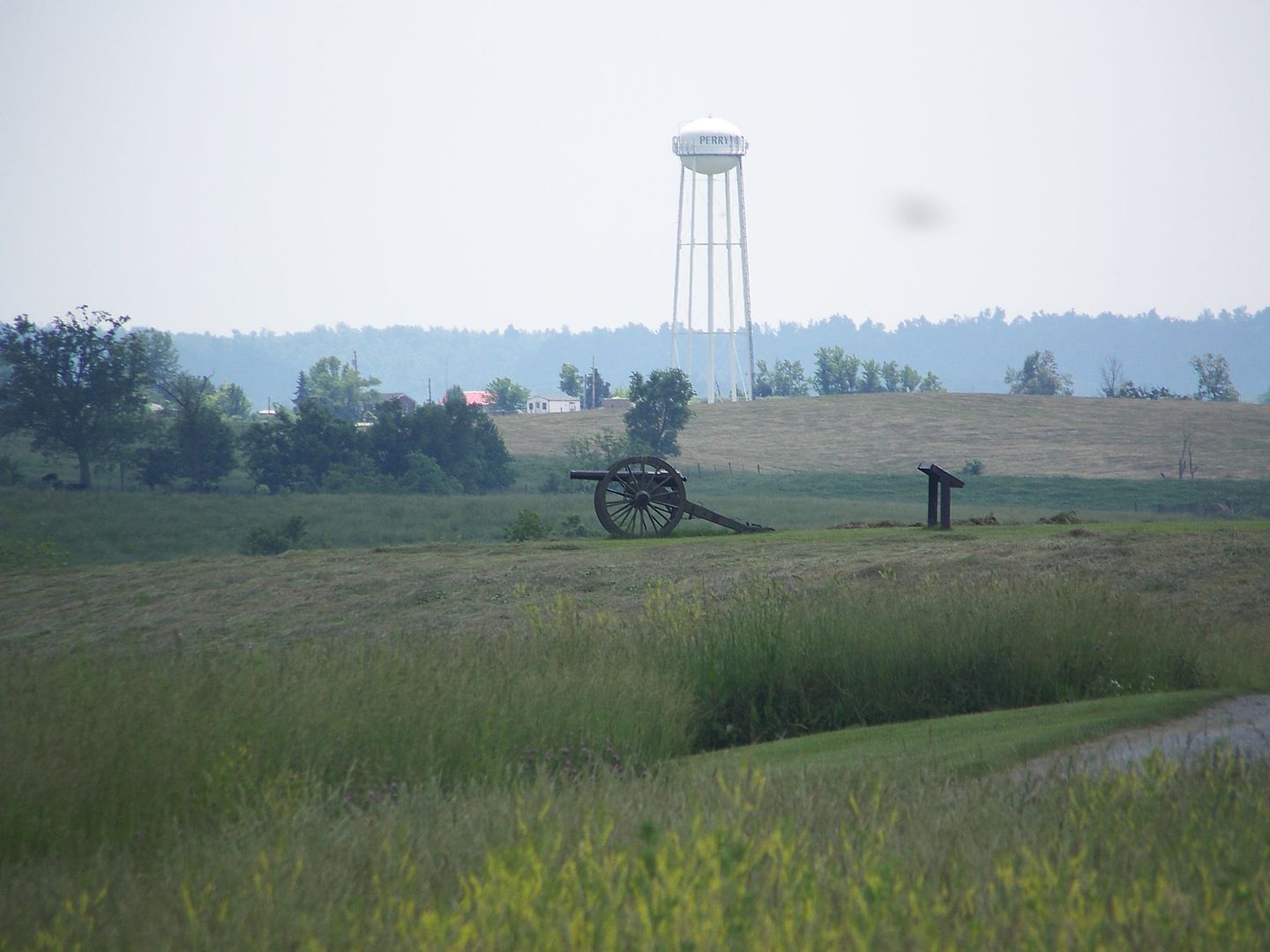
I especially find the below photo to be quite haunting in a hard-to-describe way. It does not exactly show a battlefield overrun by modern sprawl, but the water tower in the distance, staring down upon the cannon like a flying saucer in the sky, (or like one of these aliens from Star Trek the Next Generation )  certainly provides a sign of encroachment over the rolling hills of this beautiful battlefield. This structure certainly dominates the view of this section of hallowed ground.and  may hint at what could come in the future if the Commonwealth of Kentucky is not careful about its historic jewel.


You can visit the Friends of Perryville site to find more information on how to help support preservation of this ground, or, from a national perspective, theCivil War Preservation Trust is a wonderful organization to support as well.

I end with a couple appropriate lines from the Gettysburg Address that speak of the need to preserve and respect such land much better than I ever could.

we can not dedicate -- we can not consecrate -- we can not hallow -- this ground. The brave men, living and dead, who struggled here, have consecrated it, far above our poor power to add or detract... 
Amen to that.


Sunday, August 29, 2010

Battle of Richmond (Ky)

Fought on August 29 and 30, 148 years ago, the Battle of Richmond (Ky) , was a decisive victory for the Confederates and one of the best examples of a "rout" in the Civil War, especially in the Western Theater. Though it has not earned the fame of the Confederate victory at 2nd Bull Run (or 2nd Manassas, if you prefer), it was a key victory for the Confederates, getting their invasion into Kentucky off to a very positive start.  After this triumph, in which the men of Major General Kirby Smith bludgeoned the still inexperienced troops of  Major General William "Bull" Nelson, the Confederate hopes of securing Kentucky, and thousands of additional recruits, for their side seemed brighter than ever. Smith soon moved onto to major Kentucky cities such as Lexington and the state capital of Frankfort in the days after the success at Richmond, while Braxton Bragg's role in this invasion was just getting started.


(As an aside, Nelson, a very large man who was wounded and temporarily captured at Richmond, may be more well-known for his manner of death than for his generalship. He got into a dispute with Union Brigadier General Jefferson C. Davis at a hotel in Louisville a few weeks after the battle at Richmond. Davis confronted Nelson for what he considered to be an insult to his character, and Nelson then slapped Davis, who grabbed a pistol and shot Nelson. Davis had a powerful friend in Indiana Governor Oliver Morton, and escaped punishment for this act.)

William "Bull" Nelson, courtesy of blueandgraytrail.com


E. Kirby Smith, courtesy of sonofthsouth.net

While waiting for Bragg's army to reach Kentucky, Smith sent a division of his troops, perhaps 6,000-8,000 men total,  under the command of Brigadier General Henry Heth (of Gettysburg fame), to threaten Cincinnati, an important trade city located along the Ohio River, about 80 miles to the north of Lexington and 100 miles from Richmond. After several days in the region with no fighting other than than a couple of small skirmishes, Heth realized the region was heavily defended by earthworks along the hills of Northern Kentucky. Union general Lew Wallace, per orders of Department of the Ohio commander General Horatio Wright, rounded up thousands of troops and tens of thousands of local militia to man these defensive positions. When Heth saw the strength of these fortifications, and received orders from Smith to leave the region, he and his men returned south to rejoin Smith's men in central Kentucky, just a day or two before Bragg and his troops crossed into Kentucky. The threat to Cincinnati had dissipated, but Kentucky was still in the throes of invasion.

Here is an article that nicely summarizes what many people call "Bragg's invasion of Kentucky" though it seems to have been Smith's idea. With Smith being mostly inactive after the victory at Richmond, Bragg's army raced Don Carlos Buell's Union troops to reach Louisville first, a race that ended with the Battle of Perryville, the bloodiest battle fought in Kentucky. This hard-fought battle shifted most attention of the Kentucky campaign (when attention can be diverted from the Antietam campaign in the East) to Bragg, his decisions and his army.

Nevertheless, the battle at Richmond gave the Confederates one of their most decisive victories in the war and provided positive (though short-lived) momentum for them in the fall of 1862. Though that momentum waned as Smith waited for Bragg, and eventually disappeared completely following Bragg's post-Perryville retreat, this battle showed that the Confederates in the West could fight well and defeat their opponents, though general perception often is that the Union dominated in this theater. Perhaps they did, but the Rebel army was very capable of taking the upper hand at times. 

Here is a link to the map of the Battle of Richmond created by the Civil War Preservation Trust (CWPT), which earlier this year named Richmond to its list of 2010's most endangered battlefields .

Beside helping the CWPT, support for the Richmond Battlefield can be provided through the website of the Battle of Richmond Association as well.

I have never been to the Richmond battlefield, so I think that might be a good idea for a trip one day this fall.

Thursday, July 22, 2010

CWPT Campaign to save 782 acres at Brandy Station

Here's a link to the announcement at the Civil War Preservation Trust's website.

I received the following announcement (slightly different than at the webpage) about it today via email


Help Save the Brandy Station Battlefield

Save the land where Buford, Rooney Lee, Hampton, and Devin fought
A Can't-Miss Opportunity to Preserve 782 Battlefield Acres
What would you think if I told you that you could help save 782 acres of hallowed ground at the Brandy Station battlefield in Virginia for just $85.68 per acre?
Brandy Station
Help Save Franklin
In a world where CWPT often must pay about $5,000 - $10,000 or more per acre of hallowed ground I've got to tell you that a price of $85.68 per acre gets your attention!
The two parcels that make up this new preservation efforts are highly significant to the Battle of Brandy Station. The northernmost tract is where Gen. John Buford's Federal cavalry fought with Rooney Lee's Confederate troopers. The southern parcel includes land where Federal cavalry under Col. Thomas Devin repeatedly clashed with Confederates led by General Wade Hampton. As historian Bud Hall puts it, “there is no piece of Piedmont plain in Culpeper County that witnessed more infantry and cavalry action than this property.”
Brandy Station 2010 Preservation Campaign
  • Acres: 782 acres
  • CWPT Fundraising Goal: $67,000
  • Match: Roughly $116 to $1
  • Match Sources: Landowner donated conservation easements
For more: www.civilwar.org/brandystation10
New battle map, historian videos, history articles, and photos online!
In this very extraordinary case at Brandy Station, we have two landowners donating conservation easements on their land directly to the Commonwealth of Virginia.
What this means is that, in return for federal and state tax benefits based on the value of their property, these landowners have forsaken all future development rights to this land meaning, it will be protected just the way it is forever. The funds that CWPT are raising will pay for necessary closing costs, making sure the land is preserved.
Please let me hear back from you as soon as possible, and please accept my deepest thanks for your generosity.
Very sincerely yours,
Jim Lighthizer
Jim Lighthizer
President, CWPT

Wednesday, May 26, 2010

Good news about Perryville

As I'm planning my trip to the state historic site honoring the largest Civil War battle here in the beautiful Commonwealth, I found an email in my inbox this morning. Unfortunately, I can't change my schedule to be at this ceremony, but it sounds really cool, and it is certainly news worthy of a commemoration.


Dear CWPT Supporter,


You are cordially invited to join us next Tuesday, June 1, 2010 at Perryville, Ky., to celebrate the transfer of 54 acres of hallowed ground to the Commonwealth of Kentucky for inclusion in Perryville Battlefield State Historic Site.
CWPT leaders, including President James Lighthizer and Chairman John L. Nau, III, will be joined by Kentucky Tourism, Heritage and Arts Secretary Marcheta Sparrow and other Commonwealth officials to mark this historic occasion.


Following the ceremony, historians Kent Masterson Brown and Kurt Holman will lead a walking tour of the property. The event will also include a reception hosted by Friends of Perryville Battlefield.


The event site is located on Battlefield Road, southeast of the Visitor Center. Signage and park staff will direct attendees to the parking area nearby.


WHAT: Land Transfer Ceremony, Tour and Reception at the Perryville Battlefield
WHO: CWPT leadership, Kentucky Tourism, Heritage and Arts Secretary Marcheta Sparrow, and other Commonwealth officials
WHEN: Tuesday, June 1, 2010, at 1:30 p.m.
WHERE: Battlefield Road, southeast of the Visitor Center, Perryville Battlefield, Kentucky


No RSVP is necessary. For more information, please visit our website or contact Emily Egel (eegel@civilwar.org) or Mary Koik (mkoik@civilwar.org).


We hope to see you at Perryville next week!


Here are links to the Civil War Preservation Trust's map of the Perryville battle, and then a link to an interview with Kenneth Noe, author of: Perryville: This Grand Havoc of Battle

On the map, the 54 acres now being saved are in light blue on the far right side. It is where Patrick Cleburne began his march to attack Union forces.


This was certainly a great email for me to see this morning - a unique birthday gift in one sense.  I wish I could attend the ceremony, but hopefully my own tour of this hallowed ground will be enjoyable and eye-opening.