Showing posts with label Lincoln. Show all posts

Wednesday, April 1, 2020

Michael Gabbard, Part 1: Common Soldier

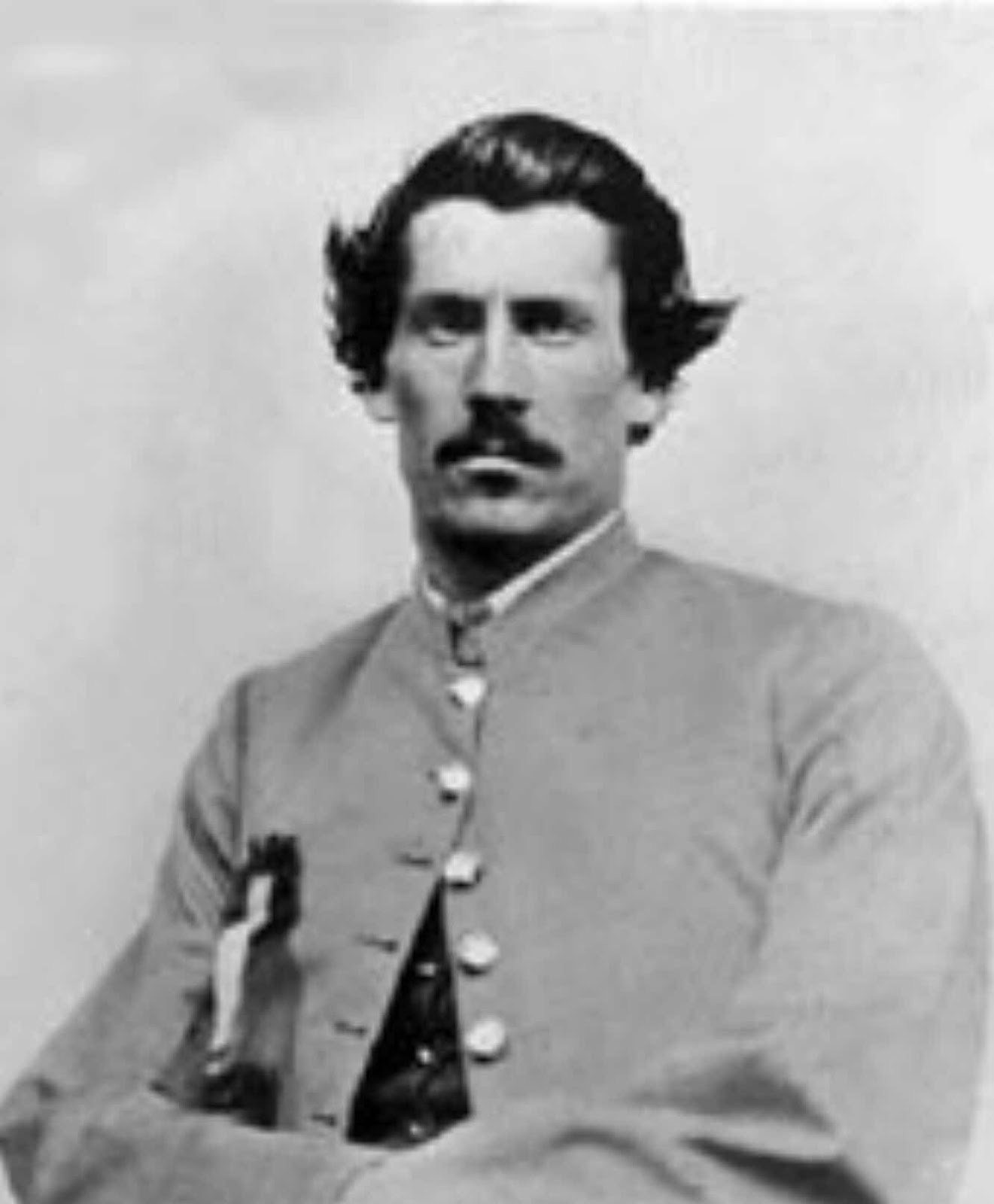
My previous post explored the life of Mary Ann (Mangan) Gabbard, a nineteenth century woman who was born in Ireland before immigrating to the United States, where she met and married the subject of this post, American soldier Michael Gabbard. Gabbard, a story claims, was a part of the honor guard which accompanied Abraham Lincoln’s body from Chicago to his burial place in Springfield

——

Michael Gabbard had been born on April 30, 1837, the son of Isaac Hugh and Jane (Isaacs) Gabbard. He married Mary Ann on September 15, 1864, while he was still serving in the Civil War, which he had entered as a private in Company D of the 8th Kentucky Infantry, which he joined in Owsley County on September 24, 1861 for a standard three-year term.

Photos from findagrave.com 
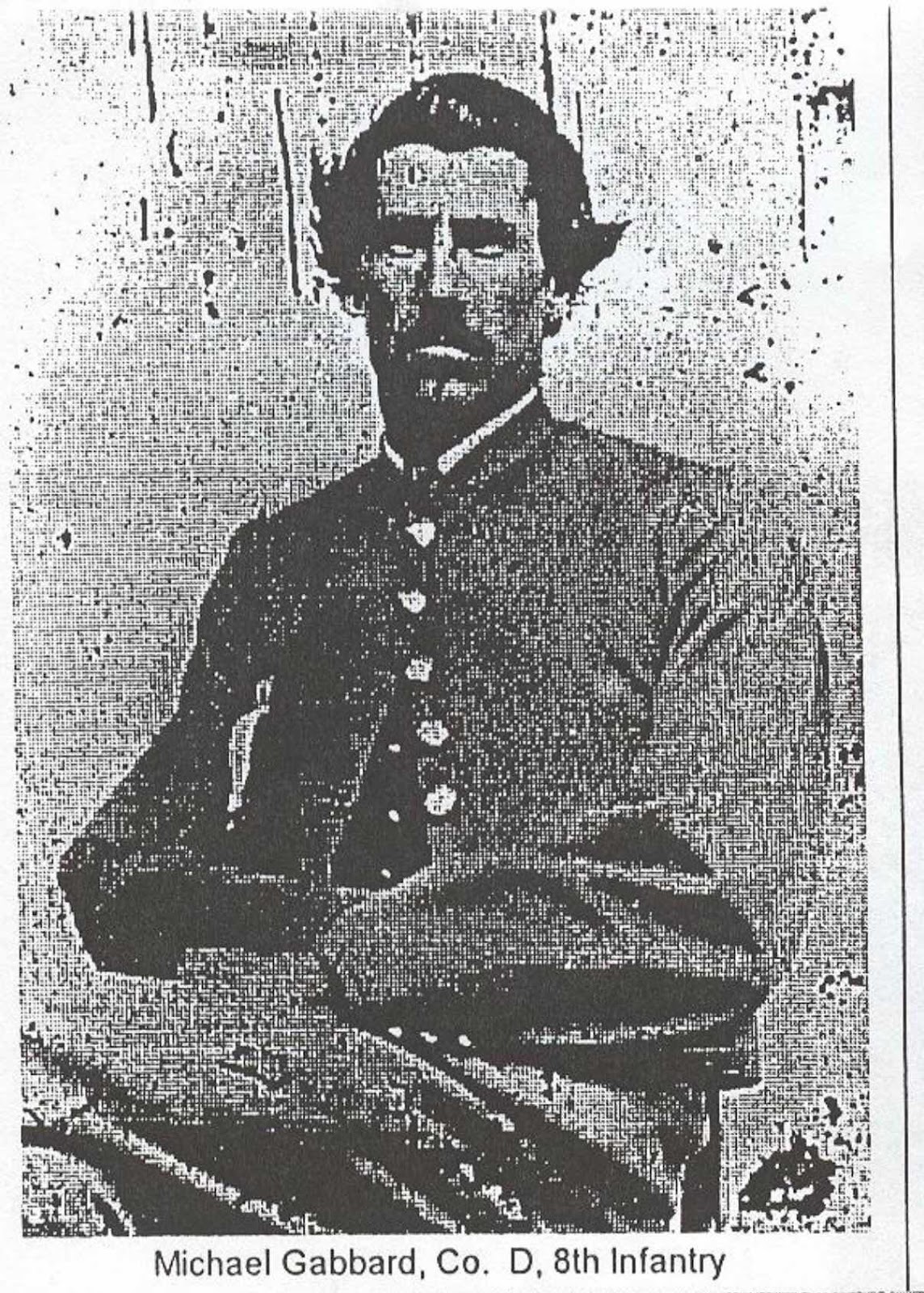


A brief recap of his time in the war is in a photocopy of a newspaper article which was among the documents I received from a cousin who alerted me to his story. The article is entitled It Happened Here, written by Jess  D. Wilson (copyright 1979, Jackson County Recorder, McKee, Ky.) It stated: Margie, as I told you, your great grandpa, Mike Gabbard, was wounded at Look Out Mountain during the Civil War. His entire kneecap was blown away. He used a cane and later a crutch, too. The wound never healed. 

After suffering the knee injury, he transferred to the Veterans Relief Corps (VRC.) His wife’s autobiography says he was in the 7th Regiment of that unit, but the Soldiers and Sailors database indicates he was in Company G of the 8th Regiment, as do forms on Fold3.com. Since she did not writ her story until about 1913 (according to a family history page,) it is likely that she misremembered the exact unit number.

Unfortunately, this newspaper story is untrue, as various observations and information contradict it. One example is that his wife’s autobiography (see my previous post linked at the start of this story) mentions nothing of him being seriously wounded, even as he pushed her on a swing. A man with a blown away kneecap might not be able to do a physical activity, or the wound would at least be noticeable, if as severe as the story described it. Additionally, would a man with a “blown away” kneecap have been able to participate in Lincoln’s honor guard, as he supposedly did? 

Even if Mary Ann  just did not remember that type of detail, or if the honor guard story is not true, a more irrefutable contradiction of this story comes from the timing of events.

The Battle of Lookout Mountain did not take place until November 24, 1863, after the couple had met. She acknowledges he was already in the VRC in Chicago when they met, and records on Fold3 show he had transferred to the VRC on August 5, 1863, after being listed sick on multiple muster rolls. This was three months before his reported wounding. This could be a case of her memory being faulty regarding details, but the dates on the military records confirm that he was in the VRC before the battle where he supposedly was injured. 

I did view pension index cards in his file but admittedly did not spend the time or money to request his pension file, so maybe I am missing key information about his specific ailment, though the earliest date I saw on any of them was 1876. He apparently fell ill more than once and the last illness was severe enough to remove him from his original regiment. This is one detail I wish I had, so perhaps I will request his pension records eventually.

The records I did find show that injury at Lookout Mountain was not the reason he transferred to the VRC as he was not even in that battle, being in the VRC long before that fight took place. (For anyone who may want to look at his paperwork, please note that I found some under “Michael Gabbard” and others under “Micheal Gabbard” on Fold3.)

Another piece of this story that is a bit puzzling is that some of the records on Fold3 seem to contradict each other, based on the dates and information on these documents (though none of these, even the differences, support the idea of him being wounded at Lookout Mountain.) With so many different military forms to complete and so many men involved in the war, such mistakes were probably inevitable.

Here is a recap of the information and dates on the paperwork in his Fold3 file:
Joined for duty Sept 24 1861 Owsley County, 3 years, mustered in  Lebanon Ky Jan 15 1862 

Muster roll cards: 
Sept 24 to Dec 31 1861, present or absent: not stated
Jan & Feb 1862 present
Mar & Apr 1862 present
May & Jun 1862 present
Apr 30 to Aug 31 1862 present
Sept & Oct 1862 present
Aug 31 to Dec 31 1862 absent, at convalescent camp, Nashville
Jan & Feb 1863 present
Mar & Apr 1863 present
Apr 1863 present 
Feb 28 to June 30 1863 absent, sent to convalescent camp, Murfreesboro, TN
July & Aug 1863, absent, left at Murfreesboro TN sick, 1st July 1863
Jun 30 to Oct 31 1863, transferred to the Invalid Corps Aug 5, 1863

Appears on muster-out roll dated Chattanooga TN Nov 17 1864, last paid to Feb 28, 1863,  transferred to Invalid Corps Aug 5, 1863 

Appears on returns (1 card): 
Jan 1863 absent sick Dec 26 1862, Nashville
May & June 1863 absent sent to convalescent camp at Murfreesboro TN
July 1863 absent sick, sent to convalescent camp Nashville TN
Aug & Sept 1863, absent sick, sent to convalescent camp, Murfreesboro May 11 1863
Oct 1863, Loss, Aug 5, 1863, Murfreesboro TN (over, but no 2nd page)
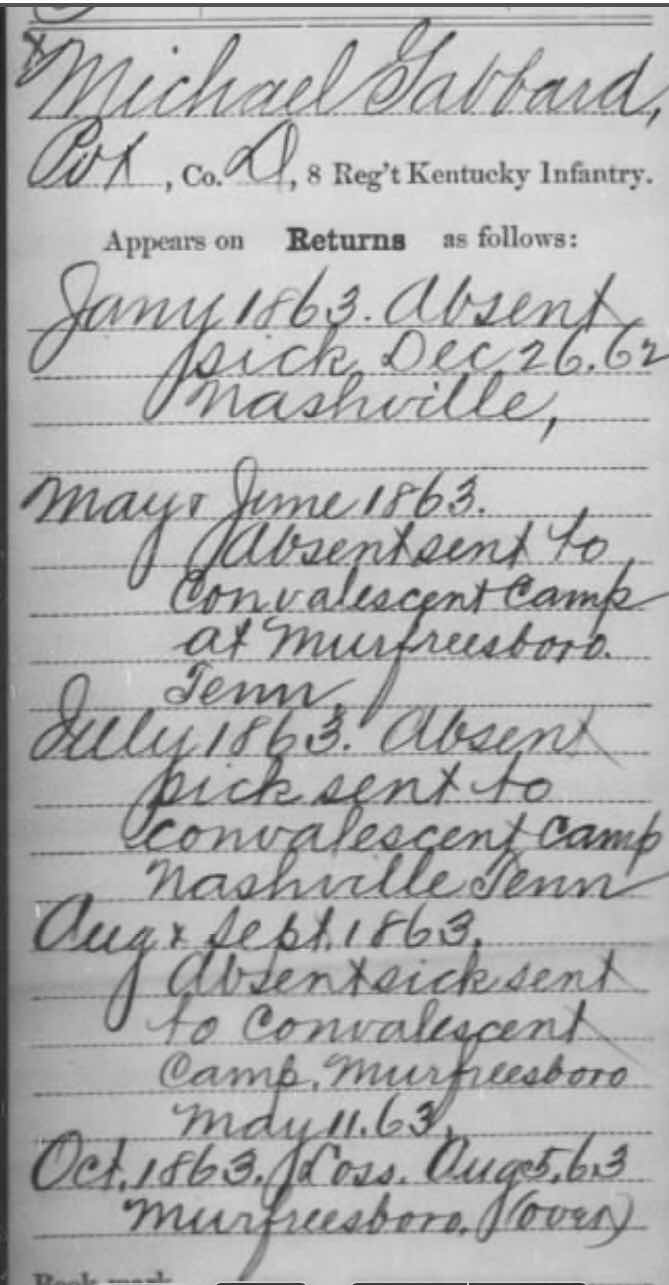

Some of the dates showing present or absent do not match other cards, but the main point for this story is that none of them show him available to the 8th Kentucky Infantry at the time of the fight at Lookout Mountain in November 1863.

How exactly his story developed into one saying he suffered a major injury at Lookout Mountain may be lost to history. Did he suffer a knee injury while in the VRC or perhaps in a non-military accident after the war? Did his memory falter or did he fabricate the story and share it? The 1890 Veteran’s Schedule Census does list him having a “damaged limb,” supporting the idea of his knee/leg being injured somehow, but I have found no other source stating how/when/where he was injured or where the Lookout Mountain fight entered the legend. Maybe the pension file would help with that.

The newspaper story quoted previously may partially clarify how this version of his story came into being, as it states: Nell wrote down... a lengthy (24 typed pages) family history from their oral tradition. “Nell” was a granddaughter of Michael and Mary Ann. Since the stories came from family oral history, it is likely that failing memories and mis-worded stories (wording might change with every telling and every attempt to recall them) led to a tale that does not match official records. 

This explanation might also apply to so the next part of this story as well. The next post will explore the story of Michael Gabbard’s reported role on Lincoln’s honor guard.


Wednesday, March 25, 2020

Not a Happy Marriage: The Story of Mary Ann (Mangan) Gabbard

A while ago, I began working on a story about a Civil War soldier named Michael Gabbard, who supposedly was on the honor guard transporting Abraham Lincoln’s body from Chicago to Springfield. I planned to do a post exploring that story, but part of the information a cousin gave me about this was a typed autobiographical sketch of this man’s wife, Mary Ann Mangan. I started to use excerpts from it in my post, but the sections related to him and/or the Civil War were much longer and more interesting than I expected, so I realized that her story would make a worthwhile post itself. It provides unique perspectives of life in that era, including how a relationship developed into the life of an immigrant, marriage, family loyalty, even an example of teenage rebellion (not a new concept), and, overall, a life story of one young woman in mid-nineteenth century America. Those interested in studying gender roles or race relations in Kentucky might find parts of this story valuable. (For anyone curious about her entire story, a copy of the full document is here.)

In my transcription of the pieces of the document relevant to this post, I attempted to correct most spelling/grammar errors, but intentionally left a couple grammar mistakes which I thought added authenticity or a “down-home” feel to this tale, making it read how I imagined she spoke. I have italicized her words below, but added a few links and other details.


Mary Ann Mangan was born March 25, 1848 in Ireland. In her youth, she lived in both Ireland and England, before sailing to the United States in 1858, landing in New York Bay. In New York, “we exchanged our British money for U.S. money. I saw the first Negro I ever saw in New York.” Her family travelled west to Milwaukee. “There I saw my first watermelons, cucumbers and squashes. There I saw the first ear of corn. I didn’t know whether it was hand made or natural.” They eventually moved to Illinois. 

While living in Peru (Illinois,) I attended church and Sunday school regularly. While attending school, I became acquainted with a number of nice young men and girls who were my classmates. In the spring of sixty-one, while on my way to school, I was told the South had seceded and war was inevitable. War was the topic of the day. The war cloud was darkening the northern horizon and the valiant sons of the North were preparing to rush to the awful encounter. 

I quit school, went home, and went to clerk in a store in my home town. The proprietor of the store was a Southern lady and she it was who persuaded me to marry your father, my husband. I stayed with this Southern storekeeper in the summer. When school opened, I would quit the store and go to school. I left the Southern lady and went to work for an old gentleman and his wife. The lady was an invalid. She was very kind to me and I liked to live with her very much.

I was living in Chicago and, with a friend, went to visit the great Senator Douglas’ grave on the bank of Lake Michigan. There was a picnic on the grounds. There were swings. I got into one and my friend was going to swing me when a young man stepped up and said: I’ll swing you if you wish me to. I let him move the swing a short time. Then I said Please stop the swing. He done as I requested. I thanked him and went walking off. It was time to go home. When I was getting to the street car, my acquaintance of the swing was at the car door and asked me if I enjoyed myself. Yes, I answered in a happy, joyous way. My friend who was with me was an old lady and she requested the name of the young man who swang me and had been so nice to her. He gave her his name and address. He promised to get a pass for the lady to go inside of Camp Douglas. The law of the camp was ‘No citizen allowed inside,’ unless some friend was a soldier and on duty there. The young man’s name was Michael Gabbard, Co. G 7th Regt., V.R.C.  Camp Douglas, Chicago, Ill.  He got my address and I hadn’t been at home but two days when I got a letter from said Michael. 

And what began in an indifferent acquaintance ended in marriage. I had not been long acquainted with Mike Gabbard when he asked me to marry him. I was not thinking of such a thing. I was young and told him I didn’t want to marry. He was persistent. I went home. Mike wrote to Mother while I was at home, asking her consent. She was furious. She made life so hard for me. I went to my southern friend with my trouble and of course she was for her Southern friend. She persuaded me to leave home and marry him, which I did. If Mother hadn’t been so harsh to me, I wouldn’t have left home and married a strange man. Mother never forgave my Southern friend for what she done in the matter. After I was married and with Mike in Chicago, mother wrote to me to come home and stay with her until Mike got his discharge as Mike could not get a house to move into as the houses in camp were all occupied. Mike consented for me to go. I was but a short time at home when he got a pass for twelve hours, which he lengthened to eight days. When he went back to camp, he was put in the guardhouse four days. It was Christmas time and he had lots of company in the guardhouse. Mother and my good stepfather treated him royally. Aunt Sally and Aunt Kate gave us a dinner as also did Mike’s Southern friend. Mike went back to duty at Chicago. I stayed with Mother.....Mike was at this time waiting for a house to become vacant. At last, the happy time arrived. He notified me to come. He had a house. Well, we got to housekeeping.

Mother hated to see me go very much and I hated to leave her and my good old stepfather. He and mother came to the train to see me off and bid me goodbye. That was the last time I ever saw my stepfather. I parted with him forever; he was a good man. Mike liked him. I went to housekeeping in Camp Douglas, Chicago. I liked to keep house very much. There was three young men, soldiers, of Mike’s company, (who) boarded with us.  We enjoyed their company very much. One was a New Yorker, one was an Indianan, and one was a Canadian. They were cultured gentlemen, and we enjoyed their company very much. (Let me say here, your Father was well liked by all his comrades.) In the latter part of sixty-five, the war was over. The prisoners were all discharged, and gone home. And the soldiers wanted to be discharged also. They had enough of war, such a cruel war.  They wanted to follow their peaceful avocations of life. 

Mike got his discharge from service at Chicago, Ill. Your Father received two honorable discharges. We left Chicago in the latter part of Nov, 1865, arrived on Lexington, Ky., and stopped at the Broadway Hotel. Took the stage next day for Richmond, Ky., stayed over night at the Webster Hotel. Next day took the stage to Irvine, Ky. We arrived in Irvine on Sunday evening, the landlady was not at home when we arrived at the Iiamson House, our hostess being a colored lady. She took charge of my things, waiting on me very politely. In the mean time, plying me with questions. She asked me where I was from, and when I told her I was from the North, she asked me if she was free. I told her “yes! You’re as free as I am.”  She gave me an earnest look, threw her arms up over her head and shouted “Thank you Lord. I’ll just stay with them through Christmas.” Her mistress had told her she was not free in order to get her work. She was a good cook and her place couldn’t easily be filled. The landlady got very angry at me for telling her black woman she was free. I had no apology to make to the landlady. 

Mike and I walked to Proctor, stayed all night at an old acquaintance of Mike’s, Frank Daugherty. Next day we started to walk to Booneville Ky.

She then writes more about her life before concluding with the following revealing, especially sad lines: 

Married at Chicago in September 15th - 1864
Michael Gabbard of Booneville Ky to Mary A Mangan of Henry, Illinois.

The marriage was performed by a Justice of the Peace. His name was Charles Chilson. I kept his business card a long time after I came to Ky. It was not a happy marriage with me but I remained true to my obligations as a wife and as a mother. I done the best I could for my children, whom I dearly loved. They are all married and in homes of their own and I am in the evening of life. I wish to live in quiet until I reach the Home not made with hands, eternal in the heavens. 

A family history site claims Michael may have been known as “Drunk Mike,” perhaps the cause of the unhappiness, and my cousin wondered if he may have been shell-shocked or had what we now call post-tramautic stress disorder, especially since he had been serioysly injured in the war (thus his presence in the Veterans Reserve Corps.) Could such a condition have led him to the bottle? 

I find it extremely interesting - perhaps even suspicious - that this account makes no mention of her husband as part of Lincoln’s honor guard. Could she have forgotten this information from about 50 years earlier? Any memoirs or reports written so long after an event or time may include faulty memories. (For instance, she noted Michael I. The 7th regiment, VRC, but re olds show he was in the 8th. That was likely a slip of the memory on her part.) Another possibility is that the nature of the marriage may have discouraged her from praising him, but she did make other positive comments about him, so her intentionally omitting the honor guard situation seems improbable. The document does not read as though she was bitter, nor that  she intended to discredit him. It makes no mention of his supposed fondness for the bottle and only includes that one line about unhappiness.

I do wonder about this omission because if her husband was on that honor guard, that would have seemed like an important piece of his life, but maybe it was not important to her. Otherwise, did she not believe he was on the honor guard? Was he truly part of that unit? If not, where did the story come from? In the next post, I will explore this part of their story more. 

The lack of a name for her “Southern friend” also puzzles me, but 50 years is a long time so her memory may have failed or she felt it too insignificant to include.

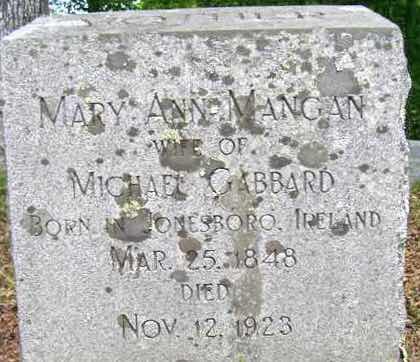
Mary Ann (Mangan) Gabbard passed away on November 14, 1923 and was buried in the Elihu Reynolds Cemetery in Cow Creek, Owsley County, Kentucky. Her husband had died in 1902 and was buried in the Esau-Gabbard Cemetery in Ricetown, Owsley County. Was her burial in a different cemetery due to her unhappiness with the marriage? Or was her spouse buried in a family cemetery which ran out of room before she died? 

One of their granddaughters, Edna Gabbard, married Charlie McIntosh. My family tree includes a McIntosh line (including a direct ancestor in the war) though any relation to this particular family is likely quite distant. That might be a genealogy project for the future.  

I will continue to work on the story about her husband Michael Gabbard and will post it when it is ready. 


These undated photos are from findagrave.com.

  
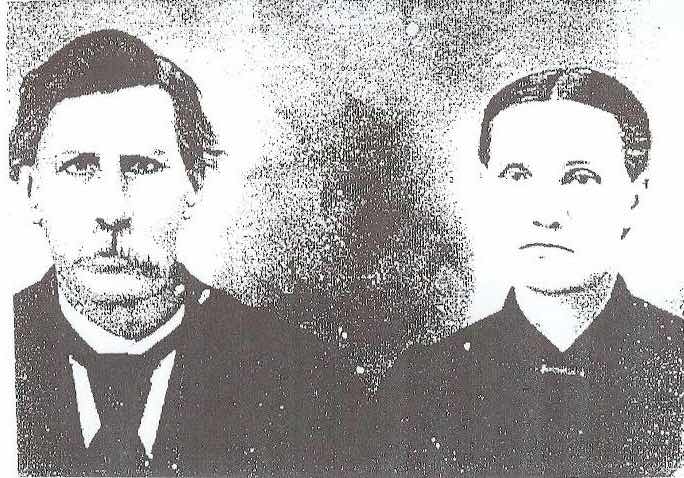
Michael and Mary Ann Gabbard

Mary Ann Gabbard

Headstone of Mary Ann (Mangan) Gabbard.

Wednesday, January 20, 2016

Review: Lincoln's Confederate "Little Sister:"Emily Todd Helm by Stuart Sanders.


Stuart Sanders, the author of three books  (Perryville Under Fire; The Battle of Mill Springs, Kentucky; and Maney's Confederate Brigade at Perryville) has produced another high-quality work, a long-form essay entitled Lincoln's Confederate "Little Sister," Emily Todd Helm. It came out about a year ago and I finally found the time to read it and am glad for it. It is available at Amazon.com. 

The basic story of this essay - the challenges facing a woman who was a sister of Mary Todd, sister-in-law of President Lincoln and wife and brother of Confederate soldiers - should be well-known to most who study the Civil War, but this essay goes beyond the basics and recounts her life story on a deeper level, providing details that may be less familiar. 

The essay starts with a scene of Emily in her later years, before the story goes back in time, even before her birth, to explore the Todd family background and influence in Kentucky. It describes Emily and Mary's father Robert Todd and how he raised two families after the unfortunate death of his first wife. 

Sanders discusses Emily's childhood and the development of her close relationship with her older half-sister Mary and brother-in-law Abraham Lincoln. He then discusses her marriage to Benjamin Hardin Helm, who also had influential family ties to the state and its government. Their affection for each other was very strong.

This sets up the story of the split and misfortunes that the Civil War created for her family. Eight members of the Todds supported the Confederacy while six remained loyal to the United States. During the war, Emily lost her husband and two brothers and took each loss very hard.

The biggest and most famous controversy of her life, first mentioned at the start of the essay, was her trip to Washington .D.C. in late 1863. This essay does an outstanding job of describing her visit from its origins with Emily's refusal to swear an oath of allegiance to the United States to a less-than-friendly encounter with a Senator and to the President's attempt to offer her assistance as she returned to Kentucky. The discussion of her strong bond with Mary and how both had endured personal tragedy (Emily losing a husband, Mary a son) during the war is especially poignant and makes it more understandable how the widow of a Confederate general was allowed to visit the White House during the war. Biologically, they were half-sisters, but in real life they were much closer.

The ending of the relationship between Emily and the Lincolns is another powerful piece of this tale. 

The essay then describes her long, sometimes contradictory, life in the years after the war. She was a beloved widow of a former Orphan Brigade leader, yet also a family representative at events commemorating the life of President Lincoln; she was proud of her Confederate ties, refused to take the oath of allegiance, yet accepted a Government appointment to help support herself and her family and adopted a spirit of reconciliation.

This is an informative and well-written essay, with a writing style that is easy to read. Having it in this format also makes for a quick read. Despite its relative brevity, however, it tells an intriguing story of this woman and how the war affected so many of her closest relationships. Her enjoyment of genealogy and wish to protect her family legacy were noteworthy and perhaps even ironic given the sadness to which her family ties contributed so much.

Though her name and much of her story may be familiar to Civil War students, Stuart Sanders' work provides a more detailed account of her life's story, making this a very worthwhile read. I highly recommend adding it to any e-library or reading list. 

Tuesday, December 22, 2015

The Last Campaign Song of 1860

During the first years of the sesquicentennial, I frequently found stories in the Covington Journal from 150 years prior and reprinted or discussed then here. Unfortunately, the list of available surviving editions stopped in August 1862 and did not resume until 1868. It was a pro-Southern and Democratic journal, so perhaps those sentiments led it to shutting down for a while, or maybe other issues were destroyed, not saved for modern microfilming,  but at least we have come issues from the war left.

Anyway, I have been on a genealogy kick lately and thought again of this resource and decided to start  looking through it again for more interesting stories, probably focusing on the pre- and post-war period, though who knows what I may find? I doubt I find a lot, but suspect there are at least some interesting stories waiting for me.

Today, I take some song lyrics from the November 3, 1860 issue, the final issue before the monumental Presidential election of that year. I don't think they need too much explaining as the writer's preferences come across fairly strongly (though I will add that "phiz" is an apparently old-fashioned word for "face.")

The Last Campaign Song
To the air of "Oh, Susannah"

I had a dream the other night,
When all around was still.
I thought I saw poor Breckenridge
A sitting on a hill.
A corn-cob pipe was in his mouth,
A tear was in his eye;
Says he, they beat us North and South
But Yancey do not cry.

(Chorus) Fire-eaters do not cry, said he
Tho' we are left of hope bereft,
By Bell of Tennessee. 

Not far away stood Stephen A., 
I think I see him now;
With clenched fists and lips compressed,
And dark and frowning brow.
With sorrowing phiz poor Breckenridge
No sooner caught his eye,
Than hands did place upon his face,
And loud began to cry.

---Oh, Lord Stephen, don't be mad with me, 
There was nothing so deceivin'
As Bell of Tennessee.

Then in the rear, there did appear,
A doleful picture drawn,
With clothes neglect and hair erect,
And features woe-begone
I'll go again to splitting rails
Quoth he, with piteous sigh;
The colored question once more fails,
So, darkies, let us cry;

---Oh, dear niggers, come and cry with me;
Our hopes are o'er for evermore,
With Bell of Tennessee.

Then by his side I then espied,
Old Buck with phiz demure,
Friend Abe, he said, I'm much afraid, 
Our cause is hopeless sure.
To Breckenridge tho' I was pledged,
All powers I did apply,
Tho' indirect, to you elect,
So, Lincoln do not cry.

--- Oh, fanatic, do not cry said he, 
We all have fell by Old John Bell,
That hails from Tennessee. 

John Bell did end up winning Kentucky's electoral votes, which clearly did not help the three candidates mentioned here, so perhaps the song's point was not totally off-the-mark.

Monday, August 3, 2015

Lincoln Statue in Cincinnati to be moved?

No, this does not have anything to do with the controversy over Confederate monuments. This story is a couple of months old and I missed it when it first came out. I guess I will have to try to pay more attention to local news now. :) 


The possibility of moving the Lincoln statue from one end of the park to the other is real, but no final decision about that has been made.
A park superintendent said Tuesday there would be a public hearing scheduled to get input from the community before any conclusion is reached.

I do not see any more recent updates.
This statue has an interesting history, including quite a bit of controversy. I will post a story about it soon.
Courtesy yelp.com


Lytle park, with current location of Lincoln Statue, courtesy cincinnativiews.net

The statue was dedicated in 1917, so perhaps an opportunity for a re-dedication on its centennial will present itself to the city. That might be nice.

Monday, October 13, 2014

A Few Book Summaries

Here are a few other books I read in spring and summer. I enjoyed them all, but didn't take notes to do full reviews, but will add a few thoughts on each.


Co. Aytch by Sam Watkins
This book, made famous by Ken Burns' PBS series on the Civil War, was recommended to me when I was on a public hike at Perryville and imam glad I finally read it. It is a fun read, with good descriptions of what Watkins saw at many battles, including Perryville, where some of his lines are on museum displays and are commonly repeated in other books about that battle. It is Watkins' story, written tests after the war, so keep in mind how human memory works when writing so long after an event, but it is still an enjoyable read and a good look at what private soldiers in that wsr witnessed.

The Battle of Mill Springs Kentucky by Stuart Sanders
I still have not visited this battlefield, and am almost ashamed by that. This is a good book from the History Press and gave me a lot of good information on this early Union victory. I like how the author writes, as I also enjoyed his works on Perryville as well as this one. It is a good read

Lincoln's Melancholy:  How Depression Challenged a President and Fueled His Greatness
By Joshua Wolf Schenk
I had heard about this work years who, but never got around to reading it. I am glad I finally did. I found it to be a fascinating look at another side of  Lincoln's life and personality. His moodiness was not a new revelation to me, but it's depth and how often Lincoln struggled with it did add to my knowledge and perspective of this man. The Sutton seemed to have a good grade of psychological concepts and explained them in easy to understand ways.


Morgan's Great Raid: the Remarkable Expedition from Kentucky to Ohio by David Mowery
This is not a long look at the details of every confrontation during this 1863 raid, but is a good overview of the emtire raid and provides a nice look at how much ground Morgan, his men and his pursuers covered during these weeks. Mowery's writing is easy yo follow and I enjoyed how he described the challenges that those in and against the raid faced. 

Liddell's  Record by St. John Richardson Liddell, edited by Nathaniel Cheairs Hughes Jr.
If you like honest and blunt assessments from soldiers, this is a book you should read. Hughes Jr. cobbled together Liddell's records and molded them into a fine story in Liddell's own words. Like the Watkins book, this was written after the war, but is still a valuable read due to Liddell's honest accounts of battles and Confederate leaders he experienced or encountered during the war? He was not afraid to offer criticism of his superiors. He was another fascinating character I am glad I discovered. He may not be in the same class as Daniel Sickles in terms of being a "different" personality,, but is still another interesting individual, though not very well-known.

1864: Lincoln at the Gates of History by Charles Bracelen Flood
I found this book when looking for additional sources for my upcoming(January 8, 2015) talk on Abraham Lincoln, and I am fortunate to have found it. It offers a terrific account of what proved to be perhaps the most important year of the Civil War, and how Lincoln dealt with the many issues, including his re-election, that popped up throughout these 12 months. I found several new ideas and thoughts to incorporate into my talk, and a few details as well. It is a well-written, easy-to-read book about a crucial year.

Decided  on the Battlefield: Grant, Sherman, Lincoln and the Election of 1864 by David Alan Johnson
This is another book I found to help me understand the happenings of 1864 and it was another valuable reference. It focuses on the presidential election of 1864 and how battlefield events influenced the results of that voting. It is another well-written narrative and look at the last full calendar year of the war. This is another fine book.


Friday, January 18, 2013

Lincoln: The Movie


I finally found time to see Steven Spielberg's film Lincoln today and though I am not trying to do a full review of it (there are plenty already available since it has been out 2 months) I wanted to write a few words while it is still fresh in my mind.

First of all, this is probably now my favorite movie of all time. Silence of the Lambs was probably my previous favorite, but this really does not mean much since I see so few movies. (My last trip to the theater was for Star Trek: Nemesis a long time ago.) Still, my impression of this movie was that it is simply sensational.

A couple of scenes actually hit me kind of hard emotionally. One was early in the movie when the president got on the floor to wake up Tad and then picked him up on  his back to go to bed. The other was when Lincoln was reading to his son while waiting for the results of the vote on the 13th Amendment. I don't know the reasons, but both of those really struck me as being great scenes and images.

Another one was when he was leaving to go to Ford's Theater with Mary. Of course, I know the historical record and what happened next, but to be emotionally involved in the movie and then get to that point - well, it really got to me, just imagining the pain of the next few hours for so many people.

I am not going to pick nits over any issues of the film. I thought a couple of scenes toward the end were a bit contrived or maybe could have been done better. Would it have been better to show the events at Ford's Theater? Or, maybe they could have ended the flick with Lincoln walking down the White House hallway, heading towards his ride to the theater, leaving the rest up to the viewer's imagination. Then again, who am I to criticize Spielberg, especially for a film I loved so much.

I also must admit that being away from the theater for so long made me forget how spectacular the big screen can be. That is so different from my normal TV, Ipad or computer screens, but I had not thought about that before today. That added to how impressed I was with this show.

I really liked how it addressed some of the subtle items of Lincoln's life and challenges he faced, stuff that non-history buffs might not know, such as the relationship with his son Robert, with Mary, with cabinet members, the politicking to get votes and the different views of Republicans, conservative and radical.

Overall, it was just an enjoyable movie, with a lot of historical information in it, presented in a way that people who might not watch a documentary may enjoy and learn from. I just had a wonderful time watching it and kind of wish somebody would do a similar film and call it "Mary Todd" about her years in the White House and then afterwards with all the challenges she faced. I guess there would not be enough demand for something like that, but I think a similar effort could produce a spectacular (and probably gut-wrenching) story. Maybe it would be too sad to show in such a format, but I would certainly watch it.

Tuesday, January 31, 2012

Book Discussion: Antietam Crossroads of Freedom


James M. McPherson 
copyright 2002
Oxford University Press

 
When I buy a book, I usually read it, then place it back on my shelf. Occasionally I will grab a book to try to find a phrase or claim I remember in the book or to clarify my memory on some subject, but very rare is the book that I read a second time.

Antietam: Crossroads of Freedom became one of those rare books. I read and enjoyed it a few years ago, but have now just re-read it as part of the "Let's Talk about it: Making Sense of the American Civil War" series I have mentioned here before. 

As expected, this book is very readable and informative, written in a style as most of McPherson's books are. It is only 156 pages long as well, so it is a quick read too.

I've entitled this post as a "discussion" instead of a review as I expect this to be more of an exploration of my thoughts of the message of the book than of a more traditional review. I'll try to keep it at a reasonable length and not touch on most of the many other points that can contribute to these thoughts. (I'm even leaving out any talk of  Gettysburg as the turning point - please pick yourselves up off the floor after reading that if the shock overcomes you.)

My main question about this book is if Antietam is truly the turning point of the war as McPherson contends. He does a good job of showing the mood in the north in the months before the war, with the great concern after the failure of the Peninsula Campaign and the route of Second Bull Run. Some leaders in Great Britain and other European countries were watching events closely and momentum seemed to be favoring either recognition of the Confederacy by those countries, or intervention into the war. 

Then Lee's army invaded Maryland. That should have been no way to improve Northern morale.

At this point, the book describes the action of the battle itself, from the famous "lost orders" to George McClellan's equally famous lack of aggressiveness. McPherson shows how that, even before the battle, the Union forces had experienced a sudden improvement in their morale, and were ready for the challenge of a battle on what they considered their territory. This contributed to the ferocity of the fighting, and after the fighting ended, many Union survivors were ready to pursue their enemy and try to inflict even more punishment on them.

McPherson then presents his arguments about Antietam's importance to the outcome of the war, and they are familiar - the Confederates returned to Virginia, Lincoln had the opportunity to issue the Emancipation Proclamation, and foreign recognition of the Confederacy suddenly became unlikely, if not impossible.

They are good, strong arguments, but I'm not sure I agree with them. 

For one, the war was only one-and-a-half years old when this fight took place, yet lasted two-and-a-half years more afterwards. Can it be a turning point if the event lasts longer after it occurs? 

I suppose that raises the question of what is a turning point, as well as the difference between A turning point and THE turning point. 

Also, if Antietam is a turning point because it ended the hopes of foreign recognition of the Confederacy, that implies an assumption that the Confederacy could only win the war with such recognition. Though time proved the Confederates did not get such recognition and did not win the war, I am not convinced that the failure to obtain such recognition doomed the Confederacy. I believe they still had the possibility of gaining victory without foreign intervention. During the summer and early fall of 1864, the Confederates had inflicted many casualties on Union forces in Virginia and had frustrated their foes elsewhere, particularly in the Union's attempt to approach Atlanta. Europe did not offer recognition, but the Confederate armies still bogged the Union armies down and the lack of progress on the part of the Northern forces frustrated and aggravated people at home. Doubt about the war's outcome began to build, and even President Lincoln looked unfavorably at his chances of re-election.

I can understand listing Antietam as one of many turning points in the war, though perhaps that cheapens the importance of whatever is meant by "turning point." In the discussion of THE turning point, my interpretation is of THE moment or event after which Union victory was inevitable. In that regard, I turn back to the middle and end of 1864, and contend that Lincoln's re-election in 1864 was the key event in showing that the Union would prevail. William T. Sherman's capture of Atlanta certainly aided Lincoln's re-election and I have often thought that event was the key, but now I believe the actual election result was the symbol and sign that the northern people were not succumbing to war-weariness; they did not elect a candidate whose party favored peace at almost any cost; they decided to continue fighting until success came.  This spirit displayed by the Northern people dismayed many in the south, and destroyed Southern hopes that the Confederacy could win simply by outlasting the north. The supposed "mechanics" "hirelings" and "wage slaves" of the North had shown a more persistent fighting spirit than their enemies had expected.

That - the failure to injure Northern morale badly enough to convince Northerners to give up on the war - was more important than the failure to get European of the Confederacy as a separate nation. Or at least it was as important, but it was not, at least in my understanding, less important to the Confederacy's chances of victory.

Of course, the "turning point" issue is one of the many questions that will in all likelihood always spur debate on the Civil War and McPherson's book does add to that discussion. It may create new thoughts and perspective too. In high school, I bought the "Gettysburg as the high-water mark" turning-point view, have sometimes accepted the points McPherson makes in his book about Antietam and its aftermath, and have also given thought to Sherman's Atlanta campaign as the so-called "turning point" before settling (at least for now) on Lincoln's re-election as the true key "moment" that demonstrated how the war would eventually end. 

Although I may not agree now  with McPherson's arguments, I thoroughly enjoyed this book and his analysis. I'm glad I read it again and look forward to the discussion it creates at our next "Let's Talk About it" session tomorrow night.


Sunday, July 17, 2011

Kentucky and Kentuckians - Neutrality, Yeah or Nay?

Here are some articles from the Covington Journal of July 13, 1861 discussing Kentucky and its potential role in the Civil War.

The Neutrality of Kentucky
Mr. Mallory, the Representative of the Louisville District, speaking, it would seem for the Union Representatives of Kentucky on the floor of the House, has pledged the State to stand by Lincoln's government in the prosecution of the war.

And so falls to the ground the neutrality of Kentucky.

The neutrality of Kentucky was urged and defended by Mr. Crittenden. It was endorsed by the Legislature and sanctioned by the people. It has kept our beloved State out of the war, and secured for her comparative quiet.

Is this principle to be given up at the bidding of a few politicians at Washington city? Let the people speak

Is it Disinterested Patriotism
The telegraph informs the public that at a meeting of Kentuckians (not members of Congress) at Washington city, it was resolved that the government must be sustained in its war policy.

Now who are these Kentuckians at Washington who propose to give tone to public sentiment? - In all probability they are men seeking appointments from the Federal administration in the civil service or in the army, or sharpers on the lookout for fat contracts. Of course they are all for sustaining the government in " a vigorous prosecution of the war." 

400,000,000 Dollars and 400,000 Men
President Lincoln asks for four hundred millions of dollars and four hundred thousand men with which to prosecute the war against the South. The share of Kentucky will be twenty millions of dollars and twenty thousand men. Will Kentucky furnish her share of the men and money? 

---

The same edition published this untitled article as well.


 Within a few days past, some twenty gentlemen have left this city and vicinity for the Confederate States. Maj.S.K. Hays, Capt. A.Madeira, Lieuts. W.T. Estep and W.B. Phelps are, we believe of the number. - It is understood they rendezvous at Clarksville, Tenn., where two or three regiments of Kentuckians will formed (sic) for the Confederate army.

Monday, April 12, 2010

The Civil War, through the eyes of Rod Serling

So I took a day off work today, and after a trip to the gym, I'm sitting around the house relaxing and watching some episodes of the Twilight Zone on DVD.  It's a really good show and I enjoy it very much, even though I've seen every episode, some of them many times. The writers on this series did an outstanding job of telling stories, creating drama, and adding their own special "twists" to the endings of these tales.

I've noticed that several episodes of this series use the Civil War and that era for material. I found it odd at first that a science fiction show would rely on such a time period for so much material, but as I thought about it more, it came to make more sense. This show was produced at the end of the 1950s and early 1960s, right when the centennial of the Civil War was taking place, so why wouldn't the show capitalize on that? Plus, this war has always been a popular topic of Americans, so, again, it does seem unreasonable for Mr. Serling and the show's other producers and writers to take advantage of such a rich resource of potential story material.

One of the episodes about the war, and probably my favorite, is called The Passerby, where a wounded Confederate is traveling along a dusty road and stops by a woman's house to get a drink of water and some rest,. He remains there for a while, talking with the lady, a war widow who is missing her husband, as  more soldiers pass along this country lane. I won't give away the ending, in case anybody reading this has not seen it, but it is a typical Twilight Zone episode. The final passerby on this road is especially poignant.

Another episode featuring the Civil War is Still Valley in which a Confederate picket heads into a nearby town searching for Union soldiers reputed to be nearby. He does find a company of Union men, but none of them are animated at all. Unnerved by this mystery, the Rebel soldier looks around until he finally spots another person who is moving, an old man, carrying a large book. After discussing the situation with the man, the soldier finds that this man does not have long to live, but  he also that this man and his book may hold a key to ensuring Confederate victory in the war. He takes this information and the book back to his unit's camp, where the soldiers and officers discuss the pros and cons of using this potential weapon. This is another very good episode, and brings to the forefront the question of "win at all costs" versus an attitude of accepting what might happen, but maintaining your own sense of morals and values, win or lose.

An Occurrence at Owl Creek Bridge, based on the short story by Union veteran Ambrose Bierce, is probably the most famous and well-known of these episodes, telling the story of the last few minutes of a spy who was captured and is being executed. I remember seeing this one for the first time back in high school, and how the ending (again, pretty typical for the Twilight Zone) shocked me. It's absolutely fascinating how well they managed to tell this story through the medium of television.

Two other episodes I can recall both use the Civil War era as part of the story, though not the war itself as the main focus like the first three I mentioned do.

One of these is Long Live Walter Jameson, an episode in which people find out a local man is much older than they realize or can believe, with evidence from the Civil War era playing a key role in this discovery.

Another one is Back There in which a scientist (played by Russell Johnson, aka the "Professor" from Giligan's Island, another of my favorite old shows), travels back in time to April 14, 1865 to try to stop the assassination of President Lincoln. This brings up the age-old debate about even if time travel were possible, would it be wise to go back in time and change any event, either as large as Lincoln's assassination, or seemingly minute?

The Twilight Zone continues to fascinate me, and so when it's story-telling is combined with Civil War topics, it's just so much the better as far as I'm concerned. And if anybody reading this likes the show as much as I do, get the DVD collection of all the episodes. I received it for Christmas a couple of years ago and it's just awesome to be able to watch any of the episodes anytime I want. Here's a link to it on Amazon.com, though I'm sure there are other sources for it out there as well.


Friday, February 26, 2010

Lincoln at Cooper Union, February 27, 1860


2010 and the ensuing few years will bring the 150th anniversary of many events significant to the Civil War era. One such anniversary occurs this Saturday, marking the 150th anniversary of Abraham Lincoln's famed "Cooper Union" speech in New York, a speech that noted historian Harold Holzer claims "made Abraham Lincoln President".

Below is a video from c-span of Sam Waterson re-enacting Lincoln's speech that day. It is long, but a very enjoyable watch, and it's not hard to imagine Lincoln's performance being similar to Waterson's excellent work.


Lincoln's Cooper Union speech portrayed by Sam Waterson

Here also is a link to the text of that speech.

Cooper Union Speech

The famed last line is one of the strongest statements of Lincoln's career, even with the caveat "as we understand it" added to the end.

Let us have faith that right makes might, and in that faith, let us, to the end, dare to do our duty as we understand it.  


(Note on the picture at the head of this post:  It is, of course,  the famous image of Lincoln, taken during his visit to New York. This was perhaps the first nationally-known and spread image of this westerner, likely the first view that many people in the east (or the entire country) saw of their future President.)


Wednesday, January 27, 2010

Lincoln vs Douglas - in baseball?

Reading the book Baseball's First Inning: A History of the National Pastime Through the Civil War by  William J. Ryczek, I came across the following anecdote that I thought was interesting and worth sharing.

In a chapter that discusses the growth of baseball (base ball at the time) outside of the New York area, the author mentions some clubs forming in the Midwest and Chicago.

"The following year, the Clipper listed twelve Chicago clubs that played the New York game. In the tense political climate that surrounded the 1860 presidential election, the Excelsiors divided into two teams, the adherents of Abraham Lincoln on one and those of Stephen Douglas on the other. The Douglas men beat the Lincoln men, 18-16, the only battle Douglas won that year." 

The Clipper was a newspaper in New York that covered sporting events and theater, and the Excelsiors were one of the clubs that had formed in Chicago. (This excerpt was from pages 147-148.)

I had never heard that story before, but with tensions so high that summer, I guess it's not surprising such a split occurred, especially in Illinois, the home of those two Presidential candidates and long-time rivals.

It's an interesting book so far. It shows how the myth of Abner Doubleday as the inventor of baseball came into being and the chapter on how the coming of the war affected the still young sport has the clever title of Abner Doubleday Invents the Civil War.

If I see any more interesting tidbits about the war and this sport in the rest of the book, I'll be sure to share them. I doubt I do a review of it since it's not totally Civil War related, but I do recommend it to anyone interested in the early history of baseball. It's very enjoyable and informative.

Sunday, January 10, 2010

2009: Year in Books, Part 2

Continuing my look at some of the books I read in 2009, I'll start now with Why the Civil War Came, edited by Gabor Boritt, which is a very nice collection of essays about the coming of the war, including his own thoughts on how Lincoln refused to see the war coming in time to try to prevent it, some interesting discussion of the failure of the U.S. political system, and other thought-provoking essays on topics like the Northern reaction to the war, as well as the pre-war actions of women and of African-Americans. It is a bit difficult to read at times, but is well worth the effort.

All That Makes a Man: Love and Ambition in the Civil War South by Stephen W. Berry is a book that I found difficult to read at times, trying to understand the language and themes he used, especially when he discussed psychological and philosophical themes . For some reason, it did not fit my personal style of what I like to read, or maybe I just did not fit it. This book discusses the role of love and ambition in Southern men, discussing gender roles and how that influenced the way men handled the controversies leading to the war. I liked how he used pairs of men as examples in different sections, showing how the experiences and lives of each compared and contrasted. It is a really good subject, with a lot of potential, but I just did not find this book as readable or as easy-flowing as his next book House of Abraham: Lincoln and the Todds, a Family Divided by War, which I read a couple of years ago.

I believe the following books (or most of them) have already been the subjects of reviews on my blog, but I will give them brief mention again here.

James P. Duffy's Lincoln's Admiral: The Civil War Campaigns of David Farragut is a very enjoyable, informative and smoothly-flowing review of the career of David Farragut, concentrating on his Civil War experiences on the Mississippi River, at New Orleans, Mobile Bay and other locals. I do wish it had included endnotes or footnotes, however.

I claim no objectivity on this one, as I do know Dr. James A Ramage and am privileged to work at the museum named in his honor, but still found his Rebel Raider: The Life of General John Hunt Morgan to be a very informative look at the life of this famed Confederate, offering both praise and critical analysis of Morgan's actions and decisions.

Another book that I found to be absolutely outstanding, both in style of writing and, especially, for its subject and treatment thereof was Mr. Lincoln's T-Mails: How Abraham Lincoln Used the Telegraph to Win the Civil War by Tom Wheeler. It is a concise, but informative review of Lincoln's uses of this new technology, which had not been available to any war-time U.S. President previously. Wheeler shows how Lincoln had no precedent on how to use such a tool, but how he found an effective way to employ it to his advantage.

One book which was a bit confusing at times due to the many voices used, yet still provided many unique and interesting perspectives was The Slaves' War: The Civil War in the Words of Former Slaves  , edited by Andrew Ward. The confusion came from so many different sources used, yet that added to the variety and diversity of opinions and viewpoints. There were surprising views as well, such as slaves thinking of Yankees as monsters, or protecting their masters' valuables from invading Northern forces. It took me some time to get used to the format but once I did, I found this to be a very interesting look at life from the perspectives of these who had lived as slaves during the war.

1776 by David McCullough took me away from pure Civil War studies, but I actually found several themes throughout the book that reminded me of various discussions of the "2nd American Revolution," including the one large, powerful existing government versus the upstart Rebels and some mentions of sectional discord or distrust among the American leadership and troops. It is an outstanding book to read and gives a fascinating look at this pivotal year in American history.

A Yankee Goes to Gettysburg is a series of beautiful photographs from the Gettysburg battlefield followed by original poetry by Todd Patrick Coleman, a local author whom I have been fortunate enough to meet and befriend and whose book is available at the Ramage Museum. I enjoyed these short tributes to those who fought at that Pennsylvania town – they are not the typical poems with rhyming lines, but are of a more abstract style, while still adding meaning to the wonderful pictures. This is a book that can be read in one sitting, and is well worth it.

Daniel Mark Epstein wrote a fine book entitled Lincoln's Men: The President and his Private Secretaries that provides a nice perspective at some of the background work taking place in Lincoln's White House, and how Lincoln and these young men came to rely on each other for support and developed close relationships over the years. The amount of work these men (John Nicolay, John Hay & William Stoddard) did was amazing.

I did read one collection of diary and journal entries this year, and it was another fascinating book, concentrating on the last year and 4 months of the Confederacy. No Soap, No Pay, Diarrhea, Dysentary & Desertion: A Composite Diary of the Last 16 Months of the Confederacy compiled by Jeff Toalson, is exactly what its long title suggests. It takes excerpts from many people and locations to provide a diverse set of views of the end of the Civil War, including comments from soldiers, sailors and people at home, including women, some of whom had very strong opinions on Confederate leadership. This work is very enjoyable and informative.

William Lee Miller's President Lincoln: The Duty of a Statesman is a good solid look at Lincoln during his presidential years, focusing on his new-found role as not just a local lawyer and politician, but a statesman who now had worldwide correspondents and responsibilities. It focuses mostly, though, on h is role in America as a statesman and how his personal set of values and morals guided him through the tough job of war-time leader. I found it to be very enjoyable and informative, and a fairly easy read.

Lincoln at Peoria: The Turning Point by Lewis Lehrman was the final book I finished in 2009, and is one of my favorites, not just from that year. It is a very detailed, organized and fascinating look at the importance and impact of the speech Lincoln gave at Peoria, Illinois in October 1854. Lehrman argues, convincingly, I may add, that this speech marked a change in Lincoln's professional life, in terms of how he prepared and delivered his speeches, and about the topics he argued in those speeches. It simply is an outstanding book that I enjoyed about as much as any other I can recall reading. It, along with White's & McCullough's works, is one of the best I read in 2009, and perhaps in my life.

Friday, January 1, 2010

Emancipation Proclamation, January 1, 1863

147 years ago today, President Abraham Lincoln signed the document that has continued to give him reputation as the "Great Emancipator," a final version of the preliminary document he had announced in September of 1862. This document, controversial then and now, was the one public work of which Lincoln was the proudest.

Like with much of what happened during the war years, people throughout the continent disagreed on the traits of Lincoln's work.  Some thought he had exceeded his authority with this declaration, while others felt it did not go enough. Some, particularly in the South, saw it as an example of tyranny and too much governmental power, while others believed that "freeing the slaves in areas the government did not control" was a sign of a weak, ineffective order.

Even 75 years later, it still brought up questions. Historian Richard Hofstadter once wrote, “The Emancipation Proclamation of January 1, 1863, had all the moral grandeur of a bill of lading." To me, it seems that he missed the point - this was not to be some public speech or a moral statement, but, rather, a legal doucument announcing a Presidential decision. Lincoln, was, remember, a lawyer by profession, and he intended this as a purely legal announcement based on military necessity, not an opportunity to express moral beliefs or political statements as he did in speeches such as the Gettysburg Address and both of his inaugural speeches.

Here is a link to an article that discusses some of the questions about this document, perhaps in more detail than I am able.  Questions about the Emancipation Proclamation


Still, as we celebrate the coming of another New Year, let's not forget the magnitude of the signing of this Proclamation by the President. After the preliminary proclomation and the Union Army's struggles in the following weeks, particularly at Fredericksburg, there was some wondering as to whether or not Lincoln would still go through with this announcement as planned, but not only did he do so, but, after a morning of greeting visitors, he even took time to make sure his signature reflected his confidence that he was doing the right thing. Slavery had caused controversy in the country for decades, and such a document as the Emancipation Proclamation was rather radical compared to past Presidential or Congressional declarations. This was no ordinary public letter or speech, which Lincoln recognized and which we, almost a century-and-a-half later, should not forget.


Here is the text of the proclamation, taken from Abraham Lincoln online


By the President of the United States of America:


A Proclamation.

Whereas, on the twentysecond day of September, in the year of our Lord one thousand eight hundred and sixty two, a proclamation was issued by the President of the United States, containing, among other things, the following, to wit:

"That on the first day of January, in the year of our Lord one thousand eight hundred and sixty-three, all persons held as slaves within any State or designated part of a State, the people whereof shall then be in rebellion against the United States, shall be then, thenceforward, and forever free; and the Executive Government of the United States, including the military and naval authority thereof, will recognize and maintain the freedom of such persons, and will do no act or acts to repress such persons, or any of them, in any efforts they may make for their actual freedom.

"That the Executive will, on the first day of January aforesaid, by proclamation, designate the States and parts of States, if any, in which the people thereof, respectively, shall then be in rebellion against the United States; and the fact that any State, or the people thereof, shall on that day be, in good faith, represented in the Congress of the United States by members chosen thereto at elections wherein a majority of the qualified voters of such State shall have participated, shall, in the absence of strong countervailing testimony, be deemed conclusive evidence that such State, and the people thereof, are not then in rebellion against the United States."

Now, therefore I, Abraham Lincoln, President of the United States, by virtue of the power in me vested as Commander-in-Chief, of the Army and Navy of the United States in time of actual armed rebellion against the authority and government of the United States, and as a fit and necessary war measure for suppressing said rebellion, do, on this first day of January, in the year of our Lord one thousand eight hundred and sixty three, and in accordance with my purpose so to do publicly proclaimed for the full period of one hundred days, from the day first above mentioned, order and designate as the States and parts of States wherein the people thereof respectively, are this day in rebellion against the United States, the following, to wit:

Arkansas, Texas, Louisiana, (except the Parishes of St. Bernard, Plaquemines, Jefferson, St. Johns, St. Charles, St. James Ascension, Assumption, Terrebonne, Lafourche, St. Mary, St. Martin, and Orleans, including the City of New Orleans) Mississippi, Alabama, Florida, Georgia, South-Carolina, North-Carolina, and Virginia, (except the fortyeight counties designated as West Virginia, and also the counties of Berkley, Accomac, Northampton, Elizabeth-City, York, Princess Ann, and Norfolk, including the cities of Norfolk and Portsmouth[)], and which excepted parts, are for the present, left precisely as if this proclamation were not issued.

And by virtue of the power, and for the purpose aforesaid, I do order and declare that all persons held as slaves within said designated States, and parts of States, are, and henceforward shall be free; and that the Executive government of the United States, including the military and naval authorities thereof, will recognize and maintain the freedom of said persons.

And I hereby enjoin upon the people so declared to be free to abstain from all violence, unless in necessary self-defence; and I recommend to them that, in all cases when allowed, they labor faithfully for reasonable wages.

And I further declare and make known, that such persons of suitable condition, will be received into the armed service of the United States to garrison forts, positions, stations, and other places, and to man vessels of all sorts in said service.

And upon this act, sincerely believed to be an act of justice, warranted by the Constitution, upon military necessity, I invoke the considerate judgment of mankind, and the gracious favor of Almighty God.

In witness whereof, I have hereunto set my hand and caused the seal of the United States to be affixed.

Done at the City of Washington, this first day of January, in the year of our Lord one thousand eight hundred and sixty three, and of the Independence of the United States of America the eighty-seventh.

By the President: ABRAHAM LINCOLN

Sunday, December 27, 2009

Book Review: Lincoln at Peoria: The Turning Point, by Lewis Lehrman

Lincoln at Peoria: The Turning Point

Author: Lewis E. Lehrman
Copyright 2008
Stackpole Books


Lewis E. Lehrman’s book, Lincoln at Peoria: The Turning Point argues that the speech Abraham Lincoln gave at Peoria, Illinois on October 16, 1854, while arguing against the Kansas-Nebraska act and its main supporter, Stephen A. Douglas, in what was a preview of the famed Lincoln-Douglas debates of 1858, marked the turning point of Abraham Lincoln's speechmaking and his politicial career, especially the issues to which he gave the most attention.

After reading this work, it is hard to disagree with that theme, as Lehrman thoroughly shows how this speech – part of the year of Lincoln’s re-entry into public political debate and campaigning – was made by a more disciplined, studious, serious, mature politician than the one who previously had sometimes reverted to strategies like humor, personal attacks and spontaneous remarks. Lehrman shows that this speech relied on logic, preparation and knowledge of the history of slavery in the United States, and that such devices would also mark most of Lincoln’s future public talks, including the Cooper Union speech of 1860. Instead of focusing on economic policy such as internal improvements and a national bank, Lincoln now began to attack the expansion of slavery and the moral issues surrounding this peculiar institution. Perhaps this will be bit of an exaggeration, but it is almost as if the speech in Peoria was where Lincoln went from being a boy to a man, in terms of his speech-making and public discourse, or at least where he took the single largest step in his political growth to being the man who became President in 1860 and presided during the Civil War.

Lehrman also discusses Lincoln’s career between this speech and the 1860 election. This work almost serves as a political biography of Lincoln from 1854 to 1860, instead of a book about only the speech itself.

I particularly enjoyed chapter four of this book, where Lehrman breaks down the speech, explaining Lincoln’s arguments and how they countered points Douglas and the act’s supporters had made. These pages provide a wonderful and detailed description of the speech and the issues on which it touched, providing a clear picture of the debates between the anti-Nebraska men such as Lincoln and and the act’s supporters, including Douglas.

The other chapter that stood out was the ninth one, where Lehrman shows several historical perspectives about this speech, including some critical comments, such as a few historians who claimed this speech was more about Lincoln’s political ambitions than about any moral disapproval of slavery. Lehrman counters these with some more positive views from other historians, as well as some of his own comments. It was really nice to see the different opinions people have formed about this speech over the years – this chapter was an outstanding addition to this book, and the type of work I have not often seen in other books.

At the end of the book, Lehrman included the entire text of this speech, which I enjoyed reading. Many of the “sound-bite” type comments about it are familiar to Lincoln students, as they are often quoted in books discussing this time period, but seeing them in the context of the entire speech was very helpful.

I do wonder how my perspective may have changed had I read the actual speech first and then read Lehrman’s analysis and review of it. I understand why it was placed at the back of the book, and do not claim it should have been any different, but, with the help of hindsight, I find myself wishing I had thought to read the speech first. Such a strategy might give this book even more power than it already contains.

Throughout the book are discussions of how Lincoln applied his morals and beliefs to his speeches and his work, particularly his dislike of slavery and his insistence that its expansion be disallowed. In this respect, this book would make a good companion to William Lee’s Miller President Lincoln: The Duty of a Statesman, which includes quite a bit of discussion of the moral issues Lincoln faced once in office. I realize Miller’s book is meant as a follow-up to his previous volume Lincoln’s Virtues and serves that purpose well, but having just read his second work just before I read Lehrman’s, I found these two to be very compatible. In fact, I wish I had read Lehrman’s first, then Miller’s, due to the chronology, but having read both of them back-to-back still was a wonderful accident.

Overall, Lewis Lehrman’s Lincoln at Peoria: The Turning Point is a very fine book that Lincoln students should be happy to have on their shelves. It is very enjoyable and informative, readable, yet well researched. It is an in-depth look at what may have been the turning point of Lincoln’s life and career, and certainly was a key foundation of Lincoln’s future speeches and anti-slavery pronouncements. This is simply a very good book.